كل ما تحتاجين معرفته عن البشرة الدهنية

حب الشباب الهرموني في البشرة الدهنية: لماذا يحدث وكيف يمكن علاجه؟ (دليل 2026)

المؤسِّسة ورئيسة التحرير في Gentle Glow
Gentle Glow Editorial Team • Updated April 2026 • Evidence-based skincare
Hormonal acne on oily skin develops when fluctuating androgens alter sebum composition, making it thicker and more prone to clogging pores in the U-zone. This leads to deep, persistent breakouts rather than surface congestion. Effective treatment focuses on oil regulation, inflammation control, and maintaining a stable حاجز البشرة أو تهيّجها.
- Target the U-Zone: Focus treatments on the jawline and chin where androgens are most active.
- Regulate Sebum: Use ingredients like النياسيناميد أو topical anti-androgens to thin out “sticky” oil.
- Protect the Barrier: Avoid over-stripping the skin, which triggers بزيادة إفراز الدهون بشكل ارتدادي.
جدول المحتويات
Watch: How Hormonal Acne Forms in Oily Skin (Full Breakdown + Routine)
What حبّ الشباب الهرموني في البشرة الدهنية actually looks like
Hormonal acne on oily skin does not usually begin as a surface-level issue.
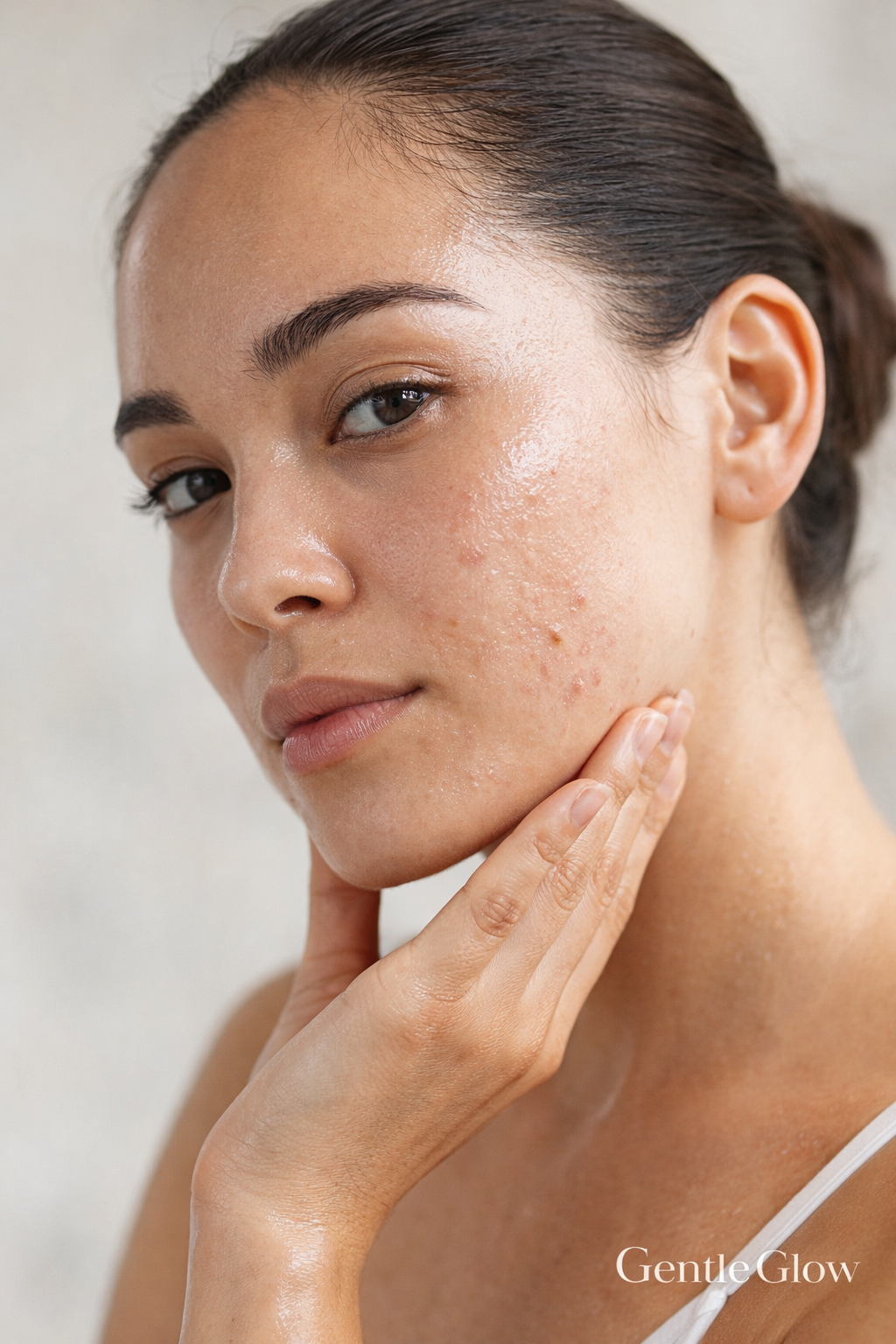
It tends to form deeper in the skin, where oil production and inflammation interact inside the pore rather than on top of it. This is why it often feels like a tender lump before anything becomes visible on the surface.
Most people notice it as a pattern rather than a one-time breakout. The same areas flare repeatedly, the texture feels different from typical clogged pores, and the skin does not respond the way it usually does to standard acne treatments.
This is often the point where things start to feel confusing.
Because on the surface, your skin still looks oily. But underneath, it behaves very differently. If you’re still understanding how your skin behaves, it helps to look at how oily and acne-prone skin actually works, where we break down oil production, pores, and breakouts step by step.
تختلف U-zone vs T-zone: why your face behaves like two different skin types
One of the most overlooked aspects of hormonal acne is that it does not affect your face evenly.
Your T-zone—forehead, nose, and upper cheeks—is primarily driven by genetic oil production. This is where you typically see blackheads, shine, and more superficial congestion.
The lower part of your face—the jawline, chin, and sometimes the neck—behaves differently. This area is more sensitive to hormonal fluctuations, particularly androgens. Instead of forming small clogged pores, it tends to develop deeper, more inflamed breakouts.
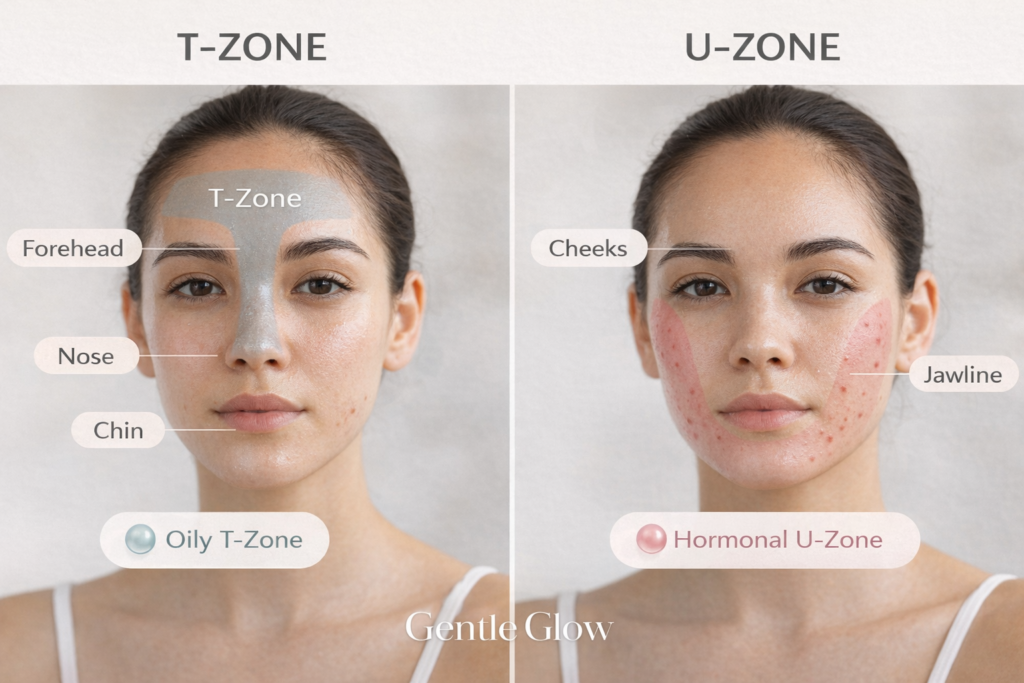
This creates a split pattern:
- The upper face feels oily and congested
- The lower face develops painful, recurring cysts
Treating both areas the same way often leads to frustration. What helps clear congestion in the T-zone can easily irritate the U-zone, especially if the حاجز البشرة أو تهيّجها is already under stress.
This is closely connected to how pore behavior differs across the face, which we explain in more detail in our guide on how pores behave in oily skin.
How to tell if your acne is hormonal
Hormonal acne usually reveals itself through consistency rather than intensity.
It tends to follow a rhythm. Breakouts appear in similar locations, often at similar times, and they feel different from typical surface-level acne.
The most reliable signs come down to pattern:
- Breakouts appear along the jawline, chin, or lower cheeks
- They feel deep, tender, and slow to come to the surface
- They often flare before your period or during stress
- They return in the same areas even after they heal
This pattern reflects how hormonally sensitive areas respond to internal signals rather than just clogged pores.
If your acne seems to “come back in cycles” rather than reacting to products or weather alone, it is usually a sign that something deeper is driving it.
Hormonal acne vs bacterial acne: understanding the difference
Not all acne behaves the same way, even if it looks similar at first.
Surface-level acne is often driven by clogged pores and bacteria. Hormonal acne, on the other hand, is driven by internal signals that change how oil is produced and how it behaves inside the pore.
The difference becomes clearer when you look at how each type develops:
| Pattern | Hormonal Acne | Bacterial Acne |
|---|---|---|
| Depth | Forms deep under the skin | Forms closer to the surface |
| الإحساس | Tender, sometimes painful | Mild pressure or irritation |
| المكان / موضع الظهور | Jawline, chin, lower face | Forehead, nose, cheeks |
| Timing | Cyclical, repeats in patterns | More random or product-related |
| Response | Slower to heal, often persistent | Responds faster to topical treatments |
This is why treatments like salicylic acid or benzoyl peroxide may help surface congestion but feel less effective for deeper, hormonal breakouts. The root cause is not just what is happening inside the pore, but what is triggering that process in the first place.
If you want to understand how surface acne forms step by step, it helps to connect this with the full acne formation cycle explained in our main acne science guide.
Why this type of acne feels harder to manage
Hormonal acne on oily skin often feels more stubborn, not because it is more severe, but because it is driven by multiple layers at once.
There is the visible breakout, but also:
- changes in oil behavior
- shifts in inflammation
- and signals coming from inside the body
This combination makes it less predictable.
It also explains why doing “more” does not always lead to better results. Adding stronger treatments, more exfoliation, or harsher routines can disrupt the skin further—especially in areas that are already sensitive.
This is the same pattern we see in skin barrier damage, where the skin becomes reactive and less stable rather than clearer.
Understanding this difference is the first step.
Because once you recognize that hormonal acne follows a pattern, not just a trigger, the approach to treating it becomes much more precise.
تختلف androgen–sebum connection: why hormonal acne behaves differently
Hormonal acne does not begin with clogged pores—it begins with a change in how oil is produced.
Inside the skin, androgens (a group of hormones that includes testosterone) signal the sebaceous glands to become more active. But this is not just an increase in oil. It is a change in the النوع of oil your skin produces.
This is what makes hormonal acne behave differently from typical breakouts.
The sebum becomes thicker, heavier, and slower to flow. Instead of moving smoothly out of the pore, it starts to accumulate more easily beneath the surface. This is part of what defines hormonal acne, which is explained in more detail by the Cleveland Clinic.
This is the point where the environment inside the pore begins to shift.
Why hormonal oil becomes “sticky” inside the pore
As sebum changes under hormonal influence, it also becomes more prone to a process called squalene oxidation.
Squalene is a natural component of your skin’s oil. Under normal conditions, it helps keep the skin flexible and protected. But when oil production increases and becomes imbalanced, squalene oxidizes more easily.
This process, known as squalene oxidation, has been observed in acne-prone skin in clinical research such as Squalene Peroxidation and Biophysical Parameters in Acne-Prone Skin: A Pilot In Vivo Study.
This changes how the oil behaves.
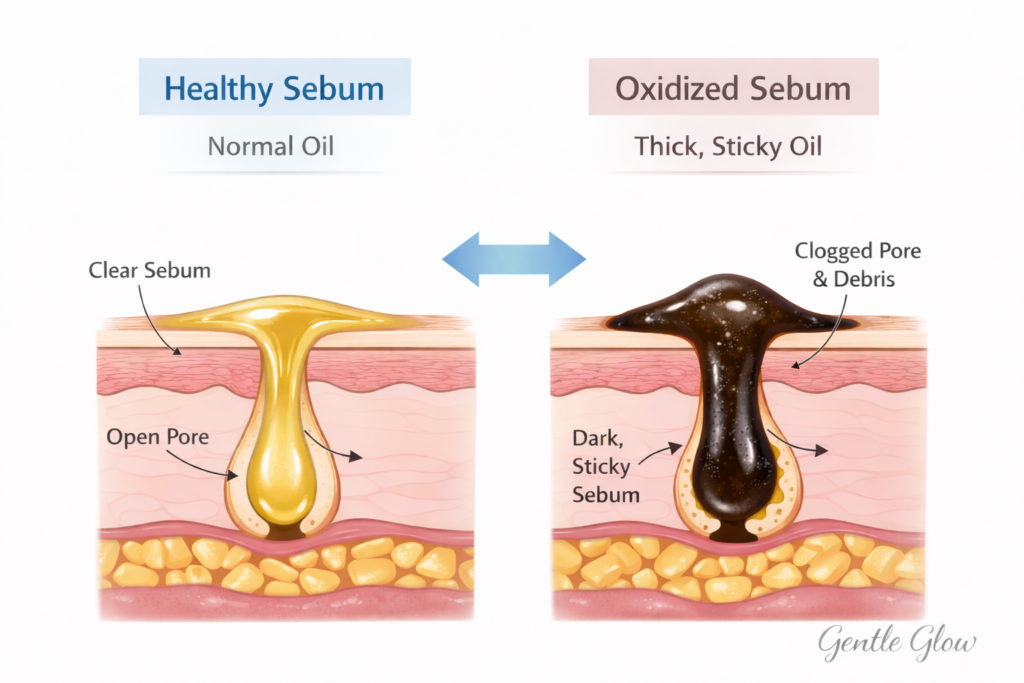
Instead of remaining fluid, it becomes thicker and more adhesive. It mixes more easily with dead skin cells and begins to form a soft blockage inside the pore.
This is not a surface clog you can wash away.
It is a buildup forming deeper within the follicle, where normal cleansing has very little effect.
If you’ve ever felt like your skin is producing oil but still breaking out in deeper, more stubborn ways, this is usually why.
This process is closely related to what we explain in our guide on why skin oil turns thicker and more clog-prone over time.
How the “pore environment” changes in hormonal acne
Once oil becomes thicker and harder to move, the pore environment becomes less stable.
Instead of a steady flow of oil and natural shedding, the pore begins to hold onto material longer than it should. Dead skin cells do not shed as evenly, and oil does not clear as efficiently.
This creates a slow buildup.
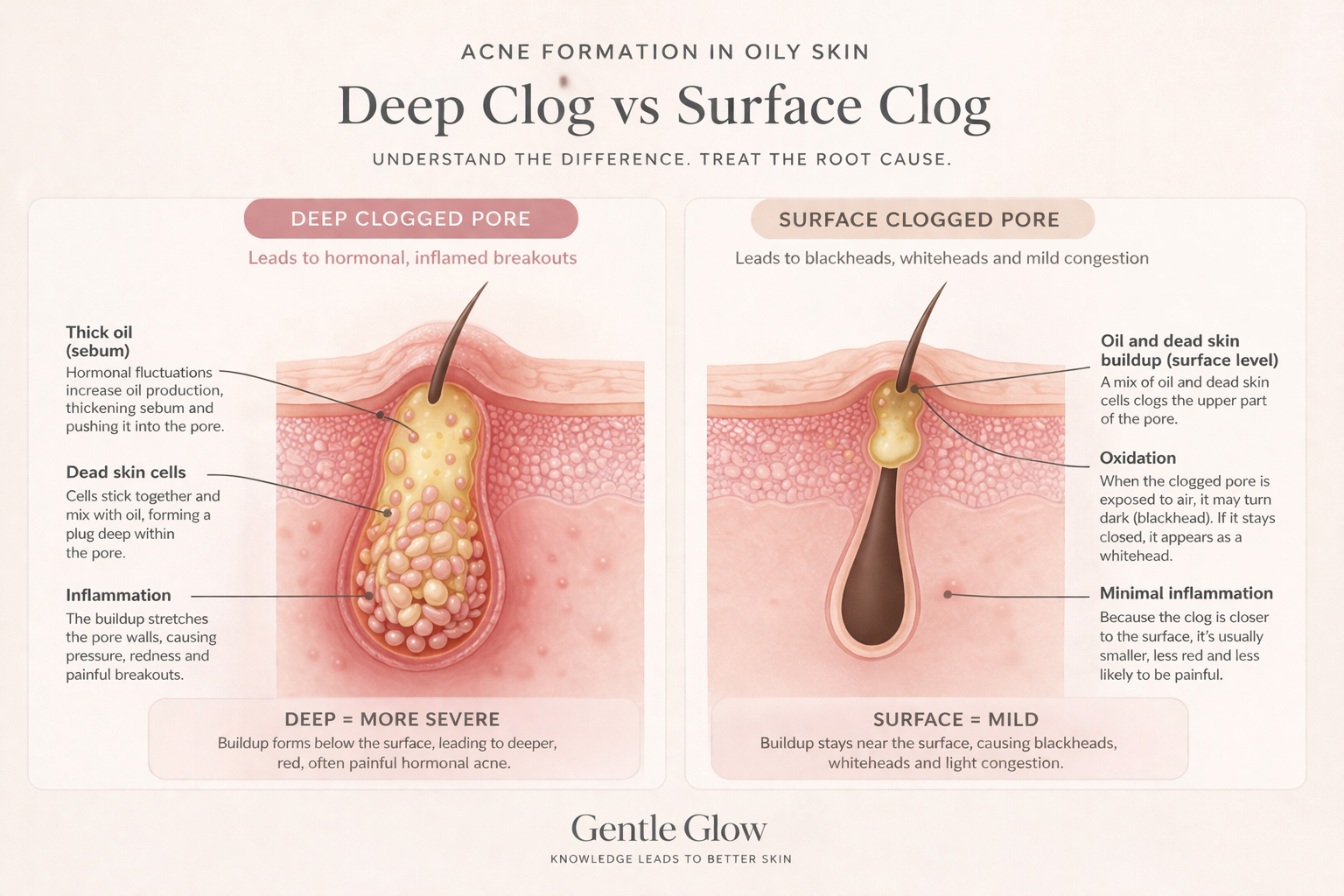
At the same time, the skin becomes more reactive. Even a small blockage can trigger a stronger inflammatory response, especially in hormonally sensitive areas like the jawline.
This is how a deep cyst begins to form.
Not suddenly, but gradually—through a combination of:
- thicker oil
- slower flow
- uneven shedding
- increased inflammation
لهذا يُعتبر حبّ الشباب الهرموني في البشرة الدهنية often feels like it starts underneath the surface before becoming visible.
The link between hormonal acne and PCOS
For some people, this process becomes more persistent due to underlying hormonal patterns such as Polycystic Ovary Syndrome (PCOS), a condition that affects hormone levels and oil production, as explained by Mayo Clinic.
In PCOS, the body produces higher levels of androgens, which continuously stimulate the sebaceous glands. This keeps oil production elevated and maintains the conditions that lead to deeper breakouts.
At the same time, insulin resistance can amplify this effect, further increasing androgen activity and making acne more difficult to regulate.
This is why hormonal acne associated with PCOS often appears:
- more consistently
- more deeply inflamed
- and more resistant to typical treatments
If your breakouts feel persistent rather than occasional, this underlying connection may be worth considering with a medical professional.
Why this type of acne does not respond to typical oil-control routines
One of the most frustrating aspects of hormonal acne is that it often does not respond to the routines that usually help oily skin.
This is because the issue is not just excess oil on the surface.
It is how that oil behaves inside the pore.
Using stronger cleansers, more frequent exfoliation, or harsher treatments may reduce surface oil temporarily, but they do not address the deeper changes happening within the follicle.
In many cases, this approach makes the situation worse.
As the skin becomes more stripped, the barrier weakens. This can increase فقدان الماء عبر البشرة (TEWL). and trigger even more oil production as the skin tries to compensate.
This pattern is very similar to what we see in over-exfoliated or barrier-damaged skin, where the skin becomes both oily and unstable at the same time.
If this sounds familiar, it helps to revisit how barrier disruption affects oil balance in your guide on كيفية إصلاح حاجز البشرة المتضرر.
Bringing it together: why hormonal acne feels deeper and more persistent
When you look at all of these layers together, the pattern becomes clearer.
Hormonal acne is not just about clogged pores. It is the result of:
- hormonal signals changing oil production
- oil becoming thicker and harder to clear
- the pore no longer clears itself efficiently, so oil and skin cells begin to accumulate inside
- and the skin reacting more strongly to that buildup
This is what gives hormonal acne its distinct feel—deeper, slower, and more persistent.
Understanding this shift is important.
Because once you see that the issue is not just oil, but how oil behaves, the approach to treatment becomes much more precise.
Your skin is not just oily — it changes throughout the month
When dealing with حبّ الشباب الهرموني في البشرة الدهنية, one of the most overlooked factors is that your skin is not behaving the same way every day.
Oil production, inflammation, and sensitivity shift throughout the month in response to hormonal changes. This is why your skin can feel balanced one week, then suddenly become more oily, reactive, or breakout-prone the next.
Its pattern follows a cycle.
And once you begin to recognize it, your routine becomes much easier to adjust without overwhelming your skin.
تختلف 28-day sebum cycle
Instead of treating your skin the same way every day, it helps to look at how it changes across the cycle. Each phase brings a different shift in oil behavior, and that shift directly affects how easily pores clog and how inflammation develops throughout the menstrual cycle, a pattern explained in more detail by Cleveland Clinic.
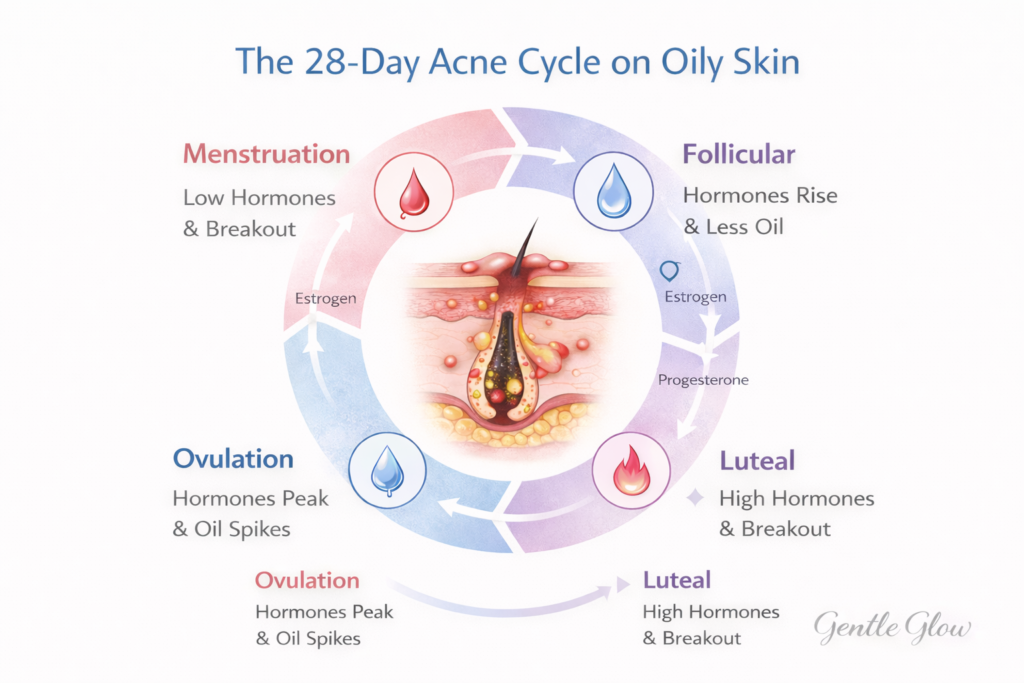
Follicular phase (week 1–2): when skin feels more balanced
At the beginning of the cycle, oil production is more stable and flows more easily through the pore. The skin usually feels calmer, less reactive, and easier to manage.
This is often when your routine feels like it is working.
Because the pore is clearing more efficiently at this stage, buildup is less likely to accumulate. The focus here is not correction, but maintenance—keeping the skin clear without disrupting its balance.
Ovulation phase: when oil starts to increase
As you move toward ovulation, oil production begins to rise. The skin may start to look shinier, and pores can feel more active.
At this stage, breakouts are not always immediate. Instead, this is when the conditions for congestion begin to form.
If oil remains balanced, the skin can still stay clear. But if it starts to accumulate, this is where the foundation for later breakouts begins.
Luteal phase (week 3–4): when hormonal acne begins to form
This is the phase where hormonal acne most commonly develops.
Androgen activity increases, which changes how sebum behaves. The oil becomes thicker, slower to move, and more likely to stay inside the pore instead of clearing naturally.
At the same time, the skin becomes more reactive.
This combination creates a shift inside the pore:
- oil does not flow as easily
- dead skin cells are more likely to accumulate
- inflammation is triggered more quickly
This is usually when deeper, under-the-skin breakouts begin to form—especially along the jawline.
Menstrual phase: when breakouts become visible and skin feels sensitive
By the time the menstrual phase begins, breakouts that started forming earlier often become more visible.
The skin may feel more sensitive, slightly inflamed, or less tolerant to products. What you are seeing at this stage is not a sudden change, but the result of buildup that has been developing during the previous phase.
This is also when the skin is least tolerant to aggressive treatments.
Instead of pushing the skin further, this phase benefits from a more supportive approach—allowing inflammation to settle while maintaining stability.
The 28-day sebum cycle (quick overview)
| Phase | What changes in your skin | What it feels like |
|---|---|---|
| Follicular | Oil is more balanced and flows easily | Calm, clearer, easier to manage |
| Ovulation | Oil production begins to rise | Slight shine, more active pores |
| Luteal | Oil becomes thicker and slower to clear | Congestion, deeper breakouts forming |
| Menstrual | Skin becomes more sensitive and reactive | Visible breakouts, increased sensitivity |
Why standard acne routines often fail for حبّ الشباب الهرموني في البشرة الدهنية
One of the most frustrating parts of حبّ الشباب الهرموني في البشرة الدهنية is that it often does not respond to the routines that usually work for oily or acne-prone skin.
This is because most routines are designed to target surface oil or bacteria. But as we’ve seen, hormonal acne begins deeper—where changes in oil composition and inflammation affect how the pore functions.
When stronger cleansers, frequent exfoliation, or multiple actives are used to “control oil,” they can disrupt the حاجز البشرة أو تهيّجها instead of improving the underlying issue.
This is where the cycle often begins:
The skin becomes more stripped, water loss increases, and oil production rises in response. Instead of clearing, the skin becomes more reactive and less predictable.
A more effective approach: treating how oil behaves
With hormonal acne, the goal is not to remove oil completely.
It is to improve how that oil moves, clears, and interacts inside the pore.
This means shifting from an “oil-removal” mindset to a more balanced approach that focuses on:
- regulating sebum
- supporting normal pore function
- reducing inflammation
- maintaining barrier stability
When these elements work together, the skin becomes more consistent, and breakouts become less reactive over time.
What a balanced routine looks like for hormonal acne on oily skin
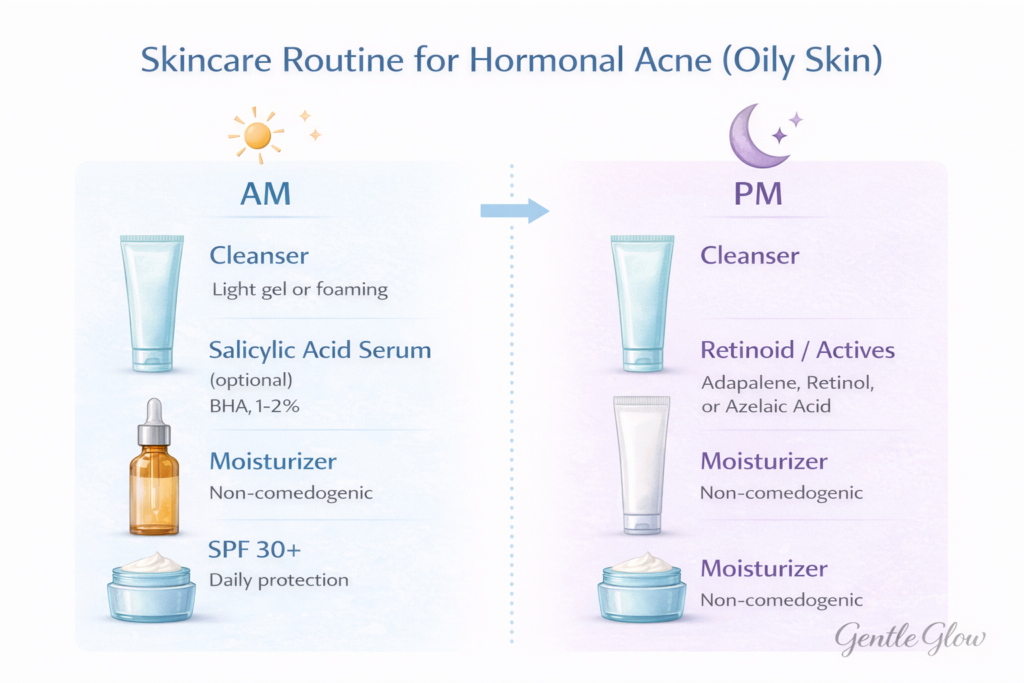
During the day, the focus is on keeping oil balanced and protecting the skin from further inflammation. At night, the goal shifts toward supporting pore function and allowing the skin to renew more effectively.
A simple structure might look like this:
| Time | Focus | What to include |
|---|---|---|
| Morning | Balance and protect | Gentle cleanser, lightweight moisturizer, oil-regulating ingredient like النياسيناميد, and daily sunscreen |
| Night | Support renewal and prevent buildup | Gentle cleanse, targeted treatment such as a retinoid or mild exfoliant (when tolerated), followed by barrier-supporting hydration |
This structure keeps the routine consistent without overwhelming the skin. If you want a more detailed breakdown, you can follow your full روتين الصباح المثالي للبشرة الدهنية والمعرضة للحبوب و للروتين الليلي للبشرة الدهنية والمعرضة لحبّ الشباب, where each step is explained in depth.
Where exfoliation fits—and where it doesn’t
مثل حمض الساليسيليك (BHA) are often considered essential for oily skin because they help dissolve oil inside the pore.
And they can be helpful—especially during more stable phases of the cycle, when oil flows more easily and the pore can clear itself more efficiently.
But with hormonal acne, the limitation becomes clearer.
When oil becomes thicker and slower to move, exfoliation alone is not enough to prevent deeper buildup. Increasing frequency or strength often leads to irritation without fully addressing what is happening inside the pore.
This is why many people feel like salicylic acid “works sometimes, but not always.”
A more effective way to use it is to treat it as a supporting step, not the main solution.
During phases when your skin feels more balanced, using a BHA a few times per week can help keep pores clear and reduce early buildup. But as your skin becomes more reactive—especially in the luteal phase—it usually helps to reduce frequency and avoid pushing exfoliation further.
If you are unsure which formulas work best without over-stripping the skin, you can explore our guide on salicylic acid products that actually clear pores, where we break down options suited for oily and acne-prone skin.
To make this easier to understand, it helps to look at how each of these ingredients works and where it fits.
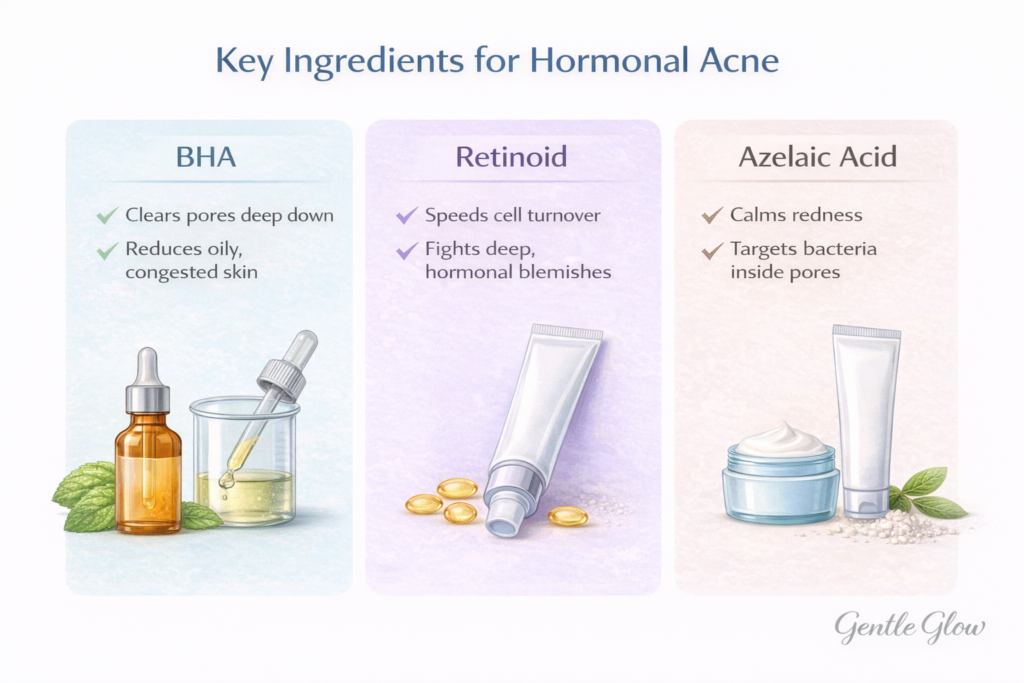
| المكوّن | What it targets | كيف يعمل | Best use for hormonal acne | What to be careful with |
|---|---|---|---|---|
| حمض الساليسيليك (BHA) | Oil + clogged pores | Dissolves oil inside the pore | Early buildup and congestion | Overuse can weaken the skin barrier |
| البنزويل بروكسيد | Acne-causing bacteria | Reduces bacterial growth | Surface acne and inflamed pimples | Can be drying and irritating, especially on the jawline |
| الريتينويدات (مشتقات فيتامين A) | Cell turnover + pore function | Normalizes how skin sheds inside the pore | Preventing deeper clogs before they form | Needs gradual use to avoid irritation |
| حمض الأزيليك | Inflammation + redness | Calms skin and supports clarity | Inflamed hormonal breakouts | Should be introduced gently on sensitive skin |
| Niacinamide (2–5%) | Oil regulation + barrier support | Helps balance sebum and strengthen barrier | Daily support across all phases | Higher % may irritate sensitive skin |
Salicylic acid vs benzoyl peroxide: why this matters for hormonal acne
A common question is whether salicylic acid or benzoyl peroxide is better for hormonal acne.
The answer depends on what you are trying to target.
Salicylic acid works by dissolving oil and helping clear the pore. This makes it useful for congestion and blackheads.
Benzoyl peroxide works by targeting acne-causing bacteria. Modern benzoyl peroxide treatments designed for oily skin increasingly focus on lower concentrations and better long-term tolerability rather than aggressive drying.
But hormonal acne is not primarily a bacterial issue.
It is driven by changes in oil behavior and inflammation. This is why benzoyl peroxide can sometimes feel too drying or irritating, especially in hormonally sensitive areas like the jawline.
Salicylic acid can support the process, but it is not always enough on its own for deeper breakouts.
Understanding this difference helps explain why some treatments feel inconsistent rather than ineffective.
The role of الريتينويدات in preventing deeper breakouts
While exfoliants work at the level of oil and surface buildup, الريتينويدات work differently.
They help regulate how skin cells renew inside the pore, making it less likely for buildup to form in the first place.
This is especially important for حبّ الشباب الهرموني في البشرة الدهنية, where slower oil flow and uneven shedding contribute to deeper clogs.
Retinoids support a more consistent internal environment, which helps prevent breakouts before they fully develop.
If you want to understand how this process works in detail, you can explore your guide on الريتينويدات للبشرة الدهنية. For practical application, it also helps to look at retinol options suited to managing oily, acne-prone skin, especially when choosing formulas that balance effectiveness with tolerance. For practical application, it also helps to understand how different retinoid molecules behave on oily acne-prone skin, especially when balancing effectiveness, irritation, and long-term tolerance.
Calming inflammation: where ingredients like azelaic acid fit
One of the defining features of hormonal acne is inflammation.
This is where ingredients that calm inflammation become important.
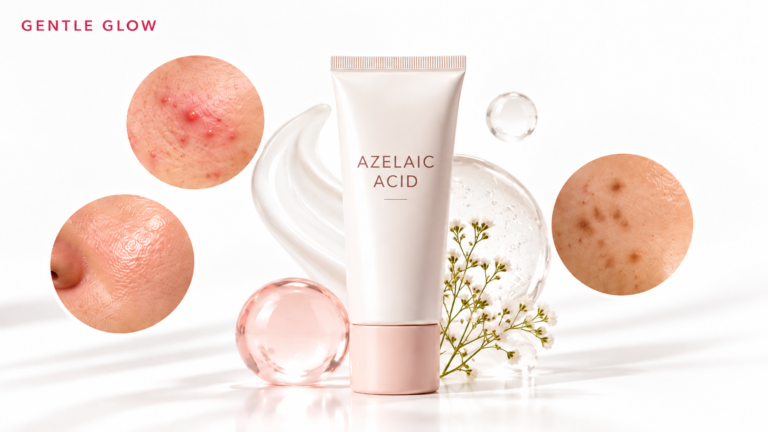
Azelaic acid is often helpful in this context because it works gently to reduce redness, support skin clarity, and improve overall tolerance without over-stripping the skin.
In practice, it is usually used once daily—most often in the evening—after cleansing and before moisturizer. If your skin tolerates it well, it can also be used more consistently during phases when breakouts feel more inflamed, particularly in the luteal phase.
It does not replace other treatments, but it complements them. Used consistently and gently, it helps calm the skin without adding the kind of irritation that can worsen deeper breakouts.
The rise of modern treatments in 2026
In recent years, treatment has started to shift toward addressing hormonal pathways more directly.
Topical options like Clascoterone work by targeting androgen receptors in the skin, helping reduce the effect of hormonal signals on oil production.
Oral treatments like Spironolactone work systemically to reduce androgen influence, which can help regulate sebum production over time.
These approaches are typically considered when acne is more persistent or resistant to topical routines, and they are best discussed with a dermatologist.
لماذا؟ حبّ الشباب الهرموني في البشرة الدهنية can feel worse in everyday life
Dealing with hormonal acne can feel frustrating, especially when it does not respond the way you expect.
I struggled with this for years before I began to understand what was actually happening beneath the surface. Once the mechanism became clearer, it also became easier to manage—more predictable, and less overwhelming.
It is rarely just hormones alone. Your daily habits that contribute to acne, environment, and routine all play a role in how your skin behaves. Small factors can quietly influence oil production, inflammation, and how the pore functions over time.
In warmer, more humid climates, for example, oil production tends to feel heavier on the skin. Sweat mixes with sebum, and the surface can feel more congested even when the underlying issue is deeper.
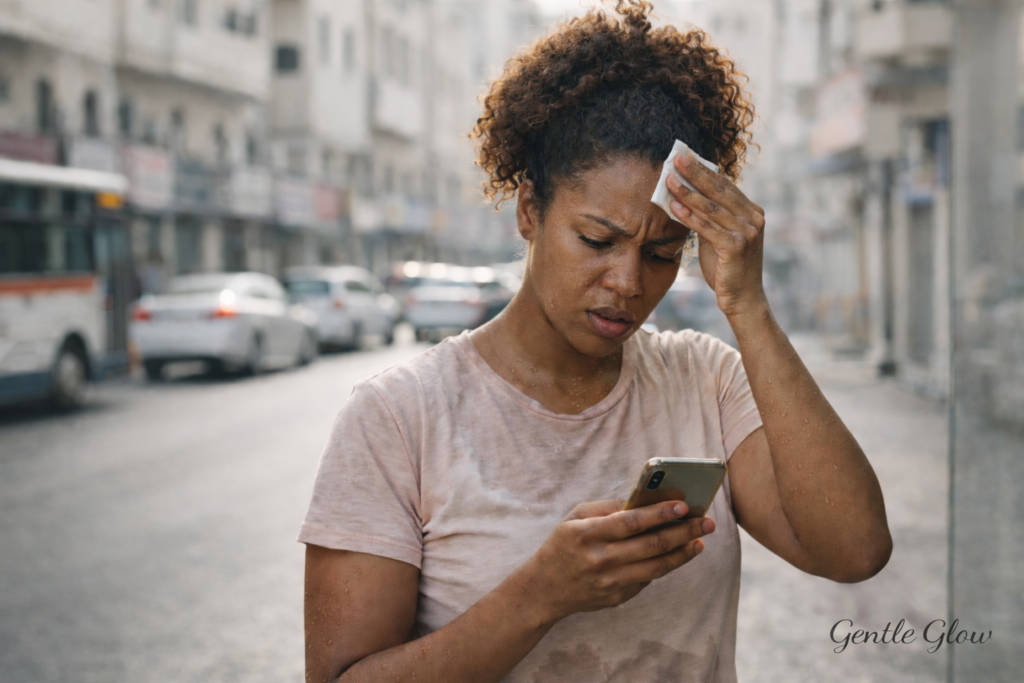
Hard water can also play a role. Mineral residue left on the skin can make it feel tighter, slightly irritated, or less responsive to products, which adds another layer of sensitivity—especially during more reactive phases of the cycle.
The acne–aging conflict: when your skin needs two opposite things
Hormonal acne often exists alongside early signs of skin aging.
On one hand, the skin produces more oil and develops breakouts. On the other, it may start to lose hydration balance and resilience which creates a conflict.
Treating acne often involves stronger, more drying approaches. But maintaining long-term skin health requires protecting the حاجز البشرة أو تهيّجها and preserving hydration.
The effective approach is not choosing between the two, but managing both—controlling breakouts while keeping the skin stable.
Final takeaway: understanding your skin makes it manageable
Hormonal acne on oily skin is not just about excess oil, and it is not random.
It is shaped by how oil changes, how the pore responds, and how your skin behaves across different phases.
Once you begin to recognize these patterns—across your face, your cycle, and your routine—the process becomes more predictable.
This is where things start to shift.
Not because breakouts disappear overnight, but because your approach becomes more precise, less reactive, and easier to maintain over time.
الأسئلة الشائعة
How to treat oily hormonal acne?
To treat hormonal acne on oily skin, focus on the androgen-sebum connection. This involves using topical retinoids (such as adapalene) to normalize skin cell turnover و Niacinamide and Zinc PCA to help support balanced sebum production. For deep cystic acne, anti-inflammatory ingredients such as azelaic acid are often more effective than standard surface scrubs.
Is azelaic acid or adapalene better for hormonal acne?
They serve two different roles. Adapalene is a long-term preventative that keeps pores from clogging. Azelaic acid is an anti-inflammatory powerhouse that targets the redness and bacteria of active hormonal breakouts. In 2026, many dermatologists recommend a “sandwich” approach: Adapalene 2–3 nights a week for prevention and Azelaic acid for active flare-ups.
What is the pattern of hormonal acne?
The classic pattern of hormonal acne is the “U-Zone” distribution. Unlike teenage acne, which dominates the forehead and nose, adult hormonal breakouts hug the jawline, chin, and sometimes the neck. These breakouts are typically deep, “blind” cysts that are tender to the touch and slow to come to a head.
Does Spearmint tea really help hormonal acne?
Yes, for many women, spearmint tea acts as a natural anti-androgen. It helps lower the free testosterone levels that trigger overactive sebaceous glands. While not a replacement for medical treatment, drinking two cups a day is a science-backed holistic habit for reducing the “oil spike” during the luteal phase.
What is the difference between hormonal acne and bacterial acne?
The primary difference between hormonal acne and bacterial acne is the trigger. Bacterial acne is caused by surface debris and C. acnes bacteria. Hormonal acne is triggered internally by androgens, which change the chemical composition of your oil, making it “stickier” and harder to clear with simple face washes.
Can I use 10% niacinamide on hormonal acne?
Niacinamide can help regulate oil and support the skin barrier, but concentration matters. Lower strengths (around 2–5%) are generally better tolerated, especially when the skin is already inflamed. Higher concentrations may cause irritation in more sensitive phases.
How can I tell if my acne is hormonal or purging?
Purging usually occurs when introducing active ingredients and is limited to areas where you normally break out. Hormonal acne, on the other hand, follows a recurring pattern, often linked to your cycle, and tends to form deeper, more persistent lesions.
المصادر والمراجع
- Hormonal acne
متاح عبر: https://my.clevelandclinic.org/health/diseases/21792-hormonal-acne - Squalene oxidation. Squalene Peroxidation and Biophysical Parameters in Acne-Prone Skin: A Pilot “In Vivo” Study
متاح عبر: https://pmc.ncbi.nlm.nih.gov/articles/PMC10748031/ - Polycystic Ovary Syndrome (PCOS). Polycystic ovary syndrome (PCOS)
متاح عبر: https://www.mayoclinic.org/diseases-conditions/pcos/symptoms-causes/syc-20353439 - Hormonal shifts (menstrual cycle). Menstrual Cycle
متاح عبر: https://my.clevelandclinic.org/health/articles/10132-menstrual-cycle - Acne (general factors & habits)
متاح عبر: https://www.health.harvard.edu/a_to_z/acne-a-to-z
يعتمد هذا المقال على أبحاث علمية في طب الجلدية ودراسات مُحكّمة حول تطوّر حب الشباب، والإشارات الهرمونية، ووظيفة حاجز البشرة.
تنويه طبي
يتم إعداد أدلة Gentle Glow استنادًا إلى أبحاث علمية محكّمة في مجال طب الجلدية وإرشادات سريرية معتمدة. المعلومات المقدَّمة هنا لأغراض تعليمية فقط، ولا تُعد بديلاً عن الاستشارة الطبية المهنية أو التشخيص أو العلاج. يُنصح دائمًا باستشارة طبيب جلدية معتمد أو مقدم رعاية صحية مؤهل قبل البدء باستخدام أي مكوّنات علاجية نشطة جديدة في روتين العناية بالبشرة.