كل ما تحتاجين معرفته عن البشرة الدهنية


Sweat vs Sebum: Why Summer Workouts Trigger Breakouts

راجع المحتوى طبيًا
Sana Wazir, MBBS, MD Dermatology
Dermatologist & Medical Reviewer at Gentle Glow
Reviewed أغسطس 13, 2026
The reason why summer workouts trigger breakouts is not because sweat directly causes acne, but because sweat, excess sebum, heat, friction, and residue can accumulate on the skin at the same time. While sweat itself does not clog pores, it can contribute to the conditions that make congestion and post-workout breakouts more likely in oily and acne-prone skin.
- Sweat does not directly cause acne: Sweat is primarily water and does not physically clog pores.
- Sebum plays a bigger role in congestion: Excess oil can combine with dead skin cells and residue inside the follicle.
- Summer workouts create the perfect environment for breakouts: Heat, friction, trapped moisture, and delayed cleansing can all increase the likelihood of post-workout congestion.
جدول المحتويات
Why Summer Workouts Trigger Breakouts?
If you’ve ever finished a workout on a hot summer day and noticed new breakouts appearing a few hours later, you’re not alone.
Many people assume sweat is responsible. The timing seems obvious. You exercise, sweat heavily, and then develop a pimple on your forehead, jawline, chest, or back.
But the relationship between sweating and acne is more complicated than that.
In reality, sweat itself does not directly cause acne.
This is one of the most common misconceptions behind acne from working out. Sweat is a normal biological function that helps regulate body temperature during exercise. The fluid released from sweat glands is made mostly of water along with small amounts of electrolytes such as sodium and potassium. By itself, sweat does not have the ability to block a pore.
What often gets blamed on sweat is actually the result of several factors happening at the same time.
| العامل | Can It Directly Cause Acne? | Why It Matters |
|---|---|---|
| Sweat | لا | Creates a moist environment on the skin |
| Sebum | نعم | contributes to follicular plugging and inflammation |
| Friction | نعم | Can trigger acne mechanica |
| Trapped Moisture | نعم | Increases irritation and bacterial growth |
| Residue (sunscreen, oil, debris) | نعم | May increase congestion risk |
During summer workouts, oily and acne-prone skin is often exposed to:
- Increased sebum production.
- Higher temperatures and humidity.
- Sunscreen and environmental debris sitting on the skin.
- Friction from workout clothing, headbands, helmets, backpacks, or sports bras.
- Delayed cleansing after exercise.
When these factors overlap, pores can become more vulnerable to congestion and irritation. What many people describe as “sweat pimples” أو post-workout breakouts is usually caused by this combination rather than sweat alone.
Understanding this distinction is important because it changes how you approach prevention. If sweat is not actually clogging your pores, repeatedly scrubbing your skin or washing your face multiple times a day may not solve the problem. In some cases, over-cleansing can leave oily skin feeling even more irritated and less balanced.
The real question is not whether sweat causes acne. The better question is what happens when sweat, oil, heat, sunscreen, and friction interact on the skin during summer.
To answer that, we first need to understand the difference between sweat و الزهم (Sebum)،—two substances that play very different roles in the development of workout-related breakouts.
For a deeper look at how excess oil contributes to clogged pores and recurring breakouts, see our guide on acne formation in oily skin.
Sweat vs Sebum: What’s the Difference?
One reason workout-related breakouts are so often misunderstood is that sweat and sebum tend to get blamed together.
While both appear on the skin during exercise, they are completely different substances with very different jobs.
Sweat is produced by eccrine sweat glands and is primarily made of water, electrolytes, and small amounts of other compounds. Its main purpose is to cool the body and regulate temperature during exercise or hot weather.
Sebum is the skin’s natural oil. It is produced by sebaceous glands and helps lubricate the skin, reduce water loss, and support the skin barrier.
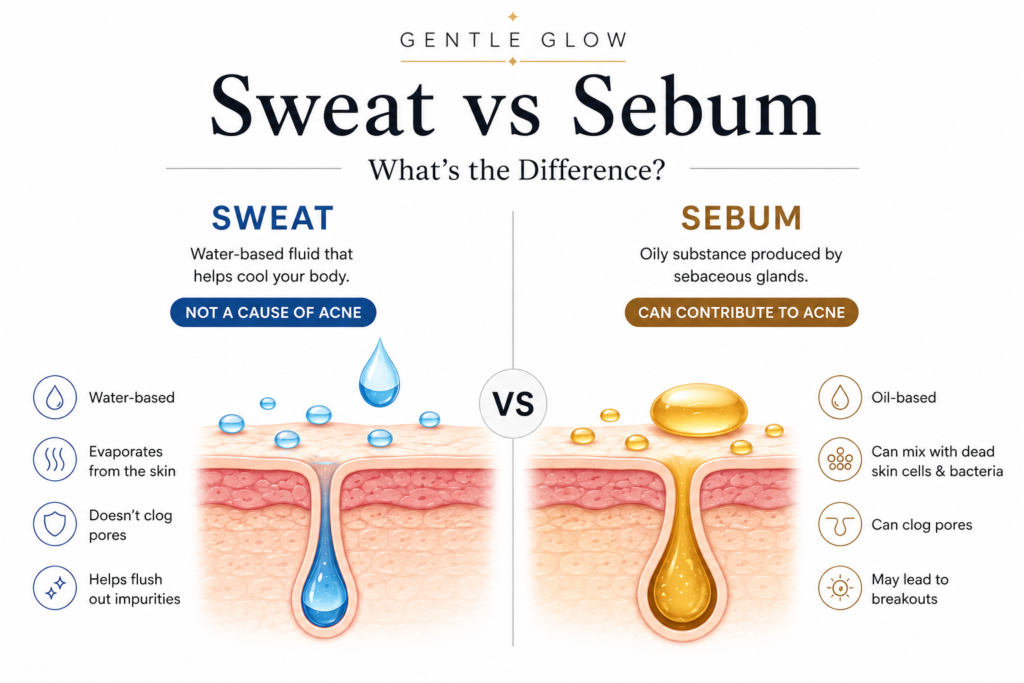
The important difference is that sweat does not directly clog pores, while excess sebum can contribute to congestion inside the follicle.
Research on role of sebum in the pathophysiology of acne and acne management has shown that sebum plays a central role in acne development, influencing follicular blockage, inflammation, and the environment within the pore. This helps explain why excess oil is far more relevant to acne formation than sweat alone.
| Sweat | Sebum |
|---|---|
| Produced by sweat glands | Produced by sebaceous glands |
| Mostly water and electrolytes | Mostly lipids (oils) |
| Helps cool the body | Helps protect and lubricate the skin |
| Does not directly clog pores | Can contribute to clogged pores |
| Increases during exercise and heat | More noticeable in oily skin |
This distinction helps explain why many people experience acne from working out without sweat being the direct cause.
Why Sweat Alone Doesn’t Cause Acne
One of the biggest skincare myths is that sweat is “dirty” and needs to be scrubbed away immediately to prevent breakouts.
In reality, healthy sweat is not a pore-clogging substance.
When sweat reaches the surface of the skin, it is mostly water. It does not have the thick, oily structure needed to become trapped inside a pore the way excess sebum and dead skin cells can.
This is why simply sweating during a workout does not automatically lead to acne.
Where the Problem Starts
The situation changes when sweat remains on the skin alongside other factors that are common during summer workouts.
Heat can make oily skin feel noticeably greasier. Sunscreen, environmental debris, and excess sebum can accumulate on the skin surface throughout the day. At the same time, workout clothing, headbands, helmets, or sports bras may create friction against damp skin.
The result is not that sweat suddenly becomes acne-causing. Instead, sweat becomes part of a larger environment that can make congestion and irritation more likely. This process is often influenced by how oil, dead skin cells, and the pore itself interact during periods of increased heat and activity.
This is why two people can finish the exact same workout and have completely different experiences afterward. Someone with normal skin may sweat heavily and never develop a breakout, while someone with oily or acne-prone skin may be more vulnerable to congestion when sweat, sebum, friction, and heat all overlap.
What Actually Happens to Your Skin During Summer Workouts
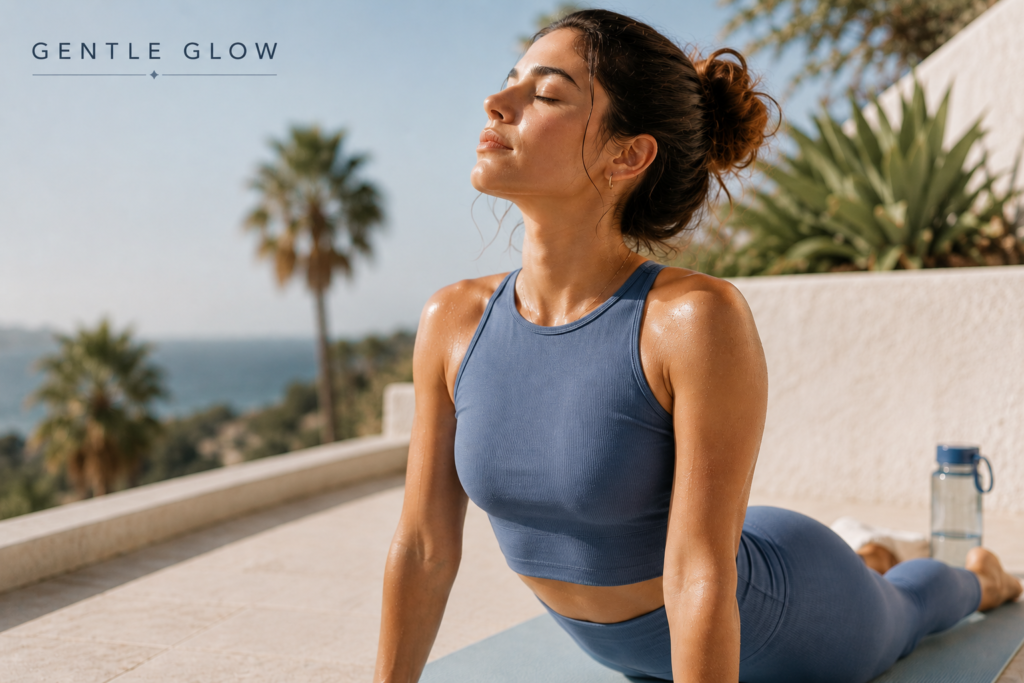
By now, we’ve established that sweat does not directly clog pores and that excess sebum plays a much larger role in acne formation.
The next piece of the puzzle is understanding what happens when heat, sweat, oil, sunscreen, and friction all interact on the skin during exercise.
Summer workouts create a unique environment that is very different from your skin’s normal daily conditions. As body temperature rises, sweat production increases, oil becomes more noticeable on the skin surface, and moisture remains trapped against the skin for longer periods. At the same time, workout clothing, headbands, helmets, and sports bras can create additional pressure and friction.
None of these factors automatically cause acne on their own. However, when several occur together, they can create conditions that make congestion and irritation more likely in oily and acne-prone skin.
Heat Can Make Oily Skin More Vulnerable to Congestion
Summer workouts place the skin under a combination of heat and humidity that many people don’t experience during cooler months.
As temperatures rise, sweat production increases to help cool the body. At the same time, oily skin often appears shinier as excess sebum spreads more easily across the skin surface. This can make the skin feel greasier and increase the amount of sweat, sunscreen, and environmental debris sitting on the skin during exercise.
For people who already struggle with oily or acne-prone skin, these conditions can make congestion more likely than they would be during a cooler workout.
Sweat, Sebum, and Sunscreen Often Accumulate Together
One reason acne from working out is so common during summer is that exercise rarely happens on completely clean skin.
Many workouts take place after several hours of wearing sunscreen, skincare products, makeup, or simply after a full day of oil accumulation. As sweating increases, these substances remain on the skin alongside excess sebum.
As a result multiple layers of oil, residue, and moisture can collect on the skin surface at the same time.
This helps explain why breakouts often appear after outdoor runs, long gym sessions, or hot-weather activities—even when sweat itself is not the direct cause.
Many people also reach for body sprays, perfumes, or fragrances immediately after exercising, particularly during summer when sweat and body odor feel more noticeable. However, applying fragrance to warm, flushed skin can sometimes increase irritation, especially when heat, sweat, and friction are already affecting the skin’s surface. Allowing the skin to cool first and understanding how to wear fragrance without irritation during hot weather may help reduce unnecessary discomfort.
Friction Can Trigger a Different Type of Breakout
Another commonly overlooked factor is friction.
Dermatologists refer to friction-related breakouts as acne mechanica, a form of acne that develops when repeated rubbing, pressure, heat, and moisture irritate the skin.
Common triggers include:
- Tight workout clothing
- Sports bras
- Headbands
- Helmet straps
- Backpack straps
- Compression garments
When skin is already damp from sweat, repeated friction can increase irritation around the follicle and make breakouts more likely.
This is one reason many people notice post-workout acne appearing in specific locations such as the hairline, jawline, chest, shoulders, or upper back rather than across the entire face.
External triggers like friction can influence acne differently from internal factors such as hormones, stress, sleep quality, and other daily habits that affect the skin.
This helps explain why breakouts often develop hours after exercise rather than while you’re actively working out.
Why Breakouts Often Appear Hours After Exercise
Many people expect workout-related acne to appear immediately.
In reality, post-workout breakouts often become noticeable several hours later—or even the following morning.
What is actually happening is that the skin has been exposed to a combination of heat, excess oil, friction, sunscreen residue, and moisture for an extended period. The effects of that exposure may not become visible until later, once congestion and irritation have had time to develop.
This is also why changing out of sweaty clothing, reducing unnecessary friction, and removing accumulated residue can be just as important as the workout itself.
The goal is not to avoid sweating. Sweating is a normal and healthy response to exercise.
The goal is to minimize the conditions that allow sweat, excess sebum, heat, and friction to remain on the skin long after the workout has ended.
The Post-Workout Cooling Window: Why What Happens After Exercise Matters
Many people ignore the period immediately following exercise, even though it can play an important role in whether post-workout breakouts develop.
In fact, the time right after a workout may be just as important as the workout itself when it comes to preventing post-workout breakouts.
As your body cools down, sweat gradually evaporates from the skin surface. While the water portion disappears, other substances can remain behind, including excess sebum, sunscreen residue, environmental debris, and minerals naturally present in sweat.
This helps explain why breakouts often develop hours after exercise rather than while you’re actively working out.
How Long Can Sweat Stay on the Skin Before Breakouts Become More Likely?
There is no exact countdown timer that guarantees a breakout.
However, leaving sweat, oil, and residue sitting on the skin for extended periods can create more opportunities for congestion and irritation to develop—especially in للبشرة الدهنية والمعرضة لحب الشباب.
This is particularly common when people:
- Stay in sweaty workout clothing for several hours.
- Wear tight activewear during long commutes after exercise.
- Delay cleansing after outdoor workouts.
- Continue wearing sunscreen mixed with sweat and excess oil long after training has ended.
The longer this mixture remains on the skin, the longer friction, moistureو residue can continue interacting with the follicle.
Why Changing Clothes Matters
When people think about workout breakouts, they often focus entirely on the face.
However, post-workout acne frequently appears on the chest, shoulders, upper back, and jawline.
One reason is that damp clothing can continue trapping heat and moisture against the skin long after exercise is over.
Changing into clean, dry clothing helps reduce prolonged friction and minimizes the humid environment that can contribute to irritation.
This is especially important for compression garments, sports bras, and synthetic fabrics that remain in direct contact with the skin.
This helps explain why breakouts often develop hours after exercise rather than while you’re actively working out.
Cleansing Matters—But More Is Not Always Better
A common reaction to workout breakouts is to wash the skin repeatedly throughout the day.
Unfortunately, this can sometimes create a new problem.
If sweat is not actually clogging the pore, aggressively scrubbing or repeatedly washing with harsh acne cleansers may do little to address the real cause of the breakout. In some cases, excessive cleansing can leave the skin feeling irritated, tight, or less balanced.
A gentler approach is often more effective. For most people, this means removing accumulated sweat, sunscreen, and excess oil with a gentle, non-abrasive cleanser rather than repeatedly washing with harsh cleansers or scrubs.
This approach aligns with recommendations from dermatologists, who generally advise cleansing with a mild cleanser after exercise and avoiding aggressive scrubbing that can further irritate acne-prone skin.
For readers looking to build a balanced cleansing routine, understanding how to remove excess oil without over-stripping the skin is often more beneficial than simply washing more frequently.
The goal is not to eliminate every trace of oil or sweat. The goal is to prevent residue, frictionو prolonged moisture from lingering on the skin long after the workout is finished.
Is It Acne, Folliculitis, or Heat Rash?
Not every bump that appears after a workout is actually acne.
In fact, many people who believe they are dealing with sweat pimples أو acne from working out may be experiencing a completely different skin condition.
This distinction matters because different conditions respond to different treatments. What helps acne may do very little for folliculitis or heat rash.
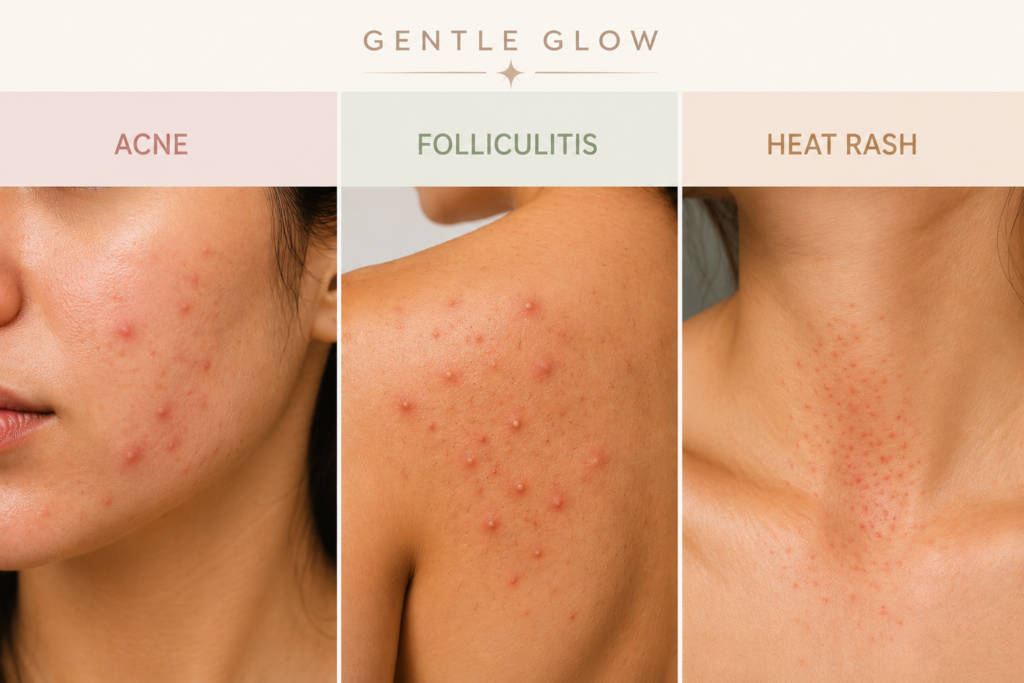
Acne vs Folliculitis vs Heat Rash
| المعيار | Acne | Folliculitis | Heat Rash |
|---|---|---|---|
| Common after workouts | نعم | نعم | نعم |
| Blackheads or whiteheads | Common | Not present | لا |
| Deep, inflamed pimples | Common | Sometimes | نادر |
| Small uniform bumps | Less common | Common | Common |
| Itching | Mild or absent | Common | Common |
| Triggered by friction and trapped moisture | Sometimes | Often | Often |
Workout Folliculitis Can Look Surprisingly Similar to Acne
Folliculitis occurs when hair follicles become irritated or inflamed. In workout settings, folliculitis can be associated with factors such as sweating, heat, occlusion, friction, and tight clothing, although the underlying cause can vary.
According to the Mayo Clinic, folliculitis is an inflammation of the hair follicles that can resemble acne, often appearing as small red bumps or pustules around hair follicles.
Unlike acne, folliculitis often appears as clusters of small, similar-looking red bumps rather than a mix of blackheads, whiteheads, and inflamed pimples.
Another clue is itching.
While acne can occasionally itch, folliculitis is often noticeably itchier than traditional acne breakouts.
It commonly develops on areas where sweat and friction tend to accumulate, including:
- The chest
- Upper back
- Shoulders
- Neck
- Along sports bra or clothing lines
Heat Rash Is Often Mistaken for Acne
Heat rash develops when sweat becomes trapped in the skin’s sweat ducts rather than reaching the surface normally.
According to Cleveland Clinic, this condition—also known as miliaria—is most common during periods of excessive heat, humidity, and sweating, which is why it can easily be mistaken for workout-related acne.
This is one reason people searching for blocked sweat pores treatment are often dealing with heat rash rather than true acne.
Heat rash typically appears as small, uniform bumps that develop during periods of heavy sweating, high humidity, or prolonged heat exposure.
Unlike acne, heat rash usually does not produce blackheads, whiteheads, or deeper inflamed lesions.
How to Tell the Difference
A simple rule of thumb is:
- Acne tends to produce a mixture of blackheads, whiteheads, and inflamed pimples.
- Folliculitis often appears as clusters of similar-looking itchy bumps around hair follicles.
- Heat rash usually presents as small, uniform bumps that develop during periods of excessive sweating and heat exposure.
Of course, skin conditions do not always follow textbook patterns. If persistent bumps continue despite improving workout hygiene and skincare habits, it may be worth speaking with a dermatologist for an accurate diagnosis.
Understanding the difference helps prevent a common mistake: treating every post-workout bump as acne when the underlying cause may be something entirely different.
Common Workout Skincare Mistakes (And What to Do Instead)
Many workout-related breakouts are not caused by a lack of effort. In fact, they often happen because people follow well-intentioned advice that doesn’t address the real problem.
When sweat gets blamed for every breakout, the natural reaction is to scrub harder, wash more often, or use stronger acne treatments. Unfortunately, these habits can sometimes create additional irritation without addressing the factors that are actually contributing to congestion.
The goal is not to remove every trace of oil from the skin. The goal is to reduce the combination of heat, friction, excess sebumو residue that can accumulate during summer workouts.
| Common Habit | What Actually Happens | A Better Approach |
|---|---|---|
| Washing with harsh acne cleansers before and after every workout | Repeated cleansing may leave the skin feeling tight, irritated, or unbalanced | Remove sweat, sunscreen, and excess oil with a gentle, non-abrasive cleanser after exercise |
| Staying in sweaty workout clothes for hours | Prolongs friction, heat, and trapped moisture against the skin | Change into clean, dry clothing as soon as practical |
| Scrubbing the skin aggressively to prevent breakouts | Creates additional friction that may worsen irritation | Cleanse gently and avoid unnecessary rubbing |
| Assuming every post-workout bump is acne | Folliculitis and heat rash can resemble acne | Consider the appearance, location, and symptoms before choosing a treatment |
| Skipping sunscreen before outdoor exercise | Increases UV exposure and skin damage | استخدام واقي شمس خفيف وغير مسبب لانسداد المسام suitable for oily skin |
| Working out while wearing makeup | Makeup can mix with sweat, oil, and other residue on the skin, which may increase buildup and contribute to clogged pores in acne-prone skin | Remove makeup before exercising with a gentle, oil-free or non-comedogenic makeup remover, then cleanse as needed |
| Reusing unwashed workout clothes or towels | Oils, dead skin cells, sweat, and microorganisms can accumulate on fabric and increase friction or contamination against the skin | Wear freshly washed workout clothes and use a clean towel to gently pat sweat rather than rubbing the skin |
Many of these mistakes can be avoided by keeping a few well-chosen post-workout skincare essentials on hand. The right combination of cleansing, hydration, and sun protection can help remove buildup without creating additional irritation.
الخلاصة
One of the biggest takeaways from this article is that sweat itself is rarely the main problem.
Sweating is a healthy and necessary part of exercise. It helps regulate body temperature and supports normal physical performance.
Instead of trying to stop sweat, focus on the conditions surrounding it.
Reducing prolonged friction, changing out of damp clothing, cleansing away accumulated residue, and avoiding unnecessary over-cleansing can often make a bigger difference than trying to eliminate sweat altogether.
For oily and acne-prone skin, understanding why summer workouts trigger breakouts can help you make small adjustments without giving up exercise.
الأسئلة الشائعة
Does Sweat Cause Acne?
No, sweat does not directly cause acne or clog pores. Sweat is primarily water and electrolytes, while acne develops when excess sebum, dead skin cells, bacteria, and inflammation interact inside the follicle. Sweat becomes a problem only when it remains on the skin alongside oil, friction, sunscreen residue, and heat.
Why Do I Break Out After Sweating?
Most post-workout breakouts are caused by the environment created during exercise rather than sweat itself. Heat, excess sebum, friction, sunscreen residue, and trapped moisture can accumulate on the skin at the same time, making congestion and irritation more likely in oily and acne-prone skin. This is one of the main reasons why summer workouts trigger breakouts more often in oily and acne-prone skin.
Can Sweat Cause Acne on the Face?
Sweat alone cannot clog facial pores, but it can contribute to conditions that favor breakouts. When sweat mixes with excess oil, sunscreen, makeup, and environmental debris, it may increase the likelihood of congestion, particularly during hot and humid weather.
How Do I Stop Acne From Working Out?
The most effective approach is to reduce friction, prolonged moisture, and residue after exercise. Changing out of sweaty clothing, cleansing with a gentle non-abrasive cleanser, and avoiding aggressive scrubbing can help minimize workout-related breakouts without unnecessarily irritating the skin.
What Is Acne Mechanica?
Acne mechanica is a type of acne triggered by friction, pressure, heat, and trapped moisture. It commonly develops beneath sports bras, helmet straps, headbands, backpacks, and tight workout clothing where repeated rubbing irritates the skin during exercise.
How Long Should I Stay in Sweaty Clothes After a Workout?
There is no exact time limit, but remaining in sweaty clothing for extended periods can increase friction and trapped moisture against the skin. Changing into clean, dry clothing as soon as practical helps reduce the conditions that may contribute to post-workout breakouts.
What Is the Difference Between Heat Rash and Acne?
Heat rash develops when sweat becomes trapped in the skin’s sweat ducts, while acne develops inside hair follicles. Heat rash usually appears as small, uniform bumps during periods of excessive heat and sweating, whereas acne often includes blackheads, whiteheads, or inflamed pimples.
Is Folliculitis the Same as Acne?
No, folliculitis and acne are different conditions, although they can look similar. Folliculitis often appears as clusters of small, itchy bumps around hair follicles, while acne typically presents as a mixture of blackheads, whiteheads, and inflamed lesions.
المصادر والمراجع
- David P, Singh S, Ankar R. A Comprehensive Overview of Skin Complications in Diabetes and Their Prevention.
- American Academy of Dermatology. Is Your Workout Causing Your Acne?.
- Del Rosso JQ, Kircik L. The Primary Role of Sebum in the Pathophysiology of Acne Vulgaris and Its Therapeutic Relevance in Acne Management.
- American Academy of Dermatology. Is Sports Equipment Causing Your Acne?.
- Mayo Clinic. Folliculitis.
- Cleveland Clinic. Heat Rash.
تنويه طبي
يتم إعداد أدلة Gentle Glow استنادًا إلى أبحاث علمية محكّمة في مجال طب الجلدية وإرشادات سريرية معتمدة. المعلومات المقدَّمة هنا لأغراض تعليمية فقط، ولا تُعد بديلاً عن الاستشارة الطبية المهنية أو التشخيص أو العلاج. يُنصح دائمًا باستشارة طبيب جلدية معتمد أو مقدم رعاية صحية مؤهل قبل البدء باستخدام أي مكوّنات علاجية نشطة جديدة في روتين العناية بالبشرة.