Everything You Need to Know About Oily Skin

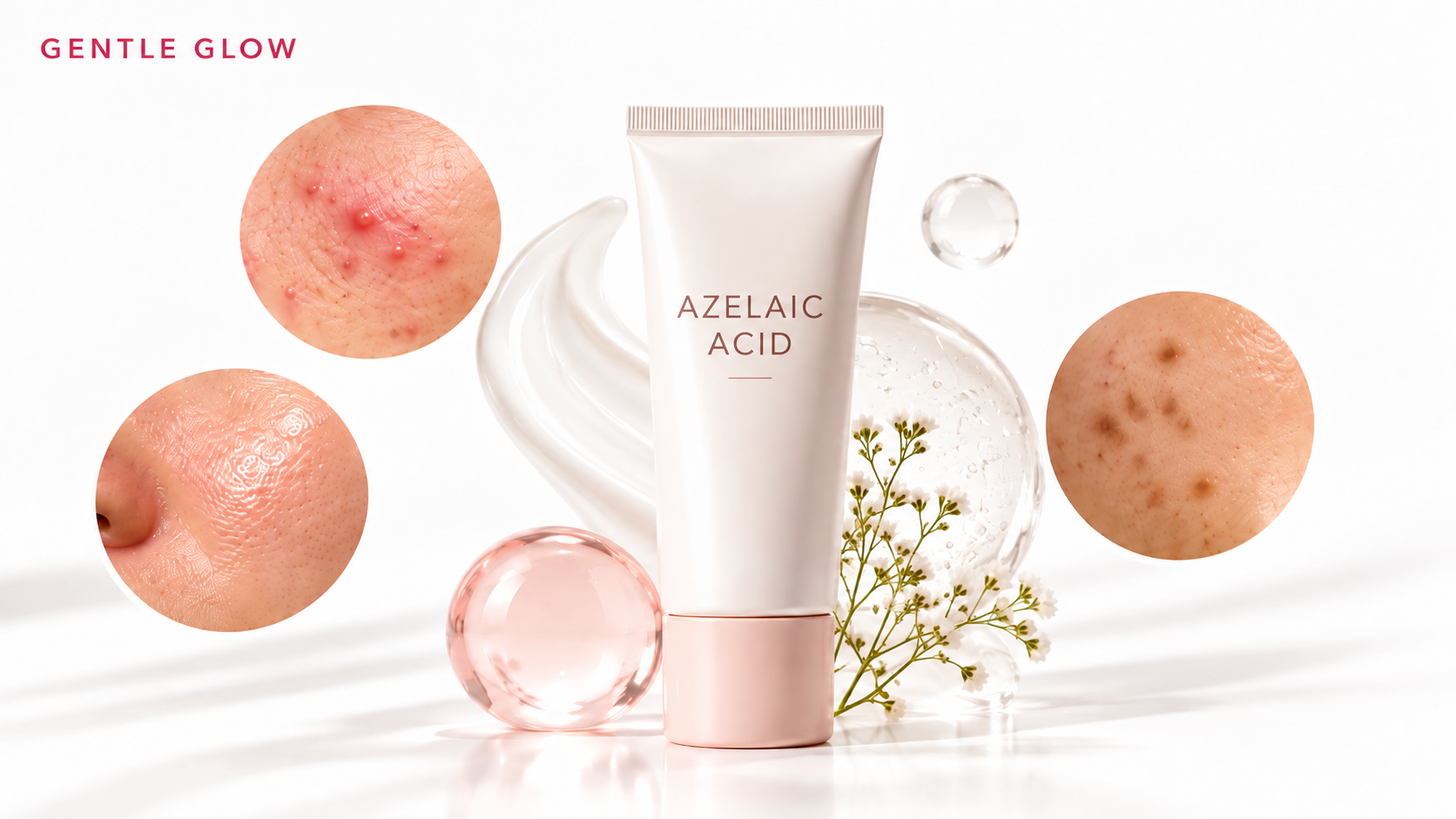
Azelaic Acid for Oily and Acne-Prone Skin: Acne, Redness and Dark Spots

Medically reviewed by
Gamal Henin, B.Pharm
Pharmacist & Medical Reviewer at Gentle Glow
Reviewed October 7, 2026
Azelaic acid for oily and acne-prone skin can help treat inflammatory and clogged-pore acne while also targeting some red and brown marks left after breakouts. Its benefits come from effects on processes involved in clogged pores, inflammation and pigment production.
- It has clinical evidence for both inflammatory and non-inflammatory acne.
- It can help acne-related post-inflammatory hyperpigmentation (PIH), while evidence for post-inflammatory erythema (PIE) is newer and more limited.
- However, being useful for oily, acne-prone skin does not mean it has been proven to reduce facial sebum production.
Table of Contents
Is Azelaic Acid Good for Oily, Acne-Prone Skin?
Azelaic acid for oily and acne-prone skin can be useful when breakouts come with clogged pores, inflammation, and marks left behind by previous pimples.
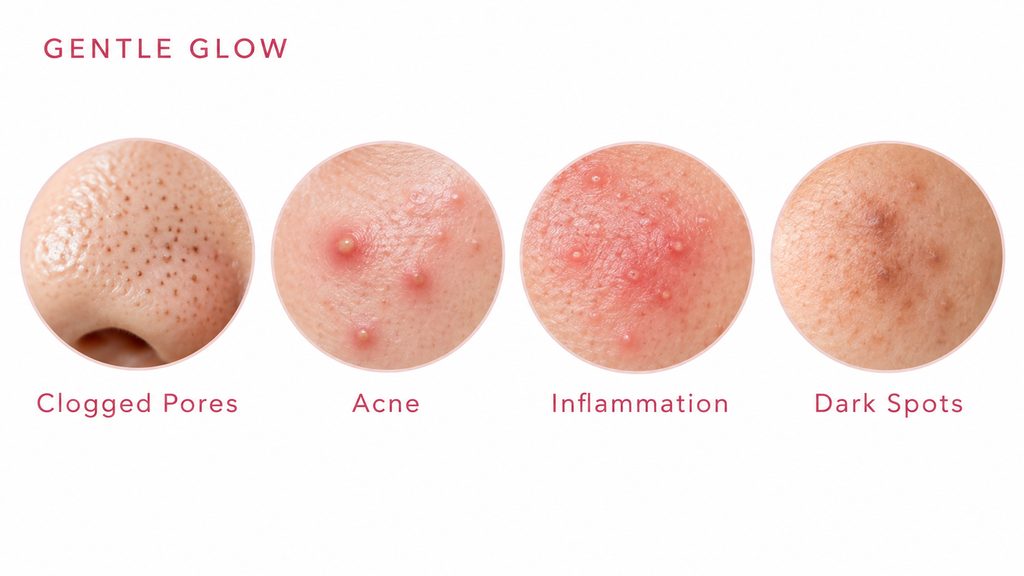
That is part of what makes it interesting for oily, acne-prone skin. One ingredient can work on several parts of the acne-to-post-acne cycle. It can help with inflammatory and non-inflammatory acne, and it can also help with acne-related pigmentation.
There is one common assumption worth clearing up, though: azelaic acid is not an established oil-control treatment.
Having oily skin does not automatically mean you need an ingredient that reduces sebum production. Azelaic acid can be useful for oily skin because of its effects on acne and inflammation, not because it has been clearly shown to reduce facial oil production.
An older human study of 20% azelaic acid found that acne improved even though oil production did not significantly decrease. This suggests that azelaic acid can help oily, acne-prone skin without necessarily making the skin less oily.
How Does Azelaic Acid Work on Acne-Prone Skin?
Azelaic acid helps acne-prone skin by reducing inflammation, affecting acne-related microorganisms, normalizing how skin cells build up inside follicles, and helping limit excess pigment production after breakouts. These different effects help explain why it can be useful for both active acne and some of the marks acne leaves behind.
You do not need a biochemistry lesson to understand how azelaic acid works.
It has several effects that are relevant to acne:
- It helps normalize follicular keratinization.
Skin cells inside the hair follicle can build up and contribute to a plug. Azelaic acid helps normalize this process, which is one reason it can be useful for comedonal acne. - It has antimicrobial activity.
Azelaic acid can affect microorganisms involved in acne, including Cutibacterium acnes. - It reduces inflammation.
Inflammation is a major part of acne, particularly when a clogged follicle develops into an inflamed papule or pustule. - It affects melanin production.
Azelaic acid can help reduce excess pigment production, partly through effects on tyrosinase activity, an enzyme involved in producing melanin. This helps explain why the ingredient can also be useful for the brown marks that remain after acne.
These effects are also why azelaic acid should not simply be thought of as another exfoliating acid.
It is chemically an acid, but it does not work in the same way as salicylic acid or glycolic acid. Its role in acne is broader than simply exfoliating the skin.
Does Azelaic Acid Help Acne and Clogged Pores?
Azelaic acid has clinical evidence for both inflammatory and non-inflammatory acne, including clogged pores such as blackheads and whiteheads. Its effect on clogged pores, however, is different from the way salicylic acid is commonly used.
Inflammatory Acne
Inflammatory acne includes papules and pustules the red, often tender spots that develop when a clogged follicle becomes inflamed.
Azelaic acid’s anti-inflammatory and antimicrobial effects make it relevant here. Clinical evidence supports its use for inflammatory acne, with the strongest controlled evidence coming from 20% cream. Evidence for 15% acne formulations also exists, but it is more limited.
That does not mean azelaic acid will clear every case of inflammatory acne by itself. Acne severity matters, and deeper or more persistent acne often needs more than one treatment.
Comedonal Acne
Whiteheads and blackheads are comedones. They form when material builds up inside a follicle.
Azelaic acid may help because it normalizes abnormal keratinization inside the follicle. In simple terms, it can make the process that contributes to the plug less abnormal.
Older clinical research found that 20% azelaic acid improved comedonal acne and performed comparably with topical tretinoin in that particular study. That does not make the two treatments interchangeable, but it does support azelaic acid as a genuine acne treatment rather than an ingredient that only helps with redness or marks.
Azelaic acid may help blackheads and whiteheads, but it is better not to describe it as something that simply “dissolves oil from the pores.” Salicylic acid works more directly as an oil-soluble exfoliant that helps unclog pores.
Azelaic acid approaches clogged pores differently. It helps normalize follicular keratinization and also addresses inflammation and other processes involved in acne.
However, for deep, painful nodules, cysts, severe inflammatory acne, or acne that is beginning to scar, azelaic acid alone may not be enough.
Can Azelaic Acid Fade Dark Spots and Red Acne Marks?
Azelaic acid can help with some of the marks left after acne, but red and brown marks are not the same problem.
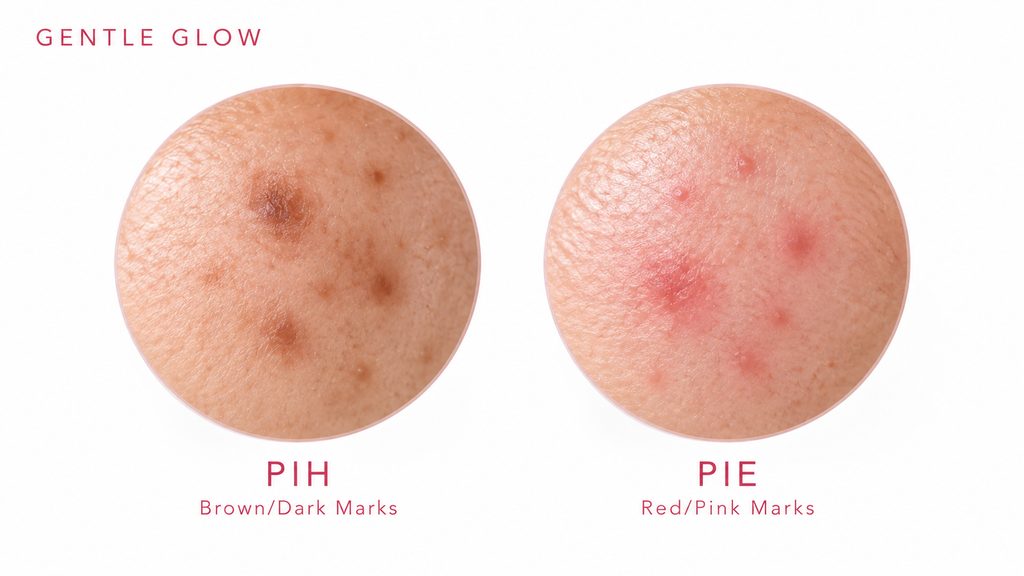
A brown or darker mark usually means the breakout has triggered extra pigment in the skin. This is called post-inflammatory hyperpigmentation (PIH).
A red or pink mark is more often linked to lingering inflammation and vascular changes after the pimple has healed. This is called post-inflammatory erythema (PIE).
Both can appear after acne, and sometimes they can occur together. Because they develop for different reasons, azelaic acid may help them in different ways.
Can Azelaic Acid Fade Post-Acne Dark Spots (PIH)?
Azelaic acid has clinical evidence for improving acne-related post-inflammatory hyperpigmentation (PIH).
Think of what happens after an inflamed pimple: the acne may disappear, but the inflammation can leave behind extra pigment. That pigment can make the area look brown or darker than the surrounding skin.
Azelaic acid can help reduce this excess pigment production, partly through effects on tyrosinase activity, an enzyme involved in producing melanin.
So its role here is not simply “lightening the skin.” It is helping reduce one of the processes involved in excess pigment production.
Clinical studies support this use. Direct acne-specific evidence includes 15% azelaic acid gel. A 20% azelaic acid cream has also been studied for facial hyperpigmentation in darker skin, although that trial was not limited specifically to post-acne PIH.
The prescribing information for 15% azelaic acid gel also advises monitoring people with darker complexions for early signs of hypopigmentation.
However, this is one of the strongest reasons azelaic acid can make sense for someone whose acne routine has a second problem attached to it: the acne is one problem, and what it leaves behind is another.
Azelaic acid may help with both.
Does Azelaic Acid Help With Redness From Acne?
Sometimes. Azelaic acid may help redness linked to active inflammatory acne and may also improve some red post-acne marks, but its effect depends on what is causing the redness.
Redness can come from:
- an active inflamed acne lesion;
- a red mark left after acne, known as post-inflammatory erythema (PIE);
- rosacea;
- or irritation from skincare itself.
These are not interchangeable.
Azelaic acid can help with inflammatory acne, so it can reduce some of the redness that comes with an active pimple. It is also an established topical treatment for papulopustular rosacea, particularly for inflammatory papules and pustules, although not every type of persistent facial redness responds in the same way.
There is also some direct evidence for azelaic acid and acne-related PIE. A small randomized placebo-controlled study found that 15% azelaic acid improved measures of acne-induced PIE over 12 weeks. The results are interesting, but the study was relatively small, so the evidence for PIE is not as extensive as the evidence for acne itself.
So if someone says, “Azelaic acid is good for redness,” the better question is: what kind of redness?
Azelaic acid may help some types. It is not a universal treatment for every red face.
What Strength of Azelaic Acid Should You Use: 10%, 15% or 20%?
There is no single “best” azelaic acid percentage for everyone. Most acne research has used medicinal products, especially 20% cream. Some 15% gel and foam formulas have also been studied, while 10% is often found in cosmetic products. Concentration matters, but we should keep in mind that formulation and delivery system also affect how a product performs.
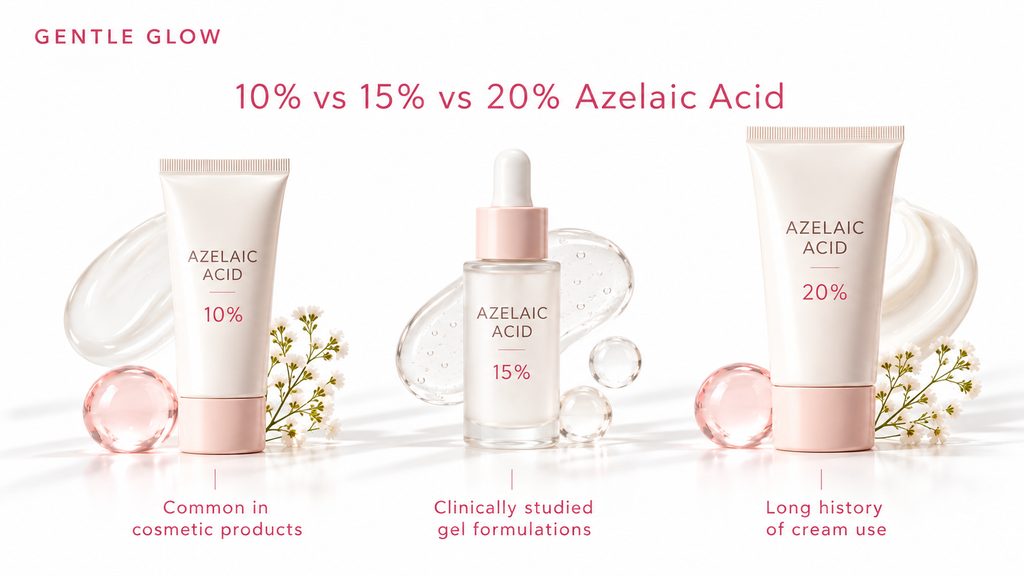
That means you should not automatically assume that a 10% cosmetic serum will produce the same results as a 15% or 20% formulation studied in a clinical trial.
| Strength | What you should know |
|---|---|
| 10% | Available in cosmetic products. Some specific 10% formulations have been studied, but evidence from medicinal-strength products cannot simply be transferred to every 10% product. |
| 15% | Studied in specific gel and foam formulations; acne evidence is more limited than for 20% cream. |
| 20% | Has a long history of clinical use and research, particularly as a cream for acne. |
There is another detail that often gets lost when people compare percentages: the formulation matters.
A 10% product contains less azelaic acid than a 15% or 20% product, but percentage alone does not tell you how well a particular formula will perform. The vehicle, delivery system, other ingredients, and how the product behaves on the skin all matter.
For example, clinical research found that a specific 10% azelaic-acid nanocrystal formulation improved acne. That is useful evidence for that formulation, but it does not prove that every 10% cosmetic serum will work like a 20% medicinal cream.
So I would avoid thinking of the concentrations as a beginner → intermediate → advanced ladder. That sounds neat, but it is not how the evidence works.
Prescription and non-prescription availability also varies between countries. What is sold over the counter in one country may require a prescription in another.
Can You Use Azelaic Acid Every Day?
Azelaic acid can often be used every day, but how often you should use it depends on the specific product and how your skin tolerates it.
Some medicinal formulations have been studied with twice-daily use. Cosmetic products may have different directions. Start with the instructions for the specific product rather than assuming every azelaic-acid product should be used once or twice a day.
If you are using azelaic acid for oily and acne-prone skin alongside other active ingredients, introducing it gradually can also make sense.
A simple routine might look like this:
- Apply azelaic acid to clean, dry skin according to the product directions.
- Follow with moisturizer if needed.
- Keep the rest of the routine reasonably simple while you are figuring out how your skin responds.
- Use daytime sun protection, especially if you are treating post-acne pigmentation.
- If significant irritation develops, reduce the frequency or stop rather than trying to force your skin to tolerate it.
There is no prize for fitting the most active ingredients into one routine.
If azelaic acid is doing something useful for your skin, you want a routine you can actually maintain.
Why Does Azelaic Acid Itch or Burn?
Azelaic acid can itch or burn because it may temporarily irritate the skin, especially when you first start using it or when it is combined with other potentially irritating actives. The sensation can vary with the formulation, concentration, and your skin’s tolerance. Mild, short-lived stinging can occur, but persistent or intense burning suggests irritation rather than a sign that the product is “working.”
Look at the whole routine.
If you are using azelaic acid alongside a retinoid, benzoyl peroxide, salicylic acid, or other exfoliating products, the problem may be the total amount of irritation your skin is receiving rather than azelaic acid alone.
Reducing the frequency, simplifying the routine, and using moisturizer may improve tolerability.
If the irritation is severe, persistent, or getting worse, stop and reassess the product or speak with a dermatologist. Official prescribing information also lists burning, stinging, itching, dryness, and irritation among possible effects of topical azelaic acid. The prescribing information for 15% azelaic acid gel also notes reports of worsening asthma.
How Long Does It Take Azelaic Acid to Clear Acne and Fade Dark Spots?
Azelaic acid usually needs to be judged over weeks rather than days, and acne can improve on a different timeline from the marks it leaves behind.
Clinical studies commonly assess improvement over several weeks to a few months. Studies of 15% and 20% formulations have reported meaningful improvement during treatment periods of roughly 8–16 weeks and beyond.
Pigmentation can take longer to become visibly lighter.
This creates an important distinction:
Acne may improve before the mark disappears.
You can have fewer new pimples while still seeing brown or red marks from older breakouts.
And if new acne continues to appear, it can create new marks while the older ones are fading. That can make it feel as though the pigmentation is “not improving” even when individual marks are gradually changing.
So rather than expecting a particular result at a particular week, look for a trend over time.
If you have used the product consistently for an appropriate period and there is little or no improvement, that is a reason to reconsider the treatment rather than simply keep waiting.
What Should You Never Mix With Azelaic Acid?
There is no universal list of skincare ingredients that you must never use with azelaic acid. The bigger issue is usually how much irritation your routine creates altogether. However, product-specific instructions still matter: prescribing information for 15% azelaic acid gel advises avoiding alcoholic cleansers, tinctures and astringents, abrasives, and peeling agents.
| Combination | What to consider |
|---|---|
| Azelaic acid + niacinamide | No clinical trial was identified showing that pairing niacinamide with azelaic acid improves results. Whether you use them together should depend on the specific formulations and your skin’s tolerance. |
| Azelaic acid + retinoids | They can be used in the same overall routine, but irritation and tolerance matter. |
| Azelaic acid + salicylic acid | They work differently, but using both may be too irritating for some skin types. |
| Azelaic acid + benzoyl peroxide | Both can have a role in acne treatment. Whether using them together makes sense depends on the overall treatment plan and tolerance. |
| Azelaic acid + alpha arbutin | There isn’t enough evidence to say this combination works better together or should be avoided. |
| Azelaic acid + vitamin C | Direct evidence on this combination is limited. Product formulation and skin tolerance matter, but there is not enough clinical evidence to claim added benefit. |
You also do not have to apply every active at the same time.
If your routine already contains several treatments, separating products between morning and evening, or alternating them may make the routine easier to tolerate.
The goal is not to avoid combinations at all costs. It is to avoid unnecessary irritation.
Which Is Better, Salicylic Acid or Azelaic Acid?
Neither is automatically better. It depends on what you are actually trying to treat.
If your main problem is oily, congested skin with blackheads and whiteheads, salicylic acid has a more direct exfoliating and pore-unclogging role.
If your main problem is acne plus brown post-acne marks, azelaic acid can address both.
If you have acne plus red post-acne marks, azelaic acid may be useful, although the evidence for PIE is more limited.
If you have deep, persistent, or scarring acne, neither may be enough on its own.
Salicylic acid and azelaic acid simply do different jobs.
Salicylic acid is a BHA and has a more direct role in exfoliating and helping unclog pores. Azelaic acid has antimicrobial, anti-inflammatory, and follicular effects, and it also has a role in acne-related pigmentation.
So if your main complaint is “my pores are constantly congested,” salicylic acid may make more sense.
If your complaint is “I keep breaking out, and every breakout leaves something behind,” azelaic acid has an advantage in that it can address more than one part of that problem.
That does not make it universally better. It makes it a better match for that particular combination of concerns.
Retinoids and benzoyl peroxide also have established roles in acne treatment, and the American Academy of Dermatology acne guidance supports several topical treatment options depending on the patient’s acne and treatment goals.
When Is Azelaic Acid Not Enough?
Azelaic acid may not be enough on its own when acne is deep, painful, scarring, progressively worsening, or not improving despite consistent treatment.
A dermatologist assessment is worth considering if your acne is:
- deep or painful;
- nodular or cystic;
- leaving scars;
- getting progressively worse;
- not improving despite consistent treatment;
- causing significant or persistent irritation.
It is also worth getting the diagnosis checked if you are treating “acne” but the redness, bumps, or irritation do not behave like typical acne.
For example, persistent redness and flushing may point toward rosacea rather than acne. And not every dark or red mark on acne-prone skin is necessarily caused by a previous pimple.
For more severe or scarring acne, treatment may need to include options beyond topical azelaic acid. In the 2024 American Academy of Dermatology acne guideline, azelaic acid receives a conditional recommendation, while benzoyl peroxide and topical retinoids receive strong recommendations. This does not mean azelaic acid is ineffective, but it helps put its role among other evidence-based acne treatments into perspective.
The point is not that azelaic acid has “failed” if you need something else.
It may simply be doing one job in a problem that needs more than one treatment.
Final Takeaway
Oily, acne-prone skin rarely has just one problem. You may have active breakouts, clogged pores, inflammation, and brown or red marks from older acne, all at the same time. Azelaic acid for oily and acne-prone skin can address several of these concerns, with the strongest clinical evidence supporting its role in acne and post-inflammatory hyperpigmentation.
There is also promising, but more limited, evidence for acne-related PIE. What it does not do is magically control every aspect of oily skin or replace every acne treatment. The right concentration, formulation, frequency, and combination depend on the problem you are actually trying to solve.
Frequently Asked Questions
Does Azelaic Acid Cause Purging?
Azelaic acid does not have a well-established purging phase. If your acne gets worse after starting it, the cause may be irritation, intolerance to the formulation, ongoing acne, or another product rather than “purging.” Persistent worsening, burning, itching, or significant redness is a reason to reassess the product rather than simply push through it.
Can You Use Azelaic Acid During Pregnancy?
Yes. Topical azelaic acid is generally considered an option during pregnancy. The American College of Obstetricians and Gynecologists (ACOG) lists azelaic acid among ingredients found in over-the-counter acne products that can be used during pregnancy. If you are pregnant, review your full skincare routine with your doctor.
Which Is Better for Redness, Azelaic Acid or Niacinamide?
Neither is universally better for redness because they work differently. Azelaic acid has established anti-inflammatory uses in acne and papulopustular rosacea, while niacinamide may support the skin barrier and other concerns. The better choice depends on whether the redness comes from acne, PIE, rosacea, or irritation.
Does Azelaic Acid Make Skin More Sensitive to the Sun?
Azelaic acid is not generally considered a classic photosensitizing acne ingredient. However, sunscreen is still important when treating post-inflammatory hyperpigmentation (PIH) because sun exposure can contribute to persistent pigmentation. Daily photoprotection can help prevent post-acne dark marks from becoming more noticeable.
Sources and References
- Mayer-da-Silva, A., Gollnick, H., Detmar, M., Gassmüller, J., Parry, A., Müller, R., & Orfanos, C. E. (1989). Effects of azelaic acid on sebaceous gland, sebum excretion rate and keratinization pattern in human skin: An in vivo and in vitro study. Acta Dermato-Venereologica Supplementum, 143, 20–30.
- Katsambas, A., Graupe, K., & Stratigos, J. (1989). Clinical studies of 20% azelaic acid cream in the treatment of acne vulgaris: Comparison with vehicle and topical tretinoin. Acta Dermato-Venereologica Supplementum, 143, 35–39.
- Shucheng, H., Zhou, X., Du, D., Li, J., Yu, C., & Jiang, X. (2024). Effects of 15% azelaic acid gel in the management of post-inflammatory erythema and post-inflammatory hyperpigmentation in acne vulgaris. Dermatology and Therapy, 14(5), 1293–1314.
- Tomić, I., Miočić, S., Pepić, I., Šimić, D., & Filipović-Grčić, J. (2021). Efficacy and safety of azelaic acid nanocrystal-loaded in situ hydrogel in the treatment of acne vulgaris. Pharmaceutics, 13(4), 567.
- DailyMed. (2026). Azelaic acid gel, 15%: Drug label information. U.S. National Library of Medicine.
- Kircik, L. H. (2011). Efficacy and safety of azelaic acid (AzA) gel 15% in the treatment of post-inflammatory hyperpigmentation and acne: A 16-week, baseline-controlled study. Journal of Drugs in Dermatology, 10(6), 586–590.
- American Academy of Dermatology Association. (2024). American Academy of Dermatology issues updated guidelines for the management of acne. American Academy of Dermatology Association.
- American Academy of Dermatology Association. (n.d.). Acne clinical guideline. American Academy of Dermatology Association.
- American College of Obstetricians and Gynecologists. (2022; reviewed 2025). Skin conditions during pregnancy. ACOG.
- Liu, H., Yu, H., Xia, J., Liu, L., Liu, G. J., Sang, H., & Peinemann, F. (2020). Topical azelaic acid, salicylic acid, nicotinamide, sulphur, zinc and fruit acid (alpha-hydroxy acid) for acne. Cochrane Database of Systematic Reviews, 5, CD011368. PMID: 32356369. PubMed
- Reynolds, R. V., Yeung, H., Cheng, C. E., Cook-Bolden, F., Desai, S. R., Druby, K. M., Freeman, E. E., Keri, J. E., Stein Gold, L. F., Tan, J. K. L., Tollefson, M. M., Weiss, J. S., Wu, P. A., Zaenglein, A. L., Han, J. M., & Barbieri, J. S. (2024). Guidelines of care for the management of acne vulgaris. Journal of the American Academy of Dermatology, 90(5), 1006.e1–1006.e30. PMID: 38300170. PubMed
- U.S. Food and Drug Administration. (2020). FINACEA (azelaic acid) gel, 15%: Prescribing information. U.S. Food and Drug Administration. FDA prescribing information
- Cunliffe, W. J., & Holland, K. T. (1989). Clinical and laboratory studies on treatment with 20% azelaic acid cream for acne. Acta Dermato-Venereologica Supplementum, 143, 31–34. PMID: 2528256. PubMed
- Lowe, N. J., Rizk, D., Grimes, P., Billips, M., & Pincus, S. (1998). Azelaic acid 20% cream in the treatment of facial hyperpigmentation in darker-skinned patients. Clinical Therapeutics, 20(5), 945–959. PMID: 9829446. PubMed
- Erlandson, M., Wertz, M. C., & Rosenfeld, E. (2023). Common skin conditions during pregnancy. American Family Physician, 107(2), 152–158. PMID: 36791447. PubMed
Medical Disclaimer
Gentle Glow guides are developed using peer-reviewed dermatology research and established clinical guidelines. The information provided is for educational purposes only and does not replace professional medical advice, diagnosis, or treatment. Always consult a board-certified dermatologist or qualified healthcare provider before starting new active skincare treatments.