
Dehydrated oily skin is a temporary barrier imbalance where the skin lacks water but overproduces oil to compensate. Increased Transepidermal Water Loss (TEWL) triggers Reactive Seborrhea, leading to tightness, enlarged pores, and deep congestion despite visible shine.
Table of Contents
What is Dehydrated Oily Skin?
Can oily skin be dehydrated? Yes. Unlike dry skin, which lacks natural oils (lipids), dehydrated oily skin lacks water. This triggers a biological defense mechanism called reactive seborrhea, where your skin overproduces oil to compensate for the lack of moisture. This results in a “plastic-like” surface shine, intense tightness, and hormonal breakouts caused by thick, trapped sebum.
If you’re unsure how oil production works in the first place, our complete guide to oily and acne-prone skin explains the biology behind sebum and pore behavior.
Dry Skin vs Dehydrated Oily Skin vs True Oily Skin
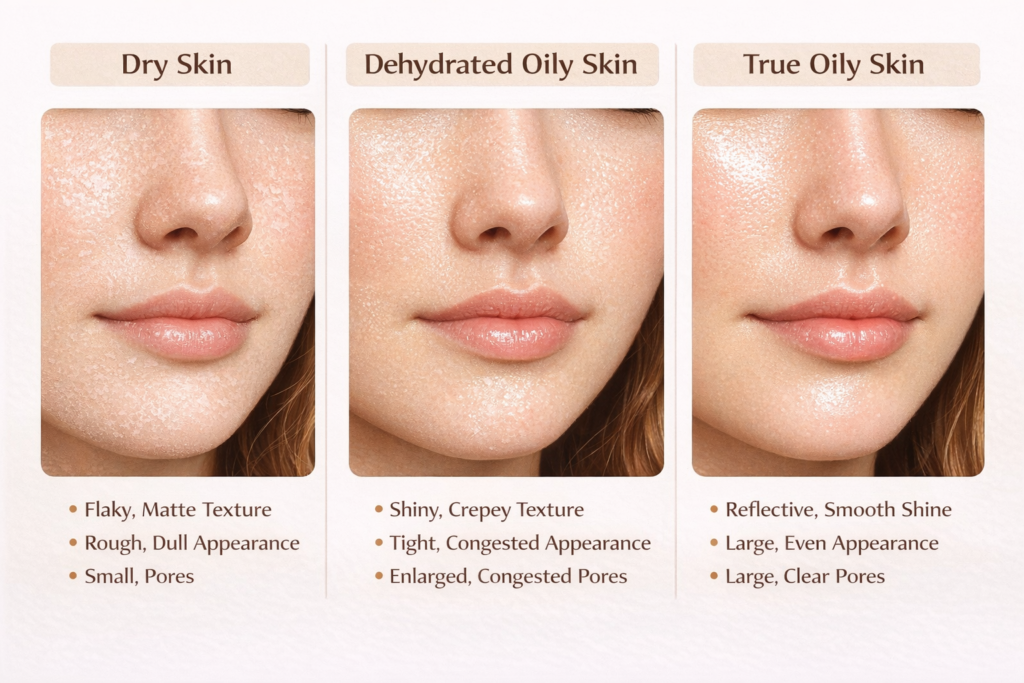
The easiest way to understand dehydrated oily skin is to compare it directly with dry skin and true oily skin:
| Feature | Dry Skin | Dehydrated Oily Skin | True Oily Skin |
| Primary Imbalance | Lack of oil (lipids) | Lack of water (H₂O) | Excess sebum production |
| Sebum Level | Low | Normal to High | High |
| Sebum Quality | Minimal | Thick / Viscous | Fluid / Spreadable |
| Pore Appearance | Small / Less visible | Enlarged & Congested | Visible / Larger |
| Tightness | Constant dryness | After washing / AC exposure | Rare |
| Surface Look | Dull / Flaky | Shiny but crepey | Greasy / Reflective |
| Breakout Pattern | Rare | Deep / Inflammatory | Blackheads / Whiteheads |
| Response to Moisturizer | Immediate relief | Gradual balance improvement | Shine reduction over time |
| Best First Fix | Richer lipid-based moisturizer | Humectant (glycerin) + ceramide cream | Oil regulation + gentle exfoliation |
The Science of the “Tight-Oily” Paradox
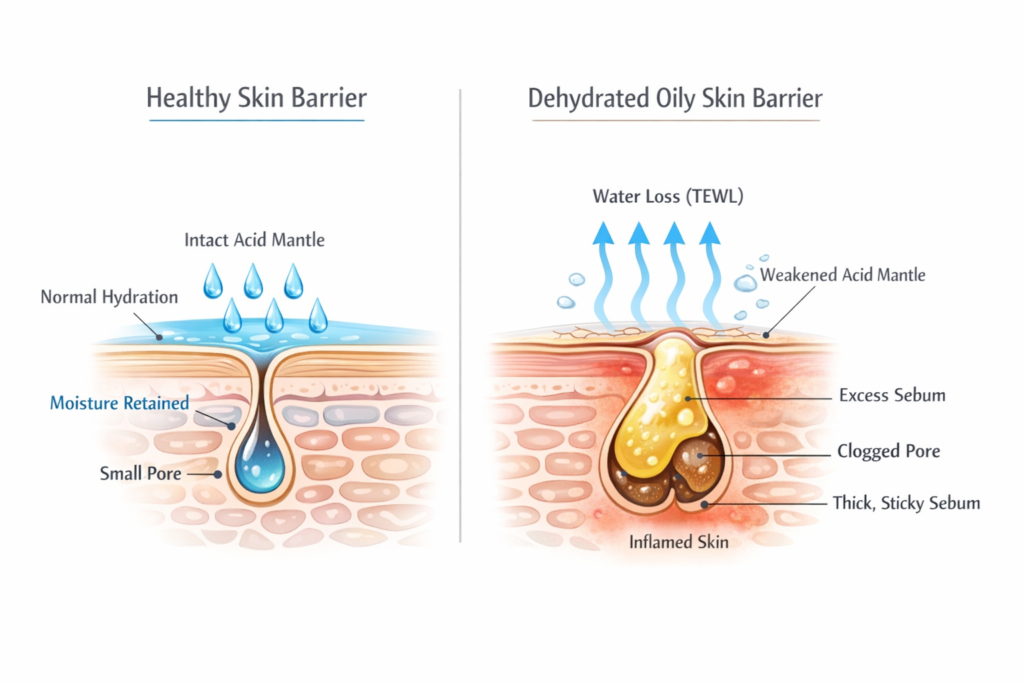
If your skin feels tight but looks shiny, the issue is not “too much oil.” It’s imbalance inside the skin barrier. To understand dehydrated oily skin, we need to look at three things: the Stratum Corneum barrier, Transepidermal Water Loss (TEWL), and how dehydration changes sebum itself.
1️⃣ The Stratum Corneum Barrier: Where Hydration Is Decided
The outermost layer of your skin is called the stratum corneum barrier. Think of it as a brick-and-mortar wall:
- Corneocytes = the “bricks” (dead but protective skin cells)
- Lipids and ceramides = the “mortar” that seals them together
- Natural Moisturizing Factor (NMF) = water-binding components inside each brick
When this structure is intact, water stays inside the skin. The surface feels comfortable, flexible, and calm.
This outer layer is also protected by the acid mantle skin layer — a slightly acidic film that supports healthy enzymes, microbiome balance, and proper shedding of dead skin cells. When the pH shifts or lipids become depleted, this protective system weakens.
In dehydrated oily skin, the problem is not a lack of sebum. It’s a weakened lipid barrier of skin that can no longer hold water efficiently.
Once this happens, water begins escaping faster than it should.
2️⃣ Transepidermal Water Loss (TEWL): The Invisible Escape
Transepidermal Water Loss (TEWL) refers to the passive evaporation of water from your skin into the air. A small amount is normal. Excess TEWL is not.
When the barrier is compromised:
- Water evaporates more quickly.
- Skin feels tight after cleansing.
- Products seem to “disappear” without improving comfort.
- Oil production increases as a defense mechanism.
In hot, dry climates — like much of Egypt and the Middle East — TEWL is amplified. High temperatures accelerate evaporation, while indoor air conditioning lowers humidity levels. This combination can “vacuum” moisture out of oily skin.
This is also why certain humectants, like hyaluronic acid for skin, may not perform optimally in very dry air if not sealed with a barrier-supportive moisturizer. Without proper reinforcement, water can be drawn upward and lost instead of retained.
When hydration drops, the skin doesn’t simply dry out.
It reacts.
3️⃣ Sebum Viscosity and Reactive Seborrhea: Why Oil Feels Different
Your sebaceous glands contain specialized cells called sebocytes, which produce sebum. In seborrhea-prone skin, oil production is already active. When dehydration occurs, the body responds by increasing sebum output in an attempt to slow water loss. This is sometimes referred to as reactive seborrhea.
But quantity is only part of the story.
Dehydration can alter sebum viscosity — making it thicker and stickier. At the same time, dehydrated corneocytes on the surface don’t shed evenly. The result?
- Oil becomes trapped more easily.
- Pores appear more prominent or stretched.
- Hard, stubborn congestion forms.
- Breakouts feel deeper and slower to resolve.
This explains why many people with dehydrated oily skin experience both skin tightening and persistent clogs. The surface lacks water, while beneath it, thicker oil accumulates under compacted skin cells.
When trapped sebum sits inside pores, it is also more prone to oxidation — a process explained in our guide on why skin oil turns black and how to prevent it. Thickened oil in a dehydrated environment is simply harder for the skin to regulate.
This is the tight-oily paradox:
Water loss triggers oil production.
Oil thickens.
Surface cells trap it.
Breakouts follow.
Understanding this biology changes everything.
Who Is Most Prone to Dehydrated Oily Skin?
Dehydrated oily skin is more common than most people realize — especially in specific environments and routines.
You may be more prone if you:
- Use salicylic acid or exfoliating acids daily
- Live in hot climates with heavy air-conditioning exposure
- Wash your face more than twice per day
- Avoid moisturizer because your skin feels oily
- Experience hormonal acne and use multiple active treatments
In these situations, the barrier is placed under constant stress. Over time, increased Transepidermal Water Loss (TEWL) and reactive seborrhea can create the tight-but-greasy pattern many people misinterpret as “just oily skin.”
Common Triggers: Why Your Skin Feels Tight After Salicylic Acid
Once you understand the biology of dehydrated oily skin, the next question becomes:
What is actually causing the barrier disruption?
In most cases, it’s not genetics alone. It’s routine stress.
1️⃣ The Salicylic Acid Trap
Salicylic acid (BHA) is one of the most effective ingredients for oily and acne-prone skin. It penetrates oil, clears pores, and reduces inflammation. But when used too frequently — or layered with other actives — it can shift from treatment to stressor.
We explore how BHA works in detail in our guide to salicylic acid for oily and acne-prone skin.
If your skin feels tight after salicylic acid, it’s often a sign that exfoliation has outpaced hydration.
Here’s what happens: Overuse weakens the stratum corneum barrier, increasing water evaporation. In response, sebaceous glands compensate — often producing thicker oil that lingers in the pore. This excess oil can worsen congestion because it contributes to the biological processes that lead to acne in oily skin.
This is why some people searching for “salicylic acid or benzoyl peroxide for hormonal acne” feel confused. If you’re deciding between them, our comparison of salicylic acid vs benzoyl peroxide for hormonal breakouts breaks down when each one works best. Both ingredients can reduce breakouts — but when the barrier is compromised, they may worsen tightness, irritation, and congestion.
If your skin feels tight after salicylic acid, you may have moved from acne treatment into barrier stress.
This doesn’t mean you should eliminate actives permanently. It means timing and frequency matter — something we’ll address in the recovery protocol.
2️⃣ Over-Cleansing and the Foam Illusion
Many people with oily skin equate “clean” with “squeaky.”
High-foam cleansers, strong surfactants, and frequent washing strip more than surface oil — especially when you’re not using a non-stripping cleanser for oily skin. They also remove:
- Natural Moisturizing Factors (NMF)
- Protective lipids
- Portions of the acid mantle
Initially, skin looks matte. But within hours:
- Tightness appears.
- Oil returns aggressively.
- Shine increases.
- Pores look more noticeable.
This rebound effect is especially common in seborrhea-prone skin, where sebocytes are already active. The skin attempts to compensate for water loss by increasing oil production.
3️⃣ The AC + Heat Evaporation Paradox
In Egypt and much of the Middle East, environmental stress plays a larger role than most guides acknowledge.
Daily exposure often includes:
- Intense outdoor heat
- Dry desert air
- Sudden shifts into air-conditioned environments
- Low indoor humidity
This combination accelerates evaporation from the skin’s surface.
Even oily skin loses water rapidly in dry air. And when humectants like hyaluronic acid for skin are used without sufficient barrier support, they may not retain moisture effectively in low-humidity conditions.
In these climates, glycerin for face formulas often perform more reliably because glycerin binds water strongly and works synergistically with barrier lipids.
This evaporation effect explains why skin can feel tight even when oil production remains high.
4️⃣ Skipping Moisturizer Because Skin Feels Oily
One of the most common mistakes in dehydrated oily skin is avoiding moisturizer entirely.
It seems logical:
“If I’m oily, I shouldn’t add more.”
But moisturizer is not about adding oil. It is about preventing water loss.
Without a barrier-supportive cream: Moisture continues escaping, and oil production remains reactive. Tightness doesn’t resolve — it intensifies.
A lightweight skin barrier repair cream for oily skin helps restore balance by reinforcing the lipid matrix — not by suffocating pores.
5️⃣ The “Active Fast” Confusion Cycle
When breakouts persist, many people layer:
- AHAs
- BHAs
- Retinoids
- Benzoyl peroxide
- Clay masks
- Alcohol toners
This creates what we call the Active Overload Cycle:
Exfoliate → Tightness → More Oil → More Actives → More Tightness.
Without addressing hydration first, clarity becomes harder to achieve.
Understanding these triggers is the turning point.
The solution isn’t stronger oil control.
It’s strategic recalibration.
The Gentle Glow Recovery Protocol
Once dehydrated oily skin is identified, the goal is not to eliminate oil.
It is to restore water balance and strengthen the barrier so oil can regulate itself naturally.
This is where most routines go wrong. They continue fighting oil instead of rebuilding structure.
Below is the Gentle Glow approach.
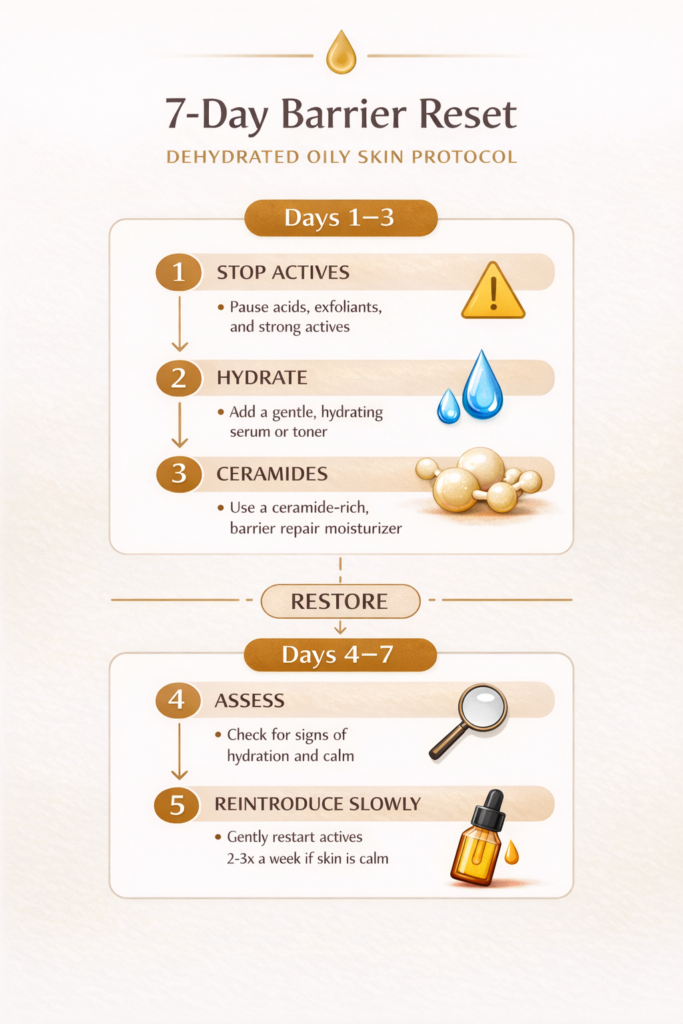
1️⃣ The 7-Day “Active Fast” Barrier Reset
If your skin feels tight, reactive, or suddenly sensitive to products that once worked, start here.
This is a temporary recalibration — not abandoning acne care permanently.
Days 1–3: Stop the Stressors
Pause:
- AHAs
- BHAs (including daily salicylic acid)
- Benzoyl peroxide
- Retinoids
- Clay masks
- Alcohol-heavy toners
Continue:
- Gentle, low-foam cleanser
- Glycerin-based hydration serum
- Niacinamide (5% range)
- Ceramide-based moisturizer
During these first few days, focus on comfort.
Tightness should gradually reduce.
Days 4–7: Stabilize and Assess
If skin feels:
- Less tight
- Less reactive
- Less shiny immediately after washing
You may begin reintroducing one active — slowly.
For example:
- Salicylic acid once every 3–4 days instead of daily.
If tightness returns, the barrier needs more time.
This short reset helps interrupt the cycle of dehydration-driven breakouts.
The Ingredient Deep Dive
To fix dehydrated oily skin, you need a specific hierarchy of ingredients. In the dry, air-conditioned climates of the MENA region, the order of these ingredients is just as important as the ingredients themselves.
2️⃣ Humectants for Skin: Water Comes First
Dehydrated oily skin lacks water — not oil.
Humectants draw water into the upper layers of the skin. But not all behave the same way.
Glycerin for Face (Climate Gold Standard)
In dry, air-conditioned environments, glycerin for face formulas often outperform hyaluronic acid alone. Glycerin binds water efficiently and supports long-term hydration stability when paired with barrier lipids.
It works especially well in hot, low-humidity climates where evaporation is high.
Hyaluronic Acid for Skin (When Layered Properly)
Hyaluronic acid for skin can still be helpful — but it should be:
- Applied to slightly damp skin
- Sealed with a ceramide moisturizer
- Avoided as a standalone hydration step in very dry air
Humectants work best when paired with barrier reinforcement.
3️⃣ Ceramides for Skin: Repairing the Lipid Matrix
Ceramides are structural lipids naturally found in the lipid barrier of skin. When levels drop, TEWL increases.
Adding topical ceramides for skin helps:
- Reinforce the stratum corneum barrier
- Reduce water loss
- Improve elasticity
- Decrease reactive oil production over time
Look for lightweight gel-cream textures labeled as a skin barrier repair cream for oily skin — especially those containing ceramides + cholesterol + fatty acids.
Barrier repair does not clog pores when properly formulated.
4️⃣ Niacinamide for Oily Skin: The Balancing Ingredient
As explained in our full niacinamide for oily skin guide, this ingredient strengthens the barrier while gradually regulating sebum, but its role in dehydration is unique. Niacinamide doesn’t just “feel” hydrating; it actually signals your skin to produce more of its own natural ceramides.
- Does Niacinamide help oily skin? Yes, by stabilizing the barrier, it tells your sebocytes to stop the “panic-production” of oil.
- Is Niacinamide good for oily skin? What are the benefits of Niacinamide for oily skin?
The answer lies in barrier support.
Niacinamide:
- Stimulates ceramide production
- Reduces inflammation
- Improves barrier resilience
- Helps regulate sebum production gradually
Unlike harsh oil-control agents, it does not strip the skin. Instead, it supports normalization.
In dehydrated oily skin, Niacinamide is often the bridge between repair and oil balance.
5️⃣ Occlusives for Acne-Prone Skin: Sealing Without Suffocating
The word “occlusive” often scares people with breakouts, but you need a “sealant” to stop water loss. The trick is to find non-comedogenic occlusives like Squalane or specialized silicones that sit on the surface to prevent TEWL without sinking into the pore and causing a clog.
The Core Principle
Hydration → Barrier Repair → Oil Normalization → Fewer Breakouts.
Not:
Strip Oil → Increase Oil → Layer Actives → Irritation → More Breakouts.
When hydration improves, oil production stabilizes naturally.
Pores appear less stretched.
Skin tightening reduces.
Congestion becomes easier to manage.
Repair first.
Clarify second.
How to Repair Skin Barrier for Oily Skin (2026 Steps)
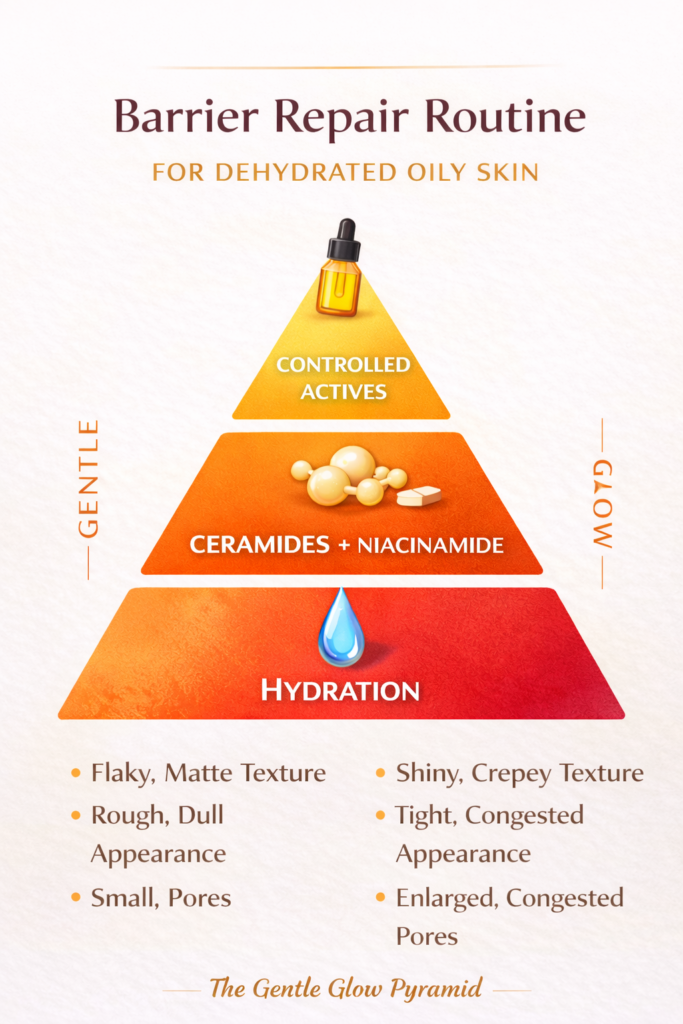
Once hydration is restored and the 7-day reset calms the skin, the next step is building a sustainable routine.
Repairing dehydrated oily skin is not about doing more.
It’s about doing the right things in the right order.
This is your long-term dehydrated oily skin treatment framework.
Morning Routine — Protect & Prevent Water Loss
Mornings are about minimizing evaporation and stabilizing oil.
Step 1: Gentle Cleanse (Optional if Very Dry)
Use a low-foam, pH-balanced cleanser.
If your skin is not heavily oily upon waking, even rinsing with lukewarm water may be enough.
Over-cleansing in the morning can restart the tight-oily cycle.
Step 2: Hydration Layer (Humectant First)
Apply:
- Glycerin-based serum
OR - A balanced glycerin + hyaluronic acid formula
Humectants for skin attract water, but they must be followed by barrier support to prevent evaporation.
Step 3: Niacinamide Support
A lightweight serum containing Niacinamide (around 4–5%) helps:
- Regulate sebum output
- Reduce inflammation
- Strengthen the barrier over time
One of the key benefits of Niacinamide for oily skin is its ability to increase ceramide synthesis, reinforcing the stratum corneum barrier naturally.
This is especially helpful for seborrhea-prone skin experiencing reactive oiliness.
Step 4: Lightweight Skin Barrier Repair Cream for Oily Skin
Look for:
- Ceramides
- Cholesterol
- Fatty acids
- Non-comedogenic gel-cream textures
A proper skin barrier repair cream for oily skin reduces TEWL without clogging pores.
Moisturizer does not increase oil production — it stabilizes it.
Step 5: Hydration-Friendly Sunscreen
UV exposure weakens the barrier and increases water loss.
Choose:
- Gel-based or fluid sunscreen
- Alcohol-free if possible
- Non-mattifying formulas that don’t overly dry the surface
Sun damage increases inflammation and worsens dehydration-related breakouts.
Night Routine — Repair & Normalize
Evening is when barrier rebuilding happens. Once hydration is stable, you can transition back to a structured routine like our night routine for oily and acne-prone skin.
Step 1: Gentle Cleanse (No Double-Stripping)
If wearing sunscreen or makeup, double cleanse — but gently:
- Oil-based cleanser (if needed)
- Followed by low-foam cleanser
Avoid harsh surfactants.
Step 2: Humectant Layer
Apply glycerin or hyaluronic acid on slightly damp skin.
This supports hydration replenishment overnight.
Step 3: Niacinamide or Barrier Serum
Continue Niacinamide nightly if tolerated.
If previously overusing actives, keep this stage simple during barrier repair.
Step 4: Ceramide-Rich Moisturizer
This is the most important step.
Ceramides for skin restore the lipid matrix and reduce TEWL. Over time, this decreases reactive oil production and reduces the appearance of enlarged pores on face caused by pressure buildup.
Step 5 (Optional): Light Occlusive
If climate is extremely dry or AC exposure is heavy:
- Apply a thin layer of a lightweight occlusive (such as dimethicone-based gel)
This helps lock hydration overnight without overwhelming acne-prone skin.
Reintroducing Actives After Barrier Repair
Once your skin:
- No longer feels tight
- Tolerates moisturizer comfortably
- Produces less rebound oil
You may reintroduce exfoliation gradually.
For example:
- Salicylic acid once or twice weekly
- Monitor for tightness
If tightness returns, frequency is too high.
This balanced approach prevents the cycle where skin feels tight after salicylic acid and oil rebounds aggressively.
What to Expect Over 2–4 Weeks
With consistent barrier repair:
- Tightness reduces first
- Shine becomes more even (less plastic-like)
- Breakouts become less inflamed
- Congestion softens gradually
- Pores appear less stretched
Repair is progressive — not instant.
But when hydration improves, oil regulation becomes easier and more predictable.
The Clinical Evidence (The “Why” Behind the Fix)
Understanding dehydrated oily skin is not just theoretical. Research consistently shows that compromised barrier integrity is associated with measurable increases in transepidermal water loss and higher inflammatory activity in acne-prone skin.
- The TEWL-Acne Connection: Multiple recent dermatological studies have confirmed that acne-prone patients often exhibit significantly higher higher TEWL in acne patients than those with balanced skin. This means that “acne skin” is inherently more prone to barrier leakage, which explains why your skin reacts so aggressively to even “mild” acids.
- The Niacinamide Genomic Effect: Research published in the British Journal of Dermatology shows that Niacinamide isn’t just a surface hydrator. It actually upregulates the mRNA responsible for serine palmitoyltransferase (SPT)—the rate-limiting enzyme in your skin’s own ceramide production. In practical terms, Niacinamide increases ceramide synthesis and improves barrier function.
- The Glycerin vs. HA Humidity Study: n low-humidity environments (like desert air or air-conditioned rooms), glycerin is one of the most reliable humectants for maintaining stratum corneum hydration and supporting barrier recovery—especially when paired with a moisturizer.
Final Verdict: Embrace the Glow, Respect the Barrier
Dehydrated oily skin is not a permanent skin type; it is a temporary state of distress. The “Gentle Glow” approach is simple: Tightness is often your skin’s first signal of barrier stress. When oil is present but comfort is not, hydration — not stronger actives — should come first. By pausing your actives, prioritizing NMF-mimicking ingredients like Glycerin, and sealing the gaps with Ceramides, you stop the compensatory oil loop. Balance isn’t about removing oil—it’s about making sure your skin doesn’t feel the need to overproduce it.
If you’re unsure whether dehydration or excess oil is driving your breakouts, start with barrier repair. Oil regulation becomes easier once hydration is stable.
Frequently Asked Questions
Can oily skin be dehydrated?
Yes. Oily skin refers to your sebum (oil) levels, while dehydration refers to the water content in your stratum corneum. You can have high oil production while your skin cells are simultaneously lacking the water they need to function correctly.
Why does my skin feel tight but look oily?
This is a sign of reactive seborrhea. When your skin loses water through a damaged barrier (TEWL), it pumps out excess oil to try and “seal” the moisture in. The result is a shiny surface with a tight, uncomfortable sensation underneath
Does drinking water help dehydrated skin?
While hydration is important for overall health, drinking water cannot fix a “leaky” skin barrier. If your barrier is damaged, the water you drink will simply evaporate through your skin. You must fix the barrier topically to “trap” the hydration inside.
What is the best skin barrier repair cream for oily skin?
Look for “gel-cream” or “water-cream” textures. The best formulas contain Ceramides, Cholesterol, and Fatty Acids (the 3:1:1 ratio) alongside Niacinamide to help your skin produce its own moisture.
How long does it take to repair a damaged barrier?
With a strict “Active Fast” and consistent humectant use, most people see a reduction in tightness within 7 to 14 days. However, complete structural repair of the stratum corneum usually takes a full skin cycle of 28 days.
Is Niacinamide good for oily skin?
Niacinamide is excellent for oily skin. It is one of the few ingredients that can simultaneously reduce oil production and increase the production of barrier-strengthening ceramides.

About the Author
Founder, Gentle Glow | Evidence-Based Skincare & Skin Biology
Hi, I’m the Founder of Gentle Glow. After years of struggling with oily and acne-prone skin—and cycling through harsh products that disrupted my barrier rather than improving it—I began researching the science behind sebum regulation, skin biology, and non-comedogenic formulation.
Gentle Glow was created to simplify evidence-based skincare. Every routine shared here focuses on root causes: barrier function, oil balance, and ingredient compatibility. My goal is to translate dermatology-backed principles into realistic, sustainable routines that work with your skin—not against it.
Beyond topical care, I believe healthy skin reflects overall balance, including nutrition, climate awareness, and lifestyle habits. Gentle Glow is built to help you make informed decisions with clarity, consistency, and confidence.
Medical Disclaimer
Gentle Glow guides are developed using peer-reviewed dermatology research and established clinical guidelines. The information provided is for educational purposes only and does not replace professional medical advice, diagnosis, or treatment. Always consult a board-certified dermatologist or qualified healthcare provider before starting new active skincare treatments.
.