كل ما تحتاجين معرفته عن البشرة الدهنية

كيف تميّز بين التصبغات بعد حب الشباب (PIH) والاحمرار بعد الحبوب (PIE) وندبات حب الشباب؟

Dermatologist, Medical Reviewer & Contributor at Gentle Glow
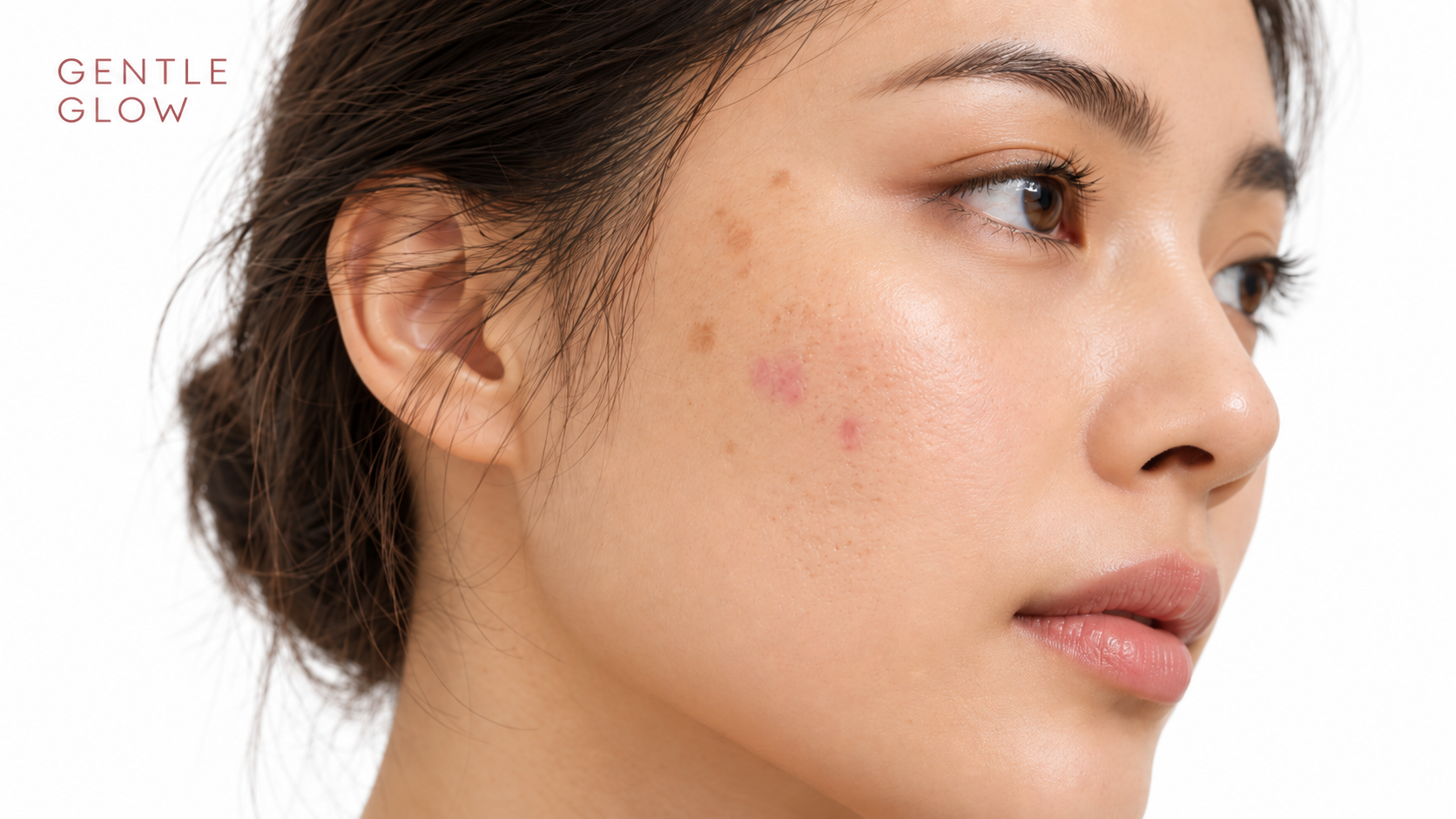
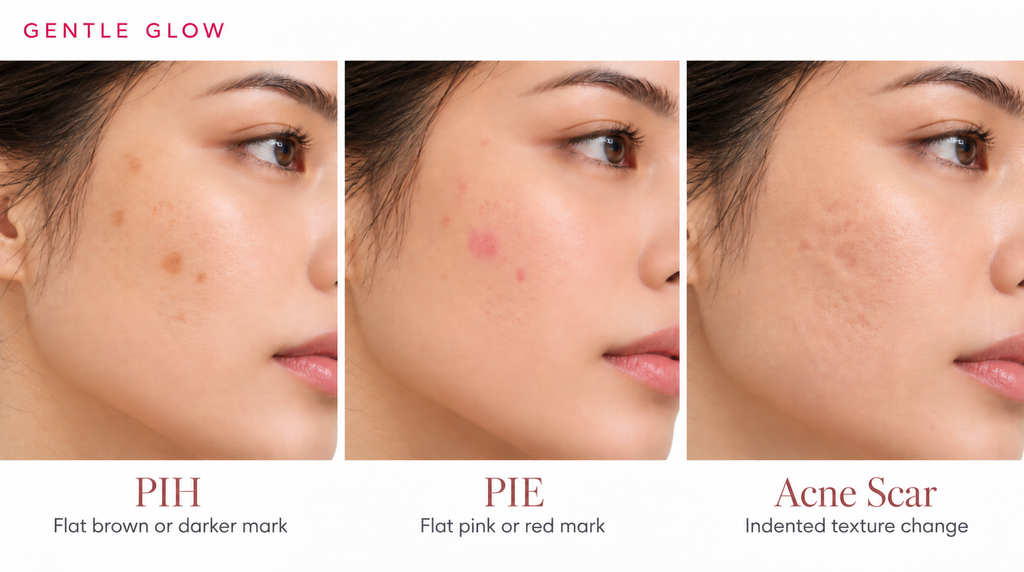
When comparing PIH vs PIE vs acne scars, healed acne can leave three different kinds of changes behind: PIH, a flat brown or darker mark from excess pigment; PIE, a flat pink, red, or purplish mark from lingering vascular changes; or an acne scar, a true structural change in the skin. These changes can also overlap.
- PIH changes skin color, not texture.
- PIE is also flat, but usually appears pink, red, or purplish.
- Acne scars change the skin’s contour and may be depressed or raised.
- Identifying the main change helps explain why the same treatment will not work equally well for all three.
جدول المحتويات
Why Do Some Acne Marks Look Red, Brown, or Indented?
Acne marks look red, brown, or indented because inflammation can affect the skin in different ways as it heals: it may leave lingering redness (PIE), trigger excess pigment (PIH), or change the skin’s underlying structure and form a true acne scar.
Red, Pink, or Purple Marks
Some healed acne lesions leave behind a flat mark that stays pink, red, or purple long after the original bump is gone. This happens because post-inflammatory erythema and vascular changes can remain visible after the acne lesion has healed. Dermatologists call this post-inflammatory erythema, or PIE.
Brown or Darker Marks
Other marks settle into a flat brown, tan, or darker patch instead, even after the acne itself has healed. This reflects extra pigment the skin produces while healing rather than a primarily vascular change, and it’s what’s known as post-inflammatory hyperpigmentation, or PIH.
Indented or Raised Areas
Sometimes healing changes more than just the skin’s color — it changes its structure. When collagen is lost or produced unevenly during repair, the result can be a true acne scar rather than a color-only mark. These generally fall into two categories: depressed (atrophic) و raised scars.
In depressed scars, the skin sits lower than the surrounding area; in raised (hypertrophic or keloid-type) scars, extra tissue sits above it. Among depressed scars, dermatologists sometimes describe narrower ones as ice-pick scars, broader, well-defined ones as boxcar scars, and shallow, sloping ones as rolling scars — useful for recognition, though the exact subtype is best confirmed by a dermatologist rather than self-diagnosed.
| المعيار | PIH | PIE | Acne Scar |
|---|---|---|---|
| Main visible change | Pigment | Redness / erythema | Structure / contour |
| Usually flat? | نعم | نعم | No — may be depressed or raised |
| Common appearance | Brown / darker | Pink / red / purple | Indented or raised |
| Main issue | Pigment | Vascular / erythematous change | Tissue structure |
A few caveats are worth keeping in mind: color can look different across skin tones. PIE may appear more dusky, purple, or brown-red rather than bright red in deeper skin, and PIH can range from tan to gray-brown depending on pigment depth. Color alone isn’t always a definitive way to sort a mark into one category, and discoloration can exist right alongside a structural scar rather than instead of it.
Are Red and Brown Acne Marks Actually Acne Scars?
Flat red or brown post-acne marks are generally not structural acne scars. PIH and PIE primarily change the skin’s color, while true acne scars change its contour or texture, so a flat mark, however stubborn or discolored, is not the same thing as a scar in the structural sense.
This distinction matters practically: if a flat, colored mark is mistaken for a scar, someone may assume it needs a procedure-based scar treatment, when it may actually respond to color-directed skincare and time. Running a finger over flat PIH or PIE typically won’t reveal any texture change, which is part of what separates it from a true scar.
A true acne scar can also have red, purple, or brown discoloration over it. In that case, the color change and the texture change are two separate issues in the same area. Treating the discoloration may make the scar look less noticeable, but it will not correct the underlying indentation or raised texture.
Can You Have PIE and PIH at the Same Time?
PIE and PIH can coexist in the same area, and it’s also possible to have a structural acne scar with residual redness or pigmentation layered on top of it. Not every post-acne mark needs to be forced into a single, tidy category.
A few real-world patterns are common:
- A single flat area that shows both redness and darker pigment at once.
- Different acne lesions on the same person healing into different types of marks — some red, some brown, some structural.
- A depressed or raised scar that also carries some residual redness or pigmentation around its edges.
The useful mental model here is that color and texture are telling you two different things about what the acne left behind, one isn’t a more advanced or more severe version of the other, and having both doesn’t mean anything has gone wrong with healing.
Can the Press Test Really Tell You If You Have PIE or PIH?
Pressing on a red or pink mark, sometimes called the blanch test, glass test, or diascopy, can temporarily push blood out of superficial vessels and make the redness fade for a moment, which suggests a vascular component. But blanching on its own shouldn’t be treated as a definitive home diagnosis of PIE, despite how often it’s presented that way.
Here’s the more careful version: if a mark visibly lightens under firm pressure, that’s a reasonable clue that a vascular component is present. But the absence of an obvious blanch doesn’t automatically mean the mark is pure PIH either, the color may be a mix of both vascular and pigment changes, or the blanching may simply be hard to see. This is especially true in deeper skin tones, where PIE can look more dusky, purple, or brown-red rather than the bright pink typically pictured in at-home guides, which can make the color shift from pressure harder to judge by the eye.
If you are trying to decide on treatment, the honest takeaway is that a home press test can offer a clue, not a diagnosis. If a mark is difficult to classify or isn’t responding as expected, a dermatologist can assess whether pigment, erythema, scarring, or a combination is contributing.
Why Aren’t My Acne Marks Responding to Dark Spot Treatments?
Dark-spot treatments are designed to target pigmentation, so they may genuinely help PIH — but they do much less for the vascular redness of PIE, and they cannot correct the structural indentation or raised tissue of a true acne scar. If a mark isn’t improving, a mismatch between the treatment and the actual problem is a common, overlooked reason why.
If the mark is flat and brown or darker
Pigment is likely a real part of what you’re seeing, and a pigment-focused approach is reasonable. That generally means controlling any new breakouts, avoiding unnecessary irritation, staying consistent with sun protection, and using a treatment with real evidence behind it.
If the mark is flat and red, pink, or purple
Treating a red mark purely as pigmentation may not address the main visible issue, which may be erythema rather than pigment alone. Avoiding unnecessary irritation is sensible, and redness that’s persistent or unclear in origin is a reasonable reason to have it assessed by a dermatologist before escalating treatment further.
If the skin is indented or raised
No topical dark-spot product will correct a structural change in the skin, that’s simply not what these treatments are designed to do. A dermatologist can help identify the specific type of scar involved and determine whether a procedure-based approach may be worth considering.
The bigger-picture point isn’t to use more products, it’s to match the next step to what the acne actually left behind: pigment, redness, or a structural change.
الخلاصة
PIH and PIE are both flat, color-only changes; one from pigment, one from lingering vascular redness, while true acne scars involve a change in the skin’s structure. Skin often doesn’t sort neatly into one category: a single area can carry both pigment and redness, or discoloration can sit right alongside a structural scar.
A home press test can offer a useful clue about a red mark, but it isn’t a definitive diagnosis, particularly across different skin tones.
فهم الفرق بين PIH vs PIE vs acne scars helps you match your next step to the actual problem, rather than defaulting to a dark-spot treatment for every leftover mark.
الأسئلة الشائعة
Will PIE Eventually Go Away?
Post-inflammatory erythema (PIE) can gradually become less noticeable as the underlying vascular changes resolve, but there is no fixed fading timeline. If redness remains prominent or does not improve, a dermatologist can assess the mark and discuss appropriate treatment options.
How Long Do PIE and PIH Take to Fade?
Both PIE and PIH tend to improve gradually rather than quickly, but there is no fixed fading timeline. Improvement varies with the intensity of the original inflammation, ongoing acne, skin tone, sun exposure, irritation, and the treatment being used for each person.
How Do I Identify My Acne Scar Type?
Acne scar types differ in shape: narrow, deep depressions are described as ice-pick scars; wider, more defined depressions as boxcar scars; and broad, shallow, undulating areas as rolling scars. Scars that sit above the surrounding skin are raised (hypertrophic or keloid-type) scars.
References
- Lawrence, E., Syed, H. A., & Al Aboud, K. M. (2024). Postinflammatory hyperpigmentation. In StatPearls. StatPearls Publishing. Updated November 25, 2024.
- Markiewicz, E., Karaman-Jurukovska, N., Mammone, T., & Idowu, O. C. (2022). Post-inflammatory hyperpigmentation in dark skin: Molecular mechanism and skincare implications. Clinical, Cosmetic and Investigational Dermatology, 15, 2555–2565.
- Fabbrocini, G., Annunziata, M. C., D’Arco, V., De Vita, V., Lodi, G., Mauriello, M. C., Pastore, F., & Monfrecola, G. (2010). Acne scars: Pathogenesis, classification and treatment. Dermatology Research and Practice, 2010, Article 893080.
- Bae-Harboe, Y. S. C., & Graber, E. M. (2013). Easy as PIE (postinflammatory erythema). Journal of Clinical and Aesthetic Dermatology, 6(9), 46–47.
- Kadu, P. P. (2024). Diascopy revisited: ‘Slide’ your way to diagnosis. Indian Journal of Postgraduate Dermatology, 2(1), 17–19.
تنويه طبي
يتم إعداد أدلة Gentle Glow استنادًا إلى أبحاث علمية محكّمة في مجال طب الجلدية وإرشادات سريرية معتمدة. المعلومات المقدَّمة هنا لأغراض تعليمية فقط، ولا تُعد بديلاً عن الاستشارة الطبية المهنية أو التشخيص أو العلاج. يُنصح دائمًا باستشارة طبيب جلدية معتمد أو مقدم رعاية صحية مؤهل قبل البدء باستخدام أي مكوّنات علاجية نشطة جديدة في روتين العناية بالبشرة.