Everything You Need to Know About Oily Skin

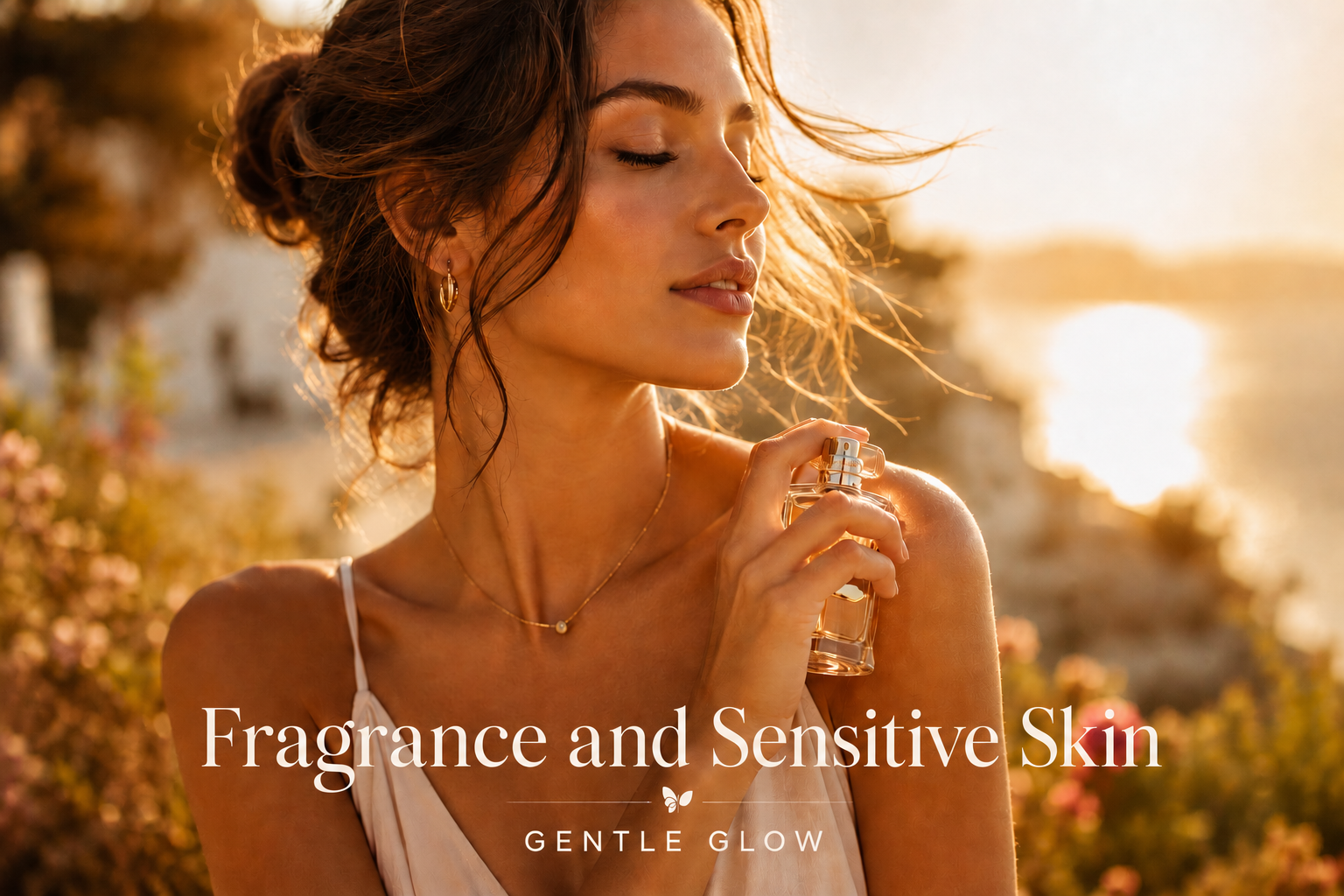
Fragrance and Sensitive Skin: How to Wear Perfume Without Triggering Irritation in Heat, Sweat, and Humidity

Medically reviewed by
Gamal Henin, B.Pharm
Pharmacist & Medical Reviewer at Gentle Glow
Reviewed June 22, 2026
Fragrance and sensitive skin can coexist comfortably for many people, even during summer. The best way to wear perfume without triggering irritation is to apply it thoughtfully, avoid highly reactive areas of the skin, and support a healthy skin barrier. Heat, sweat, humidity, friction, and sun exposure can all make fragrance feel more irritating, which is why application habits often matter as much as the fragrance itself.
- Fragrance is not automatically harmful for everyone with sensitive skin.
- Summer conditions such as heat, sweat, humidity, and friction can make irritation more noticeable.
- Where and how you apply perfume may influence skin comfort as much as the fragrance itself.
Table of Contents
Some links in this guide are affiliate links. This means Gentle Glow may earn a small commission if you purchase through them — at no extra cost to you. We only recommend products that are suitable for oily and acne-prone skin.
Watch: Why Does Perfume Burn in Summer? It’s Not Always the Perfume
Can Perfume Cause Skin Irritation?
As summer arrives, many of us reach for fragrance more often. Hot weather, increased sweating, vacations, outdoor events, and longer days naturally make perfume feel like part of the season.
Yet summer can also be the time when our skin seems least enthusiastic about the scents we enjoy.
A perfume that felt perfectly comfortable during cooler months may suddenly start causing stinging, redness, itching, or irritation. Sometimes the reaction appears after a day at the beach. Other times it shows up during a heatwave, after a workout, or seemingly out of nowhere.
This can make fragrance sensitivity feel confusing.
If the perfume was fine before, why would it suddenly become a problem now?
The answer is that your skin does not experience fragrance in isolation. It responds to fragrance within the environment around it.
Heat, sweat, humidity, friction, sun exposure, and overall skin barrier health can all influence how your skin responds to a scent. In many cases, the fragrance itself is only one part of a much larger picture.
| Factor | Why It Matters |
|---|---|
| Skin sensitivity | Reactive skin may be more prone to irritation |
| Skin barrier condition | A compromised barrier often tolerates potential irritants less comfortably |
| Heat and humidity | Can make stinging and redness feel more noticeable |
| Sweat and friction | May increase contact between fragrance and the skin |
| Application habits | Where and how perfume is applied can influence comfort |
Understanding this distinction changes how we think about fragrance irritation.
If perfume itself is not always the sole cause of discomfort, avoiding fragrance entirely may not be the only solution. In many cases, small adjustments to application habits, skincare routines, or environmental exposure can make a meaningful difference.
A more useful question is why a fragrance that feels perfectly comfortable in one situation may suddenly become irritating in another.
Fragrance and Sensitive Skin: Why Summer Changes the Way Perfume Feels
Many people assume that if a perfume suddenly starts causing irritation, the fragrance itself must be the problem.
But summer often introduces several changes at once.
Your skin is exposed to more heat, more sweat, more friction, more sun exposure, and often more skincare products than it experiences during cooler months. Together, these factors can change how comfortable a fragrance feels on the skin.
This is one reason a perfume that seemed perfectly fine in winter can suddenly feel irritating during summer.
The fragrance may not have changed, but the environment around your skin has.
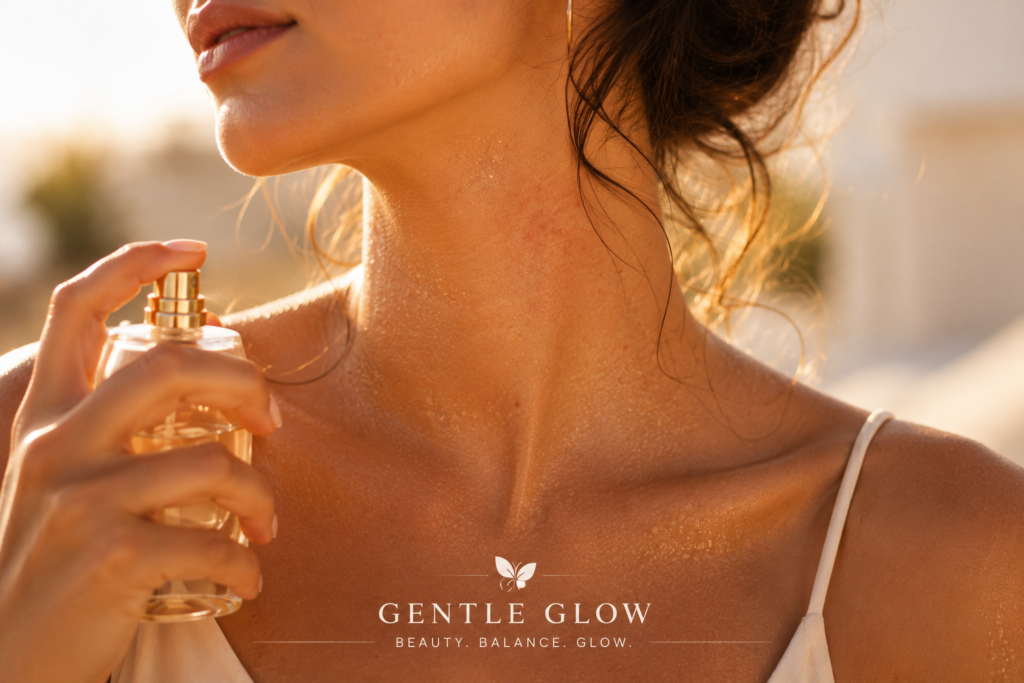
Heat Can Make Skin Feel More Reactive
During hot weather, your skin works harder to regulate body temperature. Blood flow near the surface increases, and the skin may become more prone to flushing, stinging, or feelings of sensitivity.
As a result, sensations that barely registered during cooler months can become much more noticeable.
This does not necessarily mean the fragrance has become harmful. Instead, your skin may simply be responding differently because of the surrounding conditions.
Sweat Changes How Fragrance Interacts With Skin
Sweat itself is not automatically bad for the skin.
This is a misconception that appears frequently in skincare. Just as sweat does not directly cause every post-workout breakout, it is not necessarily the reason a fragrance suddenly becomes irritating. The environment created by heat, moisture, friction, and prolonged product contact is often far more important.
However, sweat can still change the way products behave on the skin’s surface.
When perfume is applied to warm, sweaty skin, fragrance compounds may remain in contact with the skin for longer periods or spread into areas that experience more friction. This can make irritation feel more noticeable in people who are already prone to sensitivity.
The result is that a fragrance may suddenly seem harsher than usual, even though the formula itself has not changed.
Friction Is the Overlooked Summer Trigger
When people think about fragrance irritation, they often focus on the ingredients.
But friction can play a surprisingly important role.
Areas such as the neck, chest, collarbone, and inner arms are exposed to constant movement throughout the day. Clothing, jewelry, backpack straps, and even damp skin rubbing against itself can increase irritation.
This helps explain why some of the most common perfume application points are also some of the most common areas where reactions occur.
Why a Perfume You’ve Worn for Years Can Suddenly Start Burning
One of the most frustrating aspects of fragrance sensitivity is that it can seem to appear without warning.
A scent that never caused problems before may suddenly begin to sting or feel uncomfortable.
In many cases, the perfume is only one part of the equation.
Other factors may include:
- Increased heat and humidity
- More frequent sweating
- Recent sun exposure
- Over-exfoliation
- Retinoid use
- A weakened skin barrier
- Seasonal dehydration
This is similar to what many people experience with active skincare ingredients during warmer months. Products that once felt comfortable can start causing irritation when environmental conditions change.
The same principle often applies to fragrance.
Before assuming a favorite perfume has become unsuitable, it may be worth considering whether your skin itself is responding differently to the season.
Understanding that distinction is important because it shifts the focus away from simply blaming the fragrance and toward understanding the factors that influence skin tolerance.
And that raises another important question: when irritation does occur, how can you tell whether you’re dealing with simple sensitivity or a true fragrance allergy?
Fragrance Irritation vs Fragrance Allergy: Why the Difference Matters
If a perfume suddenly makes your skin sting, itch, or turn red, it’s natural to wonder whether you’ve developed an allergy.
In reality, irritation and allergy are not always the same thing, even though they can look surprisingly similar at first.
This distinction matters because many people assume that any uncomfortable reaction means they must stop using fragrance altogether. In some cases that may be true, but often the explanation is more nuanced.
Sometimes the skin is reacting because it has become more sensitive to its environment. Heat, sweat, friction, recent sun exposure, over-exfoliation, or even a weakened skin barrier can make a normally tolerated fragrance feel uncomfortable. The skin may sting, burn, or become temporarily red despite the fact that the immune system is not actually involved. Research shows that the skin barrier plays a critical role in protecting against environmental irritants, and when barrier function becomes disrupted, the skin may become more vulnerable to irritation and inflammation.¹
This type of reaction is often described as irritation.
A fragrance allergy works differently. Rather than simply finding a product uncomfortable, the immune system begins recognizing specific ingredients as a threat and reacts accordingly. These reactions are often more persistent and may involve itching, rashes, swelling, or eczema-like patches that continue long after the fragrance has been applied.
While only a dermatologist can diagnose a fragrance allergy through appropriate testing, understanding the difference can help explain why some reactions disappear once the skin calms down while others continue to return with repeated exposure.
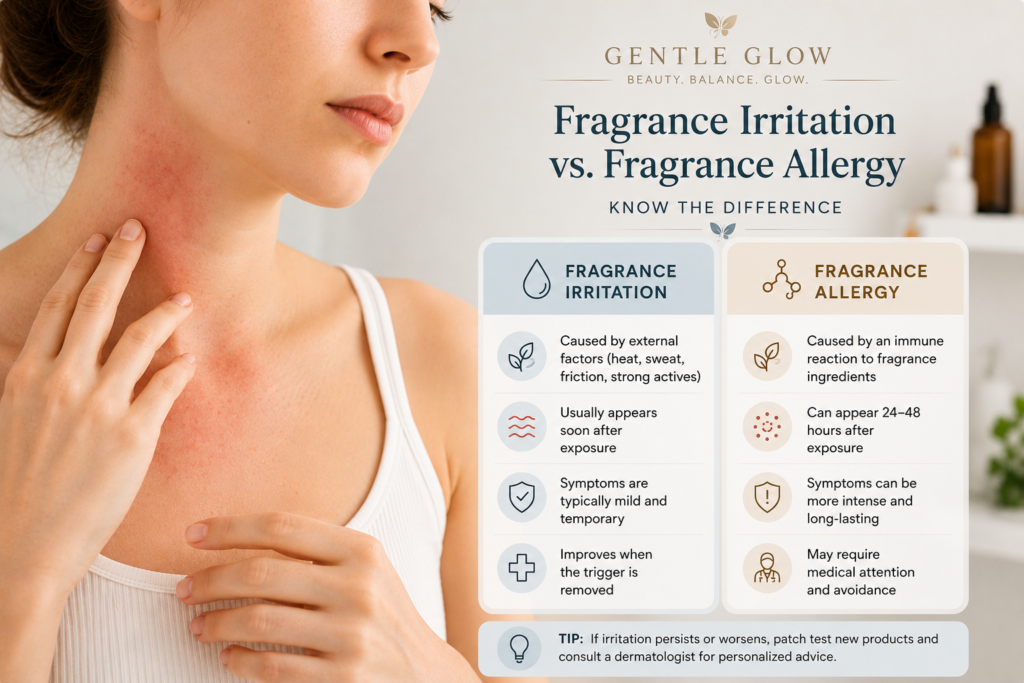
| Fragrance Irritation | Fragrance Allergy |
|---|---|
| Often feels like burning, stinging, or discomfort | Often involves itching, rash, or eczema-like symptoms |
| Commonly influenced by heat, sweat, friction, and skin condition | Involves an immune response to specific ingredients |
| May improve quickly once the trigger is removed | Can persist or return with future exposure |
| More common overall | Less common but often more persistent |
One reason this distinction is especially relevant during summer is that environmental factors can temporarily lower the skin’s tolerance threshold. A fragrance that feels completely comfortable during cooler months may suddenly become irritating during a heatwave, after a long day outdoors, or when the skin is already stressed from other products.
That doesn’t necessarily mean you’ve become allergic overnight.
In many cases, it means your skin is asking for a little more support.
Are Natural Perfumes Automatically Better for Sensitive Skin?
When people start looking for solutions, one of the first recommendations they often encounter is to switch to natural fragrances.
The idea sounds reassuring. If a fragrance comes from flowers, citrus peels, herbs, or essential oils, it must be gentler than something created in a laboratory.
Unfortunately, skin does not judge ingredients based on where they came from.
Many naturally derived fragrance ingredients contain complex mixtures of aromatic compounds that can still trigger irritation in susceptible individuals. Ingredients such as limonene, linalool, citral, and eugenol all occur naturally and are widely used in both natural and conventional fragrances.
This doesn’t mean these ingredients are unsafe. Millions of people wear products containing them every day without any problems.
What it does mean is that “natural” and “non-irritating” are not interchangeable terms.
For sensitive skin, individual tolerance often matters far more than marketing labels.
Can Perfume Cause Acne?
People with oily or acne-prone skin often worry that fragrance is directly causing their breakouts.
In most cases, perfume itself is not considered a primary cause of acne. However, some cosmetic ingredients, including certain fragrance-containing products, may contribute to acne cosmetica or irritation in susceptible individuals. This is one reason it is important to consider the overall formulation and how your skin responds rather than focusing on fragrance alone.
What can happen, however, is that irritation and acne become confused with one another. When skin feels red, uncomfortable, or reactive after applying a fragrance, it’s easy to assume that any blemish appearing around the same time must be connected.
But irritation and acne are different biological processes.
A fragrance may cause temporary discomfort without causing acne, just as a breakout can develop without fragrance being responsible.
For readers with oily skin, this distinction is particularly important because many factors that contribute to breakouts—including heat, friction, sweat, and occlusion—can occur alongside fragrance use without necessarily being caused by the fragrance itself.
Before deciding whether a perfume is suitable for your skin, it also helps to consider where that fragrance is being applied. Surprisingly, some of the most popular perfume application points may be the very areas most likely to become irritated during hot, humid weather.
The Pulse Point Myth: Traditional Fragrance Advice vs Summer Skin Reality
One of the oldest pieces of fragrance advice is to apply perfume to your pulse points.
The logic seems reasonable. Areas such as the neck, wrists, and inner elbows tend to be warmer, which may help diffuse a scent throughout the day.
For many people, this approach works perfectly well.
The problem is that traditional fragrance advice was never designed specifically for people dealing with fragrance and sensitive skin during hot, humid weather.
Many classic pulse points are also areas where sweat, friction, and heat tend to accumulate. When those factors combine, the skin may become more reactive, making irritation feel more noticeable.
This doesn’t mean pulse points are automatically wrong. It simply means that sensitive skin sometimes benefits from a different approach during summer.
| Traditional Advice | Summer Skin Reality |
|---|---|
| Apply fragrance to the neck | The neck is exposed to heat, sweat, friction, and sun exposure throughout the day |
| Spray inner elbows | Skin folds can trap moisture and increase friction |
| Reapply frequently in hot weather | More exposure may increase irritation in already reactive skin |
| Apply directly to warm skin | Heat may make stinging and discomfort feel more noticeable |
Why the Neck Is One of the Most Common Trouble Spots
If you’ve ever experienced a perfume irritation on the neck, you’re certainly not alone.
The neck sits at the intersection of several factors that can challenge sensitive skin. It is regularly exposed to sunlight, comes into contact with clothing, experiences movement throughout the day, and often becomes warm and sweaty during hot weather.
For some people, this combination creates the perfect environment for irritation.
The fragrance may not be any different than it was during winter. The skin, however, may be dealing with far more environmental stress.
This is one reason many people notice reactions on the neck before they notice them anywhere else.
Can You Spray Perfume on Clothes Instead of Skin?
For people who enjoy fragrance but struggle with skin irritation, clothing can sometimes provide a useful alternative.
Because the fragrance is sitting on fabric rather than directly on the skin, there is less opportunity for irritation to occur.
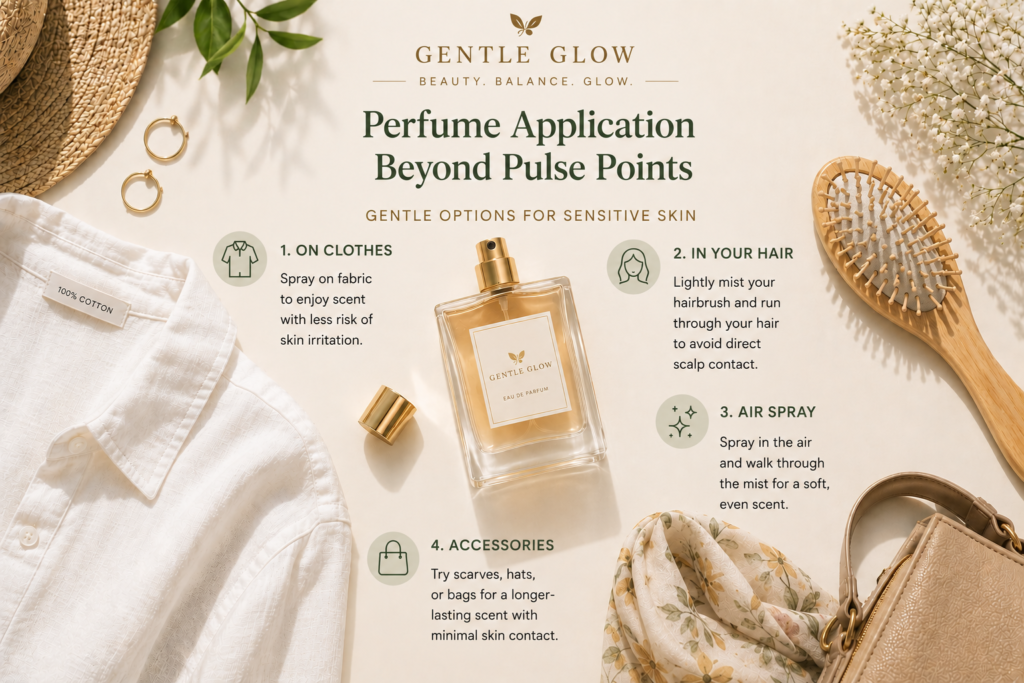
Many fabrics also hold scent surprisingly well, allowing the fragrance to linger throughout the day.
If you choose this approach, it’s worth testing a small, hidden area first since some perfumes may stain delicate materials.
For many people with sensitive skin, however, clothing application can be one of the simplest ways to enjoy fragrance while minimizing direct skin exposure.
Is It Safe to Put Perfume in Your Hair?
Hair is another option that fragrance enthusiasts often use when they want scent projection without applying perfume directly to the skin.
Rather than spraying the hair itself from close range, a gentler approach is to lightly mist a hairbrush and brush it through dry hair.
This helps distribute the fragrance more evenly while limiting direct contact with sensitive areas such as the neck and chest.
It’s worth remembering that traditional perfumes contain alcohol, which can be drying when used excessively on hair. For that reason, moderation is usually the best approach.
How to Wear Fragrance More Comfortably in Hot Weather
There is no single technique that works for everyone, but a few simple adjustments can often make fragrance feel more comfortable during summer.
Applying fragrance after the skin has had time to cool following a shower may help reduce immediate stinging.
Keeping the skin well moisturized can also be helpful. A healthy skin barrier generally tolerates potential irritants more comfortably than skin that is already stressed or dehydrated. If ongoing sensitivity has become a recurring issue, understanding how a damaged skin barrier can make skin more reactive may help explain why certain products suddenly feel uncomfortable.
Some people also find that applying fragrance to clothing, hair, or less reactive areas of the body allows them to enjoy their favorite scents with fewer issues.

This approach can be particularly helpful during summer, when heat, sweat, and friction may make skin feel more reactive than usual. Whether you gravitate toward the golden-hour warmth of Paruvea Solaris Veil, with its blend of bergamot, amber, musk, and sandalwood, or the cozy elegance of Paruvea Amaris Veil, a refined gourmand floral designed to feel warm, romantic, and comforting, thoughtful application habits often have a greater influence on skin comfort than the fragrance itself.
For people with sensitive skin, the goal is not to avoid fragrance altogether.
The goal is to find an application method that works with your skin rather than against it.
Of course, irritation is not the only concern people have during summer. Certain fragrance ingredients can also interact with sunlight itself, which is why it’s worth understanding a lesser-known reaction called phototoxicity.
Fragrance, Sun Exposure, and Phototoxic Reactions
Most fragrance irritation happens because the skin becomes more reactive to its environment. Occasionally, however, sunlight can play a more direct role.
This is where a lesser-known reaction called phototoxicity becomes important.
Phototoxic reactions occur when certain fragrance ingredients undergo chemical changes after exposure to ultraviolet (UV) light. Instead of remaining inactive on the skin’s surface, these compounds become more reactive when exposed to sunlight, increasing the likelihood of irritation and, in some cases, changes in skin pigmentation.
One of the best-known examples is a condition called Berloque dermatitis, a type of phototoxic reaction historically associated with fragrance ingredients applied to sun-exposed areas such as the neck and chest.
This doesn’t mean every perfume creates a phototoxic risk. Modern fragrance formulations are heavily regulated, and many people wear perfume outdoors without experiencing any problems.
However, certain fragrance ingredients—particularly some citrus-derived compounds—have historically been associated with a greater risk of phototoxic reactions when combined with significant sun exposure.
One well-known example is Berloque dermatitis, a phototoxic skin reaction linked to fragrance ingredients containing specific citrus-derived compounds. Early dermatology research identified substances known as furocoumarins (psoralens) in bergamot oil and other plants as important contributors to photosensitization reactions that can occur after exposure to ultraviolet light.
For people with sensitive skin, the simplest approach is often to avoid applying fragrance directly to areas that will receive prolonged sun exposure, particularly during peak summer hours.
This is another reason why clothing application or alternative application methods can sometimes be useful during hot weather.
Final Thoughts
Having fragrance and sensitive skin does not automatically mean you have to choose one or the other.
For many people, irritation is influenced by a combination of factors that extend far beyond the fragrance itself. Heat, sweat, humidity, friction, sun exposure, and overall skin condition can all affect how comfortably a scent wears throughout the day.
Understanding these influences allows you to make more informed decisions about where, when, and how you apply fragrance.
Just as we often adjust our routines when using active skincare ingredients during warmer months, it can be helpful to think of fragrance as another product that interacts with the environment around your skin.
Small changes—such as supporting skin barrier health, avoiding heavily irritated areas, or choosing alternative application methods—can often make a meaningful difference.
In many cases, the solution is not giving up fragrance.
It’s learning how to wear it in a way that works with your skin rather than against it.
Frequently Asked Questions
Why does perfume burn when I sweat?
Perfume may burn or sting when you sweat because heat, moisture, and friction can make the skin more reactive and change how fragrance interacts with its surface. This can make irritation feel more noticeable, particularly in people with sensitive skin or a compromised skin barrier.
Can you spray perfume on clothes instead of skin?
Yes, spraying perfume on clothing instead of skin can help reduce direct skin exposure and may be a useful option for people with sensitive skin. Always test a small hidden area first, as some fragrances may stain delicate fabrics.
Is perfume bad for acne-prone skin?
No, perfume is not considered a primary cause of acne. However, irritation and breakouts can sometimes occur at the same time, making it easy to mistake one for the other.
Why does perfume irritate my neck?
The neck is one of the most common areas for fragrance irritation because it is exposed to heat, sweat, friction, movement, and sun exposure throughout the day. These factors can make the skin feel more reactive, especially during summer.
Is it safe to put perfume in your hair?
Yes, many people use perfume in their hair, but traditional fragrances often contain alcohol that can be drying when overused. A gentler approach is to lightly mist a hairbrush and brush it through dry hair rather than spraying the hair directly.
What is a phototoxic fragrance reaction?
A phototoxic fragrance reaction occurs when certain fragrance ingredients become more reactive after exposure to ultraviolet (UV) light. This can lead to irritation, redness, or pigmentation changes in susceptible individuals, particularly when fragrance is applied to sun-exposed skin.
Sources and References
- Proksch E, Brandner JM, Jensen JM. The Skin: An Indispensable Barrier. Experimental Dermatology. 2008.
Available at:
https://pubmed.ncbi.nlm.nih.gov/19043850/ - Pathak MA, Daniels F Jr, Fitzpatrick TB. The Presently Known Distribution of Furocoumarins (Psoralens) in Plants. Journal of Investigative Dermatology. 1962.
Available at:
https://www.sciencedirect.com/science/article/pii/S0022202X15497404 - Reeder MJ. Allergic Contact Dermatitis to Fragrances. Dermatologic Clinics. 2020.
Available at:
https://pubmed.ncbi.nlm.nih.gov/32475515/ - Understanding the Epidermal Barrier in Healthy and Compromised Skin: Expert Panel Roundtable. 2017.
Available at:
https://pmc.ncbi.nlm.nih.gov/articles/PMC5608132/ - Litchman G, et al. Contact Dermatitis. StatPearls Publishing. 2023.
Available at:
https://www.ncbi.nlm.nih.gov/books/NBK459230/ - Nosbaum A, Vocanson M, Rozieres A, Hennino A, Nicolas JF. Contact Dermatitis. Nature Reviews Disease Primers. 2021.
Available at:
https://www.nature.com/articles/s41572-021-00271-4 - Contact Allergy to Oxidized Linalool and Oxidized Limonene: Patch Testing in Consecutive Patients with Dermatitis. 2021.
Available at:
https://pubmed.ncbi.nlm.nih.gov/34561893/ - Buckley DA. Fragrance Ingredient Labelling in Products on Sale in the UK. Contact Dermatitis. 2007.
Available at:
https://pubmed.ncbi.nlm.nih.gov/17573873/ - Kalra MG, Higgins KE, Kinney BS. Intertrigo: Causes, Prevention and Management. American Family Physician. 2020.
Available at:
https://pubmed.ncbi.nlm.nih.gov/32579453/ - Kaddu S, Kerl H, Wolf P. Accidental Bullous Phototoxic Reactions to Bergamot Aromatherapy Oil. Journal of the American Academy of Dermatology. 2001.
Available at:
https://pubmed.ncbi.nlm.nih.gov/11511848/
Medical Disclaimer
Gentle Glow guides are developed using peer-reviewed dermatology research and established clinical guidelines. The information provided is for educational purposes only and does not replace professional medical advice, diagnosis, or treatment. Always consult a board-certified dermatologist or qualified healthcare provider before starting new active skincare treatments.