

The best morning routine for oily acne-prone skin in 2026 requires four barrier-safe steps: a low-pH gentle cleanse, oil-regulating Niacinamide, a water-based moisturizer, and a non-comedogenic sunscreen. This targeted sequence stabilizes the skin’s natural Sebum Excretion Rate to prevent midday shine and clogged pores.
If your face looks balanced at 8:00 AM but shiny by 11:00 AM, this is where the biology begins.
Table of Contents
What Is a Proper Morning Routine for Oily Acne-Prone Skin?
In the past, the industry taught us that oily skin was a “problem” to be solved with harsh foams and alcohol-heavy toners. In 2026, we understand that a proper morning routine is not about removing oil—it is about regulating sebum production while protecting the skin’s natural microbiome. As we explain in our complete guide to oily and acne-prone skin, sebum production is hormonally regulated — not random.
Your skin produces oil (sebum) for a critical reason: to lubricate the surface, maintain elasticity, and act as a first line of defense against the environment. When you strip that oil away, your skin enters “emergency mode,” leading to a cycle of irritation, dehydration, and more breakouts. A modern morning routine focuses on Balance over Stripping.
The 2026 Morning Routine for Oily Acne-Prone Skin (The 4-Step Method)
The 2026 morning routine for oily acne-prone skin follows four barrier-first steps. This structure works because it aligns with your skin’s biological oil rhythm instead of fighting against it.
We call this the Gentle Glow 1-1-2 Morning Method — simple, strategic, and built for real life.
The 4-Step Structure
- Gentle Cleanse (1 min): Remove overnight oil without disrupting your acid mantle.
- Regulating Serum (1 min): Apply niacinamide (and optionally vitamin C) to stabilize sebum.
- Lightweight Moisturizer (2 mins): Support barrier hydration to prevent rebound oil.
- Non-Comedogenic SPF (2 mins): Protect skin and prevent daytime sebum oxidation.
Step 1: Cleanse — Or Just Rinse?
One of the most common questions we hear is: “Do I really need to wash my face in the morning if I washed it at night?”
The answer depends on your skin’s behavior overnight. In the morning, you aren’t washing off “dirt”; you are washing off oxidized sebum and the remnants of your night creams.
Cleanse vs. Rinse
| If Your Skin Feels… | What to Do | Why |
|---|---|---|
| Very greasy or sweaty | Use a low-pH gel cleanser | Removes excess oil without disrupting barrier |
| Balanced, not sticky | Rinse with lukewarm water | Preserves natural lipids |
| Tight but shiny | Use a mild hydrating cleanser | Prevents dehydration-triggered rebound oil |
| Irritated or over-exfoliated | Skip cleanser; rinse only | Allows barrier recovery |
If you choose to cleanse, stick to the 60-second rule. Massaging your cleanser for a full minute ensures the surfactants can break down stubborn surface oil without needing harsh scrubbing. Avoid alkaline soaps; a low-pH cleanser keeps your “Acid Mantle” intact, which is your first defense against acne-causing bacteria.
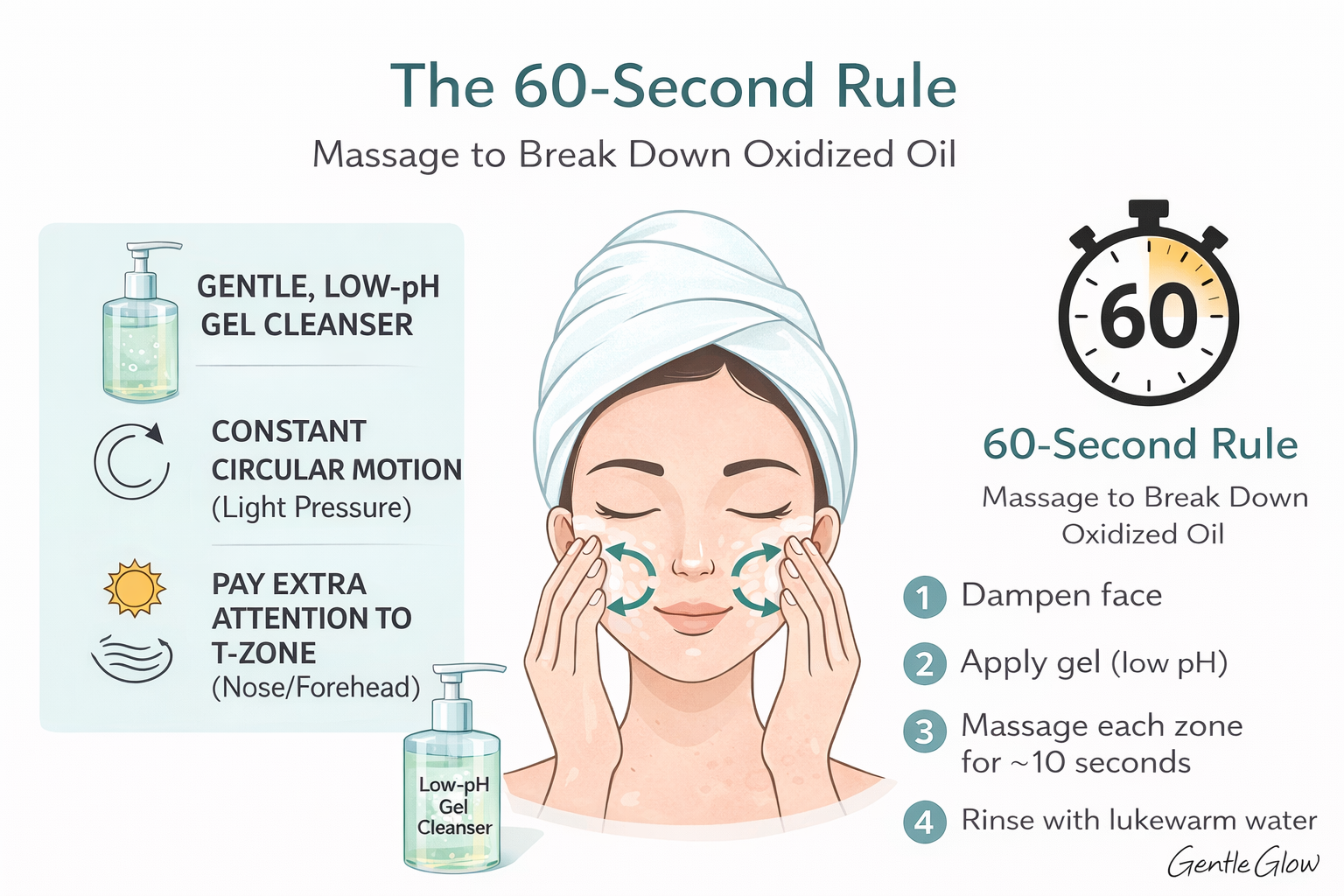
Hot water, harsh surfactants, or alkaline cleansers can shift your skin into compensation mode by mid-morning.
Step 2: Regulate Oil (Without Drying It Out)
If cleansing resets the surface, this step helps control what happens next.
And this is where many oily routines go wrong.
Instead of trying to dry the skin, we want to gently guide oil production so it stays steady throughout the day.
Niacinamide: Quietly Effective
Niacinamide is one of the few ingredients that can help regulate oil without irritating the barrier. Clinical studies show 2–4% concentrations can reduce measurable sebum production over time.
But here’s the important part:
It doesn’t shut oil down.
It helps normalize it.
That’s why it works so well in the morning — it supports stability before your natural oil cycle speeds up.
If you want the full science behind how it affects sebocytes and ceramide production, we break that down in detail in our niacinamide guide.
Vitamin C: More Than a Brightening Ingredient
Many people associate vitamin C with glow. But for oily skin, its role is more strategic.
Sebum contains squalene — a lipid prone to oxidation when exposed to UV and pollution. Oxidized sebum thickens and contributes to congestion.
Vitamin C functions as a stabilizer.
By reducing oxidative stress on surface lipids, it helps prevent that midday darkening effect.
As we explored in our deep-dive on oxidation, preventing lipid peroxidation is just as important as preventing sun damage.
If your skin tolerates it, a well-formulated vitamin C serum can be layered after niacinamide — or used in alternating mornings.
Step 3: Lightweight Moisturizer (Yes, Even If You’re Oily)
The most common myth in oily skincare is that you can skip moisturizer because your face “provides its own.” In reality, skipping this step is often what triggers your midday shine.
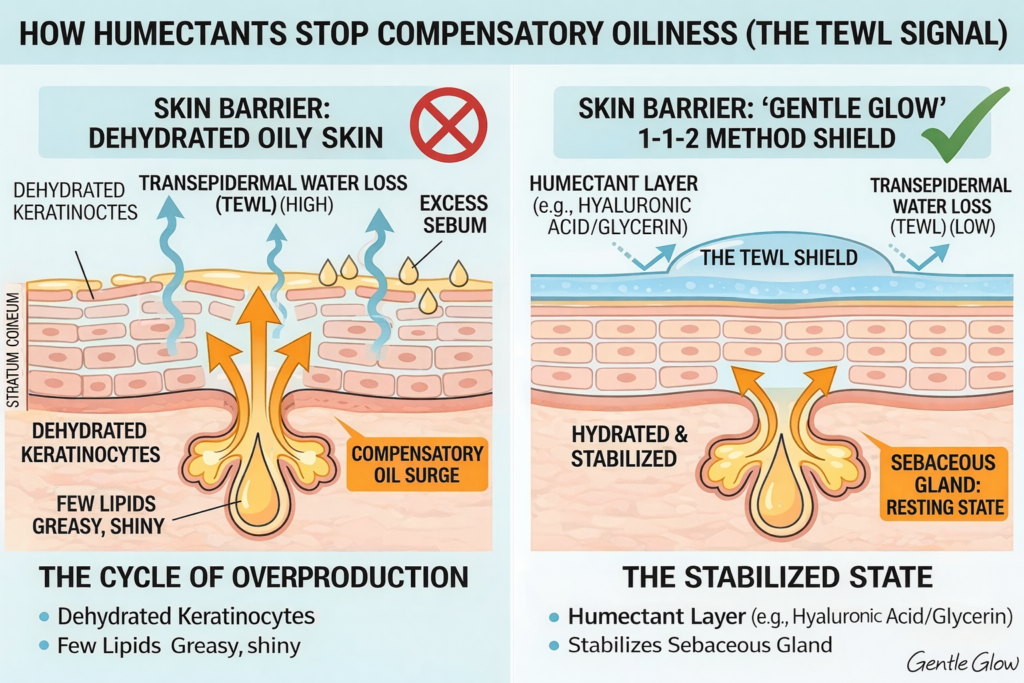
When your skin’s surface lacks water (hydration), your sebaceous glands receive a distress signal. To prevent further water loss, they pump out an excess of oil to “seal” the skin. This leads to the classic Dehydrated Oily Skin profile: a face that feels tight and uncomfortable but looks incredibly shiny.
What to look for in a 2026 Morning Moisturizer:
- Humectant-Dominant: Look for Hyaluronic Acid, Glycerin, or Urea. These draw water into the skin without adding heavy lipids.
- Oil-Free & Non-Comedogenic: Ensure the formula won’t clog pores as your Sebum Excretion Rate (SER) peaks.
- Water-Cream or Gel Textures: These absorb instantly, providing the “1-1-2 Method” hydration without the weight.
Step 4: Non-Comedogenic Sunscreen (The Shine-Proof Layer)
Sunscreen is the non-negotiable final step of the morning. For acne-prone skin, the word “Non-Comedogenic” is your best friend.
Non-comedogenic sunscreen refers to formulations specifically tested to ensure they do not clog pores or trigger acne (comedones). For oily skin in 2026, the best options are oil-free, “serum-feel” chemical filters or micronized zinc oxide formulas that provide a matte finish without the heavy “white cast” or greasy residue of traditional sunblocks. To avoid the ‘greasy mask’ feeling, stick to lightweight, non-comedogenic sun protection.
The “Sunscreen Engineering” Rules for Oily Skin:
- Gel vs. Cream: Always opt for gel-based or “fluid” sunscreens. These use volatile silicones or water-bases that evaporate, leaving the protective filters behind without the oil.
- Layering Order: Always apply your SPF after your moisturizer has fully dried (about 60 seconds). This ensures the “protective shield” forms a continuous film over your skin.
- Sweat Interaction: If you are active in the morning, look for “Sebum-Resistant” SPF. These are engineered to stay bonded to the skin even when oil production increases.
Why Oily Skin Gets Shinier by Midday
It’s a universal frustration: you leave the house with a matte finish, but by 11:00 AM, your skin feels heavy and reflective. This isn’t bad luck; it’s a physiological response known as the Sebum Excretion Rate (SER) peak. According to 2026 clinical research, our sebaceous glands follow a circadian rhythm, reaching their highest output in the late morning — a key part of how acne forms in oily skin throughout the day.
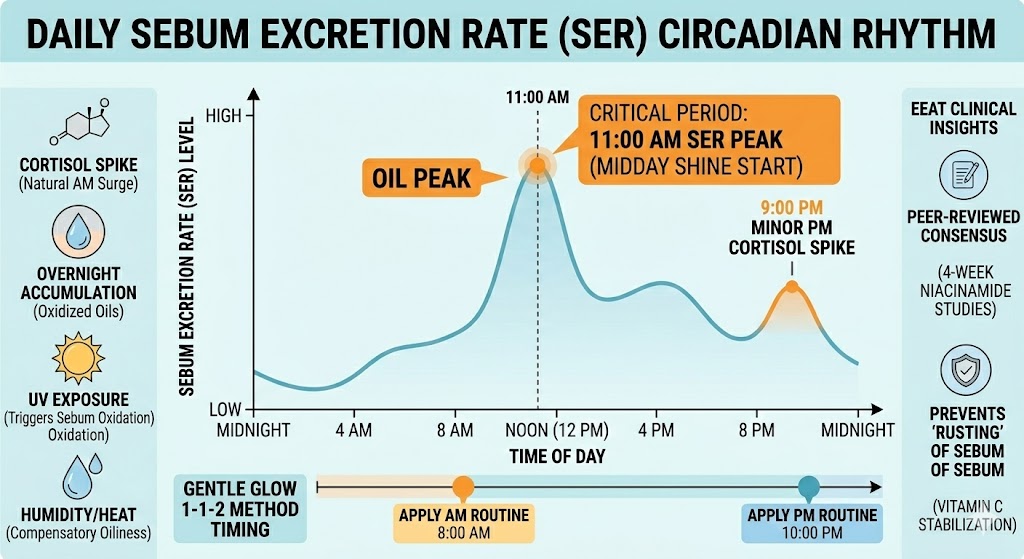
- The Cortisol Spike: Natural morning cortisol surges trigger oil production.
- Overnight Accumulation: New oil sitting on top of unwashed overnight debris (dead skin cells and sweat) creates a thick, shiny film.
- AC/Heat Rebound: Office air conditioning or humid heat causes water to evaporate from the skin, triggering “compensatory oiliness” to seal the barrier.
This is why understanding Dehydrated Oily Skin is so important. If your face feels tight but looks shiny, your routine is likely lacking the “protective shield” needed to keep oil stable. When that oil is exposed to the morning sun and pollution, it undergoes Sebum Oxidation, which is the primary cause of blackheads and dullness by noon.
If you wake up feeling greasy — even after cleansing the night before — you’re not alone. There are a few biological reasons this happens.
Overnight Oil Accumulation
While you sleep, your skin:
- Repairs itself
- Sheds dead cells
- Continues producing sebum
Even after a proper night routine, a thin layer of oil accumulates by morning. That’s normal and protective.
The goal isn’t to erase it aggressively — but to reset gently so production doesn’t spike later.
Heat, Humidity, and Air Conditioning
Climate has a direct effect on oil behavior.
- Heat increases sebaceous gland activity.
- Humidity changes how oil spreads across the surface.
- Air conditioning dehydrates the barrier, increasing rebound oil production.
If you move between outdoor heat and indoor AC throughout the day, your skin is constantly adapting. That fluctuation alone can amplify midday shine.
A morning routine must stabilize oil before these environmental shifts occur.
Sebum Oxidation During the Day
Oil doesn’t just sit on your skin. It reacts.
Sebum contains squalene, a lipid that can oxidize when exposed to UV light and pollution. When squalene oxidizes, it thickens and darkens — contributing to clogged pores and a heavier appearance of shine.
This process is called lipid peroxidation. It’s one reason pores may appear darker as the day progresses.
If you struggle with nose congestion specifically, we explain how to get rid of blackheads on the nose permanently in a separate guide.
Morning protection isn’t just about preventing sun damage. It’s about stabilizing sebum before it oxidizes.
What Makes Morning Shine Worse
“You might be making this harder than it needs to be.” Many people inadvertently sabotage their morning results before they even leave the bathroom. Common culprits include:
| Morning Mistake | Why It Worsens Oily Skin | The 2026 Fix |
|---|---|---|
| High-Foam Cleansers | Strips the acid mantle, triggering reactive oil production and increasing Sebum Excretion Rate (SER) by mid-morning. | Use a pH-balanced gel cleanser (4.5–5.5) that respects the skin barrier. |
| Alcohol-Heavy Toners | Evaporates water from the barrier, leading to dehydration and compensatory oil production. | Swap for a hydrating essence or skip toner entirely if unnecessary. |
| Skipping Moisturizer | Signals sebaceous glands to produce more oil to “seal” the skin against water loss. | Use a hyaluronic acid or lightweight water-cream hydrator. |
| Powdering at 8:00 AM | Mixes with fresh sebum and oxidized lipids, creating a pore-clogging paste. | Use blotting papers around 11:00 AM instead of early mattifying. |
How to Prevent Shine from 9:00 AM to 3:00 PM
Even with the perfect morning routine, the biological reality of the Sebum Excretion Rate means some shine may appear by noon. The goal isn’t to be “dead matte,” but to manage the glow so it doesn’t become “grease.”
- Blot, Don’t Powder: If you see shine at 11:00 AM, use a linen blotting paper first. Do not apply more powder over oil; this creates a “paste” that clogs pores. Blotting removes the excess oxidized oil without disturbing your SPF layer.
- The “Mist & Press” Technique: If your skin feels tight and oily simultaneously, use a hydrating mist followed by a light press with clean hands. This redistributes the surface moisture and calms the sebaceous glands.
- SPF Reapplication: For 2026, we recommend SPF Powders or Sprays for midday touch-ups. These allow you to maintain your “Antioxidant Shield” without having to wash your face and restart your routine in the middle of the office.
The Clinical Logic Behind This Routine
This morning routine isn’t built on trends. It’s built on skin physiology.
Sebaceous glands are hormonally responsive. They follow circadian patterns. They react to barrier disruption. They respond to inflammation and oxidation.
A few key points supported by research:
1. Niacinamide (Vitamin B3) and the Sebum Excretion Rate (SER)
It is a common misconception that Niacinamide merely “absorbs” oil. Clinical data published in the Journal of Cosmetic and Laser Therapy confirms that topical applications of 2% to 4% Niacinamide significantly reduce the Sebum Excretion Rate (SER) over a 4-week period. Rather than temporarily drying out the surface, Niacinamide works at a cellular level to downregulate the activity of the sebaceous glands, providing a long-term solution to midday shine.
2. Antioxidant Stabilization: Preventing the “Blackhead Cycle”
Research into Sebum Oxidation confirms that when your skin’s natural lipids (specifically squalene) are exposed to daytime UV rays and ozone, they oxidize into highly comedogenic by-products. According to studies in the Journal of Investigative Dermatology, this “oxidized oil” is what hardens into blackheads and triggers inflammation. Applying a stable antioxidant like Vitamin C in the morning creates a chemical “shield” that prevents this hardening process, keeping your natural oils liquid and clear.
3. The Humectant Signal: Preventing “Rebound Oiliness”
Providing external hydration through humectants like Hyaluronic Acid is critical for preventing Transepidermal Water Loss (TEWL). As noted in clinical reviews on MDPI Cosmetics, when the skin’s moisture barrier is compromised, it triggers a compensatory oil surge to “seal” the gaps. By maintaining optimal water levels in the stratum corneum, we keep the oil glands in a “resting state,” effectively stopping the cycle of “dehydrated yet oily” skin.
How This Morning Routine Connects to Your Night Routine
It is important to remember that your morning and night routines have two different biological goals.
- Morning = Defense: Protecting against UV, pollution, and oxidation.
- Night = Repair: Stimulating cell turnover and clearing deep-seated debris.
While your morning focuses on Niacinamide and SPF, your night routine is where you should utilize heavier treatments like Retinoids or Exfoliating Acids (BHA). To avoid irritation, we never recommend mixing high-strength Salicylic Acid and Vitamin C in the same morning session. Keep your “active” treatments for the evening to allow your skin to recover while you sleep.
Final Takeaway
Your morning routine sets the tone for how your oil behaves all day. When you cleanse gently, regulate instead of strip, support your barrier with lightweight hydration, and protect your skin from oxidation, you’re working with your Sebum Excretion Rate — not against it. That’s what helps reduce the midday spike.
But stability doesn’t come from one routine alone. It’s strongest when your morning routine is paired with a suitable Night Routine for Oily Skin. Morning protects and stabilizes; night clears buildup and supports renewal. Together, they create the consistency oily, acne-prone skin needs to stay balanced instead of reactive.
Frequently Asked Questions
Which serum is best for acne and oily face?
The best morning serum for an oily, acne-prone face is a 10% Niacinamide formula paired with Zinc PCA. This combination actively regulates the Sebum Excretion Rate, minimizes the appearance of enlarged pores, and provides an anti-inflammatory effect to calm active acne breakouts without adding heavy hydration.
Is Vitamin C ok for oily skin?
Yes, Vitamin C is excellent for oily skin, provided you choose a non-comedogenic, stable derivative like Sodium Ascorbyl Phosphate. Vitamin C stabilizes the skin’s natural squalene, preventing it from oxidizing in the sun, which stops the oil from hardening into blackheads or darkening throughout the day.
Can I skip moisturizer if I have oily skin?
No, skipping moisturizer on oily skin leads to surface dehydration, which signals your pores to produce even more oil to compensate. To prevent this rebound shine, use a water-based gel or hyaluronic acid hydrator to keep the skin barrier balanced without adding heavy, pore-clogging waxes.
Is retinol or niacinamide better for oily skin?
Both are essential for oily skin, but Niacinamide is better suited for morning oil control, while Retinol is strictly for nighttime cell turnover. Niacinamide stabilizes the skin barrier and reduces midday shine, whereas Retinol clears deep-seated debris and prevents future comedones while you sleep.
What does non-comedogenic sunscreen mean?
A non-comedogenic sunscreen is a formula specifically tested to ensure it does not contain ingredients known to clog pores or trigger acne. For oily skin, these are typically oil-free, fluid-based sunscreens that use lightweight chemical filters or micronized zinc oxide to provide a breathable, matte finish.

About the Author
Founder, Gentle Glow | Evidence-Based Skincare & Skin Biology
Hi, I’m the Founder of Gentle Glow. After years of struggling with oily and acne-prone skin—and cycling through harsh products that disrupted my barrier rather than improving it—I began researching the science behind sebum regulation, skin biology, and non-comedogenic formulation.
Gentle Glow was created to simplify evidence-based skincare. Every routine shared here focuses on root causes: barrier function, oil balance, and ingredient compatibility. My goal is to translate dermatology-backed principles into realistic, sustainable routines that work with your skin—not against it.
Beyond topical care, I believe healthy skin reflects overall balance, including nutrition, climate awareness, and lifestyle habits. Gentle Glow is built to help you make informed decisions with clarity, consistency, and confidence.
Medical Disclaimer
Gentle Glow guides are developed using peer-reviewed dermatology research and established clinical guidelines. The information provided is for educational purposes only and does not replace professional medical advice, diagnosis, or treatment. Always consult a board-certified dermatologist or qualified healthcare provider before starting new active skincare treatments.