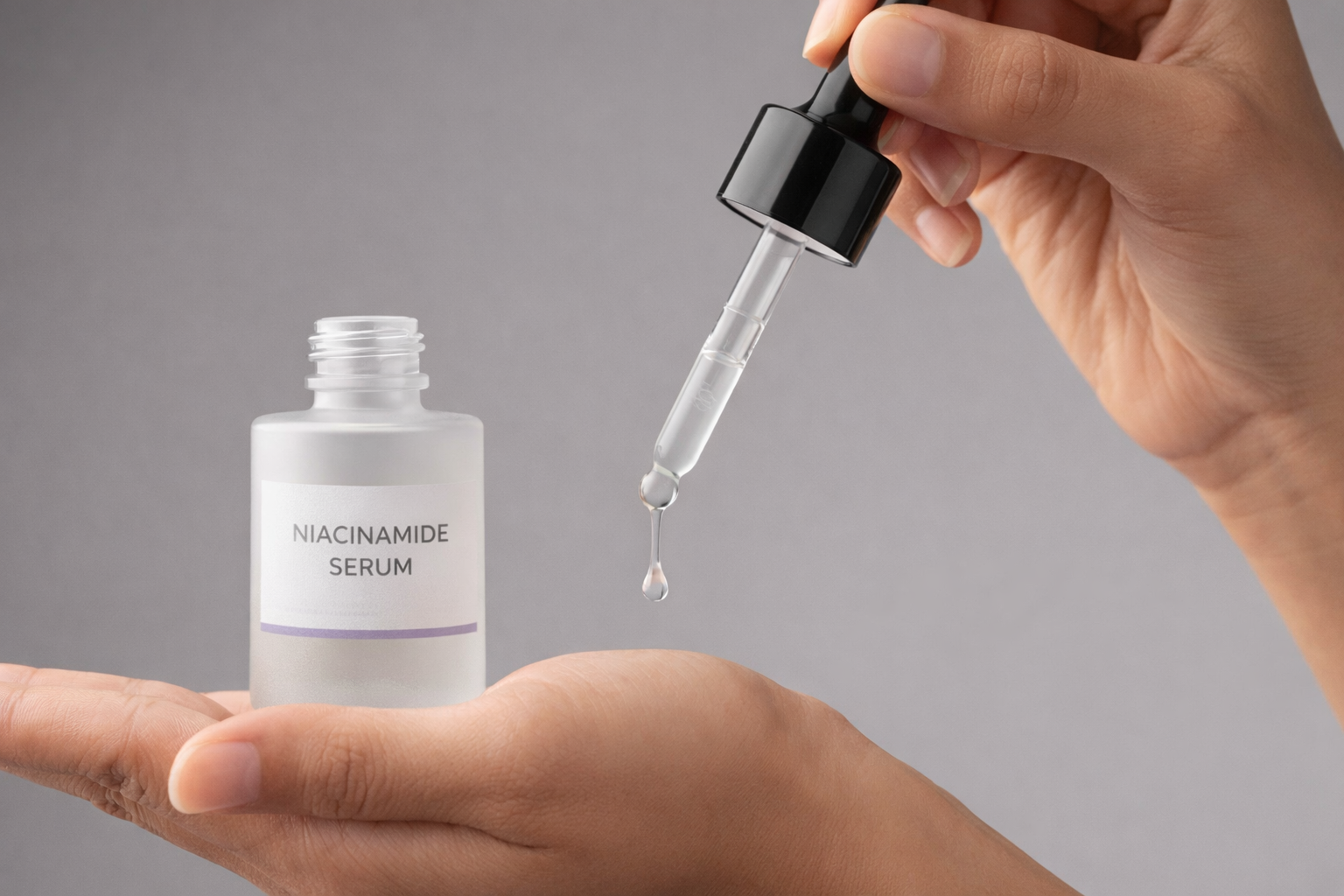

Is Niacinamide good for oily skin? Yes. Niacinamide for oily skin is a clinically proven approach that reduces excess sebum production, supports barrier repair, and calms inflammation. Unlike harsh astringents, Niacinamide (Vitamin B3) regulates oil at the source without stripping the skin, providing a long-term solution for shine control and pore refinement.
Here’s what makes it different:
- Regulates sebocyte (oil gland) activity
- Reduces visible shine without stripping
- Supports ceramide production in the skin barrier
- Helps calm acne-related inflammation
For oily and acne-prone skin, that balance matters more than aggressive oil removal.
This guide is part of our broader Complete Guide to Oily and Acne-Prone Skin, where we break down sebum production, pore biology, and acne formation in depth.
Table of Contents
Is Niacinamide Good for Oily Skin?
Yes — niacinamide is clinically supported for oily skin because it helps regulate excess sebum production without stripping the barrier. Unlike alcohol-based toners that temporarily dry the surface, niacinamide works at the level of the sebaceous gland to gradually reduce measurable oil output.
Studies evaluating 2–5% topical niacinamide show reductions in sebum excretion rate over several weeks. This makes it especially suitable for people who experience midday shine, enlarged pores, or recurring congestion.
For oily and acne-prone skin, consistency — not high concentration — is what delivers results.
Does Niacinamide Help Reduce Oil Production?
Yes, but through regulation — not suppression.
Niacinamide influences lipid synthesis pathways inside sebocytes (the cells that produce sebum). Instead of absorbing oil after it appears, it signals the gland to normalize triglyceride and fatty acid production over time.
This distinction is important. Regulation maintains skin balance, while aggressive suppression can trigger rebound oil production through barrier disruption.
How Long Does Niacinamide Take to Control Shine?
Niacinamide is not an instant mattifying ingredient. Most people begin noticing reduced surface shine within 2–4 weeks of consistent use.
Clinical studies measuring sebum output typically evaluate results over a 4-week period. Improvements in pore appearance and texture may continue to develop over 6–8 weeks as barrier lipids strengthen and inflammatory signaling decreases.
Patience supports stability. Stability supports clarity.
What Is Vitamin B3? Understanding Niacinamide for Open Pores
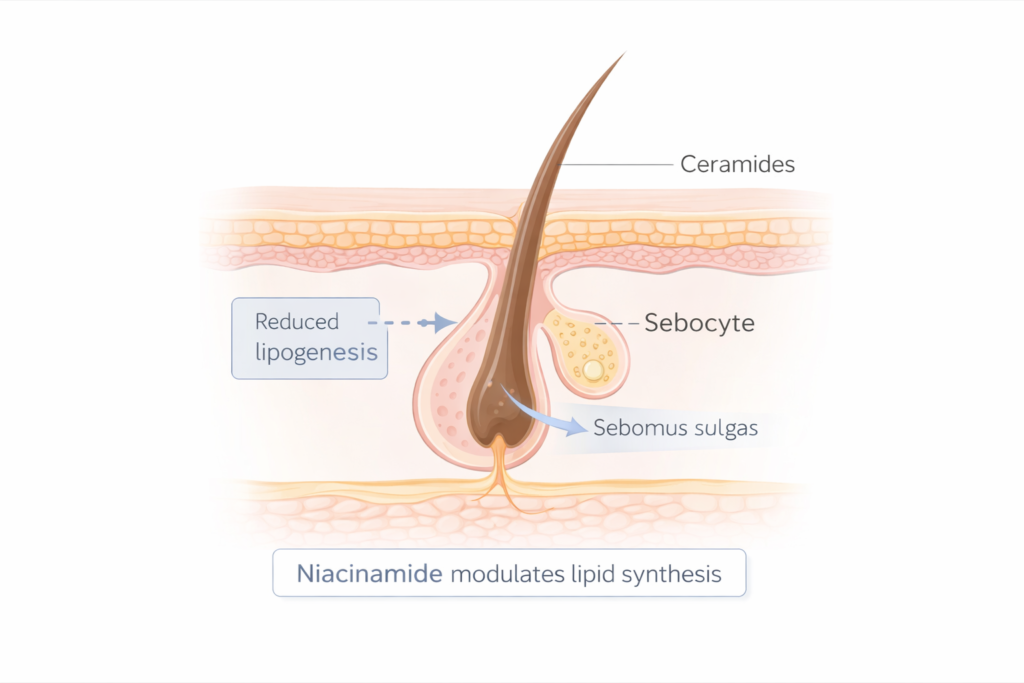
Niacinamide, also known as nicotinamide, is a water-soluble amide of nicotinic acid (Vitamin B3). In the world of dermatology, it is considered a “cell-communicating” ingredient as it supports energy metabolism and barrier repair.
At a molecular level, Niacinamide is a precursor to two essential co-enzymes: Nicotinamide Adenine Dinucleotide (NAD+) and its phosphate form (NADP+). These co-enzymes are the primary engines for cellular repair. For those with oily skin, Niacinamide is unique because it doesn’t just sit on the surface; it signals your cells to behave more efficiently, leading to a visible reduction in oiliness and a more resilient texture.
It’s important to distinguish:
- Niacin (nicotinic acid) → can cause flushing
- Niacinamide (nicotinamide) → non-flushing, barrier-supportive
Topically, niacinamide influences multiple pathways relevant to oily skin:
1️⃣ Sebocyte Regulation: How Niacinamide Controls Oil at the Source
To understand why your skin is oily, we must look at the Sebocyte— the cells inside sebaceous glands responsible for producing sebum.
Most “oil-control” products work via absorption (clays) or surface stripping (alcohols). Niacinamide is different because it engages in lipogenesis regulation. Clinical research suggests that Niacinamide helps downregulate the synthesis of triglycerides and fatty acids within the sebocytes. By “talking” to the gland and signaling it to slow down production, Niacinamide reduces the Sebum Excretion Rate (SER) over time, rather than just masking the shine for an hour.
This modulation occurs through intracellular signaling pathways involved in lipid synthesis, rather than by physically drying or absorbing oil at the surface.
This is regulation — not suppression.
2️⃣ Barrier Lipid Synthesis
Niacinamide increases ceramide production in the stratum corneum. Ceramides are essential structural lipids that reduce transepidermal water loss (TEWL).
This mechanism makes niacinamide especially beneficial for dehydrated oily skin, where impaired barrier lipids and increased water loss trigger reactive oil production.
When the barrier is stronger:
- Skin retains moisture better
- Inflammatory signaling decreases
- Compensatory oil overproduction may reduce
3️⃣ Anti-Inflammatory Support
Niacinamide helps reduce inflammatory mediators involved in acne formation, making it beneficial for oily and reactive skin types.
This multi-pathway action explains why it performs differently from traditional oil-control agents.
Why Oily Skin Feels Greasy by Noon
Oily skin is not simply “too much oil.”
Many people with oily skin experience a “clear” face at 8:00 AM, only to find an “oil slick” by 12:00 PM. This happens because sebum production is not a static event; it’s a dynamic interaction between:
- Overactive sebaceous glands
- Hormonal signaling
- Barrier stress
- Environmental exposure
Sebum is composed of:
- Triglycerides
- Wax esters
- Squalene
- Free fatty acids
During the day, sebum travels through the follicular canal and reaches the pore opening. When production exceeds natural dispersion, oil accumulates on the surface — creating visible shine.
UV exposure can also worsen oxidative stress. That’s why using a lightweight, non-comedogenic sunscreen is essential for oily skin.
In oily skin types, sebaceous glands often produce sebum at a higher excretion rate. Clinical measurements show that some individuals produce significantly more surface lipids within hours of cleansing.
That’s why skin may feel clean at 8 AM and congested by noon. For many people, adjusting their oily skin morning routine to regulate sebum before the late-morning peak can significantly reduce that midday congestion.
How Excess Sebum Contributes to Blackheads and Pore Stretching
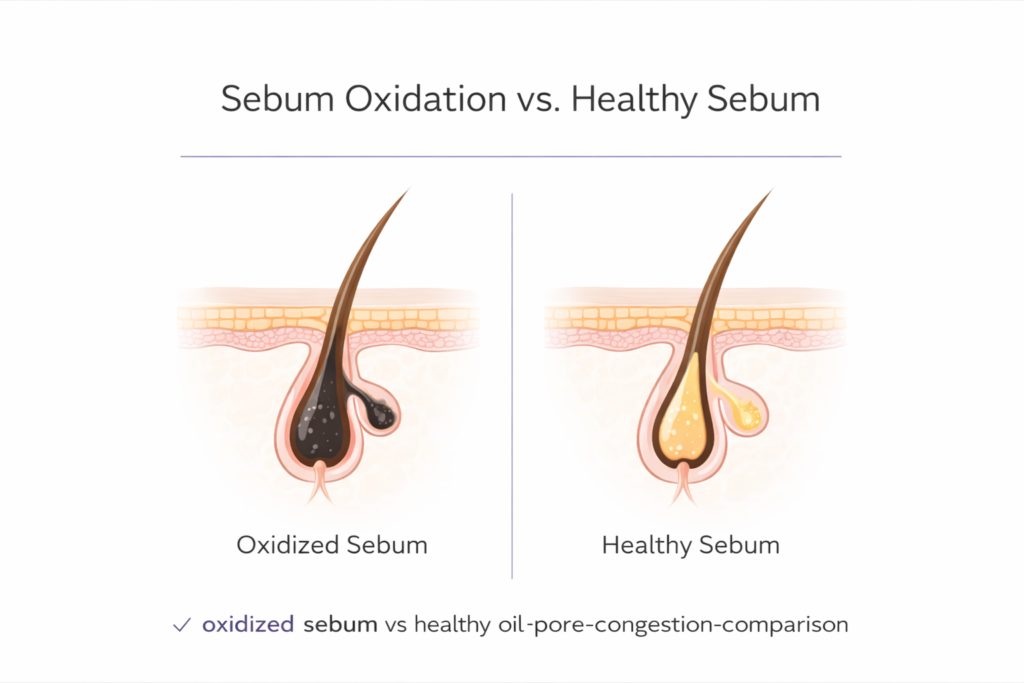
A major reason oily skin becomes acne-prone is not just the amount of oil, but the quality of that oil.
When excess oil mixes with dead skin cells (keratinocytes), it forms microcomedones inside the follicle — one of the earliest biological steps that lead to acne in oily skin.
Over time:
1️⃣ Oil accumulation stretches the follicular opening
2️⃣ Surface lipids become exposed to air
3️⃣ Oxidative stress can darken the material at the pore opening
This process contributes to visible blackheads and enlarged pore appearance.
While niacinamide is not a primary antioxidant like vitamin C, lowering excess sebum production may reduce the volume of surface lipids vulnerable to oxidation. This indirectly supports clearer pores over time. Learn more about how sebum oxidation contributes to blackheads in our in-depth science guide.
If you’re unsure whether you’re dealing with true blackheads or sebaceous filaments, read our detailed comparison of Blackheads vs. Sebaceous Filaments.
That distinction matters.
We are addressing root oil imbalance — not just surface discoloration.
The Sebum Feedback Loop (Barrier and Oil Connection)
One of the most overlooked aspects of oily skin is the barrier–oil feedback cycle:
- Harsh cleansing disrupts the stratum corneum
- TEWL increases
- Inflammatory signaling rises
- Sebaceous glands compensate
- Oil production increases further
This cycle explains why overly aggressive oil-control routines often worsen shine.
Niacinamide interrupts this loop by:
- Supporting barrier lipid synthesis
- Reducing inflammatory markers
- Encouraging balanced sebocyte activity
Regulation creates stability.
Stability creates clarity.
Clinical Snapshot: How Niacinamide Addresses Key Oily Skin Concerns
| Skin Concern | Root Cause | Niacinamide’s Clinical Role |
| Midday Shine | Overactive sebaceous glands | Reduces measurable sebum excretion rates |
| Blackheads | Excess oil + surface oxidation | Limits oil buildup and inflammatory signaling |
| Open Pores | Oil stretching follicle walls | Supports elasticity and barrier structure |
| Acne Marks | Melanosome transfer to keratinocytes | Reduces pigment transfer over time |
This is why niacinamide performs differently from drying alcohol-based toners or harsh astringents.
It works with skin biology.
Not against it.
5% vs 10%: Choosing the Right Concentration for Acne-Prone Oily Skin
One of the most common questions about niacinamide for oily skin is:
Should you use 5% or 10%?
In the 2026 skincare market, “percentage wars” have led many to believe that a 10% or 20% Niacinamide serum is the only way to see results. However, for oily and acne-prone skin, the goal is balance, not aggression.
What Research Supports
Clinical studies most commonly evaluate niacinamide at:
- 2% → measurable sebum reduction
- 4% → acne improvement comparable to some topical antibiotics
- 5% → pigmentation and barrier improvement
These concentrations consistently show benefits for oil control, texture, and tone.
Higher percentages (10% and above) are popular in marketing — but not always necessary.
In some cases, higher concentrations (10%+) can trigger “Niacin flushing” or a compromised barrier in sensitive-oily types. This often presents as small red bumps that users mistake for acne, but it is actually a sign of skin intolerance.
Does 10% Work Better?
Not automatically.
Niacinamide does not behave like a traditional exfoliating acid where stronger equals more aggressive results.
At 5%, the pathways involved in:
- Sebocyte regulation
- Ceramide synthesis
- Anti-inflammatory signaling
are already significantly supported.
For many oily and acne-prone skin types, increasing to 10% may increase the risk of:
- Mild redness
- Sensitivity
- Transient irritation
without dramatically improving oil control.
Gentle Glow Principle:
Start where biology works — not where marketing shouts.
For most oily skin:
2–5% is clinically sufficient.
10% may be appropriate for resilient, non-sensitive skin seeking pigment support — but barrier stability always comes first.
The Gentle Glow Philosophy: We recommend the 5% sweet spot. It provides maximum oil-regulating benefits while respecting the skin’s acid mantle.
Quick Myth Correction:
More niacinamide does not mean faster oil control. Concentrations above 10% do not necessarily improve sebum reduction and may increase irritation in sensitive-oily skin types.
Niacinamide vs Vitamin C for Acne Scars (Oily Skin Edition)
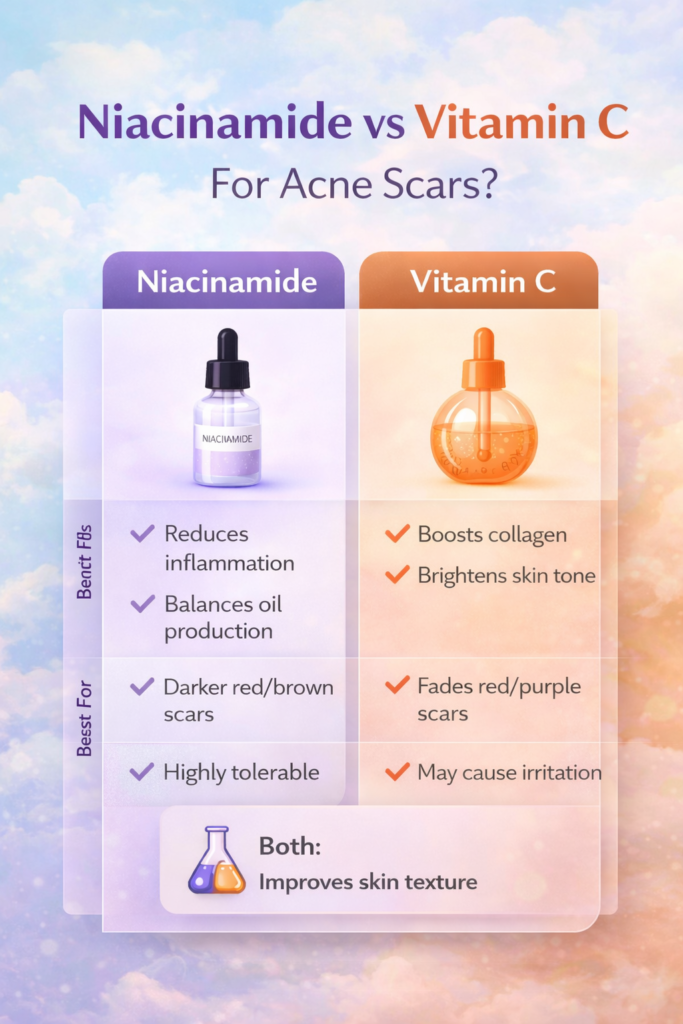
If you are dealing with Post-Inflammatory Hyperpigmentation (PIH)—those dark marks left after a breakout—you might wonder which active to choose.
Both ingredients improve discoloration, but they work differently.
Mechanism Comparison
| Feature | Niacinamide | Vitamin C (L-ascorbic acid) |
| Oil Regulation | Yes | No |
| Barrier Support | Increases ceramides | Neutral |
| Pigment Pathway | Reduces melanosome transfer | Inhibits tyrosinase |
| Irritation Risk | Low | Moderate (low pH) |
| Stability | High | Oxidizes easily |
For Oily Skin Specifically
Vitamin C functions primarily as an antioxidant and pigment inhibitor.
Niacinamide, however:
- Regulates oil
- Reduces inflammation
- Improves barrier resilience
- Supports pigment fading over time
For oily skin prone to congestion, niacinamide is often better tolerated and more multifunctional. It is also generally more stable in humid climates and offers the added benefit of oil control, making it a strong first-line option for oily skin types prone to scarring.
This does not mean vitamin C is ineffective.
It means niacinamide addresses more of the oily skin cascade.
How to Spot a Truly Non-Comedogenic Serum for Acne-Prone Skin
A “non-comedogenic” label isn’t always a guarantee.
To ensure your serum won’t cause occlusive overload (trapping oil under the surface), look at the texture logic:
1️⃣ Check the Texture
Oily skin typically responds better to:
- Lightweight gels
- Water-based serums
- Oil-free emulsions
Heavy occlusives may trap sebum in already active follicles.
2️⃣ Look at the Ingredient Deck
For acne-prone oily skin, avoid formulas overloaded with:
- High concentrations of coconut derivatives
- Thick butters
- Excessively occlusive silicones in early ingredient positions
Niacinamide works best when not buried in a heavy base.
3️⃣ Avoid Ingredient Overload
Stacking multiple strong actives can disrupt the barrier and trigger the oil feedback loop.
If your routine already includes:
- Retinoids
- Benzoyl peroxide
- Strong exfoliating acids
Introduce niacinamide thoughtfully.
Balanced layering wins over maximal layering.
The Ultimate Night Skin Care Routine for Oily Skin
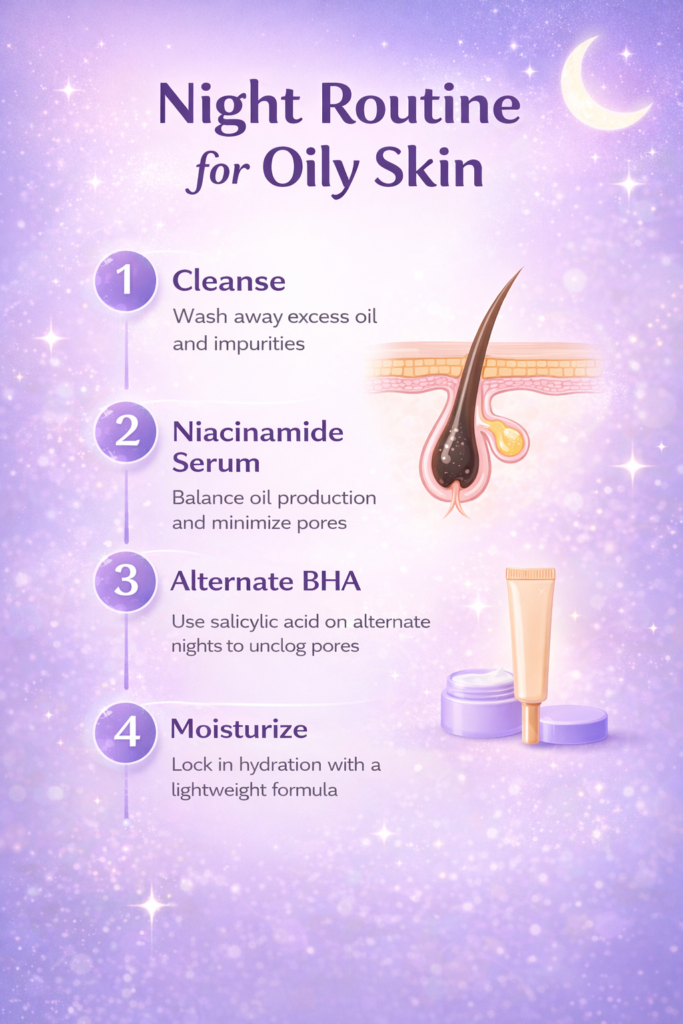
Nighttime is when barrier repair and inflammation regulation naturally increase.
Your night skin care routine for oily skin is the most critical window for transformation. While you sleep, your skin’s permeability increases, and it enters “repair mode.” Using Niacinamide at night allows the Vitamin B3 to stabilize lipid production without interference from UV rays or pollution.
For oily and acne-prone skin, a structured night skin care routine for oily skin might look like:
Step 1 — Gentle Cleanse
Remove sunscreen, pollution, and oxidized surface lipids without stripping.
Step 2 — Targeted Treatment
Apply niacinamide serum (2–5%) to regulate sebum and calm inflammation.
Step 3 — Strategic Exfoliation (Alternate Nights)
If blackheads or persistent clogged pores are present, alternate niacinamide nights with a beta hydroxy acid (BHA).
For targeted nose congestion, here’s a step-by-step guide on how to get rid of blackheads on nose safely.
BHA penetrates into oil-filled follicles to dissolve debris.
If you’re unsure when to use BHA versus benzoyl peroxide, explore our science-based comparison of Salicylic Acid vs Benzoyl Peroxide for acne and hormonal breakouts.
Step 4 — Lightweight Barrier Support
Finish with a non-comedogenic moisturizer containing ceramides or glycerin.
The goal is not to “dry out” oily skin.
It is to:
- Regulate oil
- Prevent pore congestion
- Support barrier integrity
Over time, consistency improves stability.
Stability improves clarity.
Pairing Niacinamide with BHA for Deep Pore Detox
Niacinamide and BHA complement each other when used correctly.
- BHA clears inside the pore
- Niacinamide regulates oil production
- Together, they reduce recurrence of congestion
If your skin is sensitive, alternate niacinamide nights with a beta hydroxy acid (BHA) exfoliant to target congestion within oil-filled pores.
For resilient skin, layering is possible — but always monitor barrier response.
The Clinical Evidence: What the Research Says
Niacinamide is one of the most studied ingredients in modern dermatology. To ensure your routine is grounded in fact, we look at the core data:
- Sebum Control: A landmark study published in the Journal of Cosmetic and Laser Therapy demonstrated that a 2% niacinamide application over 4 weeks significantly reduced the sebum excretion rate.
- Barrier Research: Research shows that Niacinamide increases the synthesis of free fatty acids, cholesterol, and ceramides, leading to a stronger skin barrier and reduced sensitivity to environmental stressors.
- Acne & Barrier Synergy: Clinical trials have shown that niacinamide-containing formulations can improve acne lesion outcomes while simultaneously supporting barrier repair, particularly when combined with ceramides and non-comedogenic moisturizers.
The Holistic Angle: Managing Sebum from the Inside
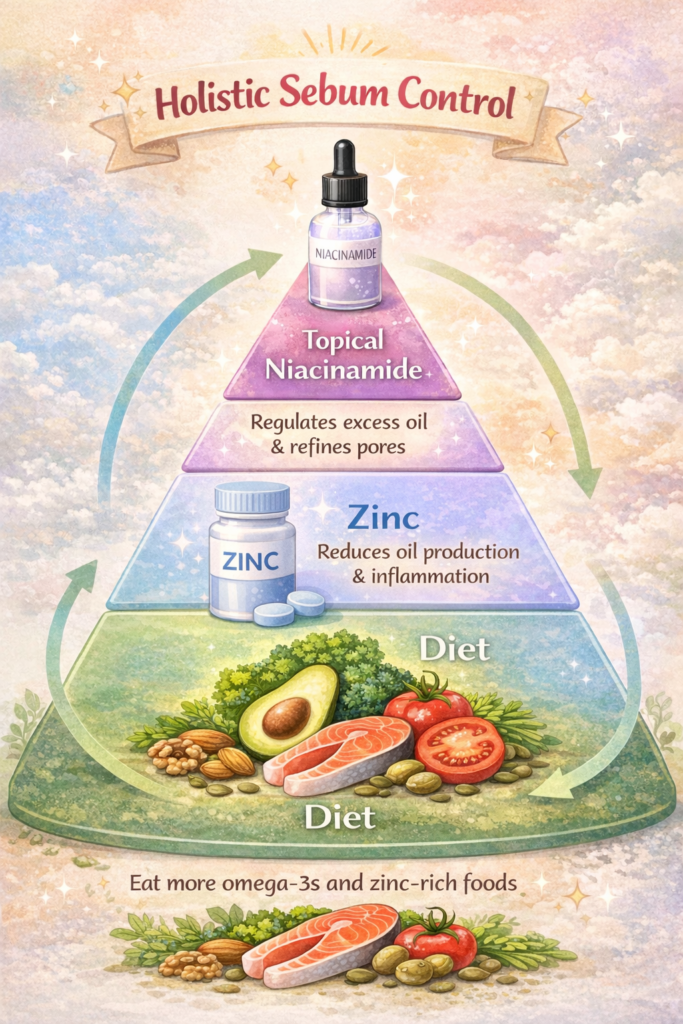
At Gentle Glow, we believe that skincare is only half the battle. To truly master oily skin, we must address the “internal triggers” that signal your glands to produce excess oil.
1. Zinc and Sebum Regulation
Zinc is often called the “internal partner” to Niacinamide. While Niacinamide works topically, Zinc (especially Zinc PCA) helps inhibit the enzymes responsible for oil production. Many high-quality non-comedogenic serums pair these two together for a dual-action approach to shine.
2. Diet and Glycemic Load
High-glycemic foods (sugary snacks, white bread, processed carbs) cause a spike in insulin. This insulin spike triggers androgen hormones, which are the direct “on-switch” for your sebaceous glands.
- The Gentle Glow Tip: Focus on anti-inflammatory, low-glycemic foods to keep your hormone levels stable and your sebum production in check.
3. Stress and Cortisol
When you are stressed, your body produces cortisol, which tells your skin to produce more oil. This is why many people experience “stress breakouts” or increased greasiness during high-pressure weeks. Mindful lifestyle practices aren’t just for mental health—they are a core part of your skincare routine.
Timeline: What Results to Expect
Niacinamide is not an instant mattifying filter.
It works gradually.
Here’s what is realistic:
- 2–4 weeks: Reduced shine, smoother surface
- 4–6 weeks: Fewer inflammatory breakouts
- 6–8 weeks: Improved pore appearance
- 8–12 weeks: Noticeable improvement in post-acne marks
Consistency matters more than concentration.
Final Takeaway:
Niacinamide is not a “magic eraser” for oily skin, but it is a biological mediator. It works with your skin’s natural chemistry to find a state of balance. Clinical evidence consistently supports niacinamide in the 2–5% range for long-term oil regulation and barrier support. By choosing the right concentration, pairing it strategically with actives like BHA, and supporting it with a mindful lifestyle, you can achieve a lasting, healthy glow that isn’t masked by excess shine.
Frequently Asked Questions (FAQ)
Can I use Niacinamide every day?
Yes. Niacinamide is stable and gentle enough to be used twice daily (AM and PM).
Why does Niacinamide make my skin feel sticky?
This is usually due to the formulation’s “base” or using too much product. Try applying it to damp skin or switching to a more lightweight, water-based serum.
Is Niacinamide better than Salicylic Acid for acne?
They serve different purposes. Niacinamide regulates oil flow and inflammation, while Salicylic Acid (BHA) physically clears the “plugs” inside the pore. For best results, use both.
Does niacinamide reduce oil production in skin?
Yes. Clinical research shows that 2–5% topical niacinamide can reduce measurable sebum excretion over several weeks.
What percentage of niacinamide is best for oily skin?
For most oily skin types, 2–5% is sufficient. Higher concentrations are not always more effective and may increase irritation risk.
Is niacinamide safe for acne-prone oily skin?
Yes. It is generally well tolerated and has demonstrated anti-inflammatory benefits in acne-prone individuals.

About the Author
Founder, Gentle Glow | Evidence-Based Skincare & Skin Biology
Hi, I’m the Founder of Gentle Glow. After years of struggling with oily and acne-prone skin—and cycling through harsh products that disrupted my barrier rather than improving it—I began researching the science behind sebum regulation, skin biology, and non-comedogenic formulation.
Gentle Glow was created to simplify evidence-based skincare. Every routine shared here focuses on root causes: barrier function, oil balance, and ingredient compatibility. My goal is to translate dermatology-backed principles into realistic, sustainable routines that work with your skin—not against it.
Beyond topical care, I believe healthy skin reflects overall balance, including nutrition, climate awareness, and lifestyle habits. Gentle Glow is built to help you make informed decisions with clarity, consistency, and confidence.
Medical Disclaimer
Gentle Glow guides are developed using peer-reviewed dermatology research and established clinical guidelines. The information provided is for educational purposes only and does not replace professional medical advice, diagnosis, or treatment. Always consult a board-certified dermatologist or qualified healthcare provider before starting new active skincare treatments.