
What is the Difference Between Salicylic Acid and Benzoyl Peroxide?
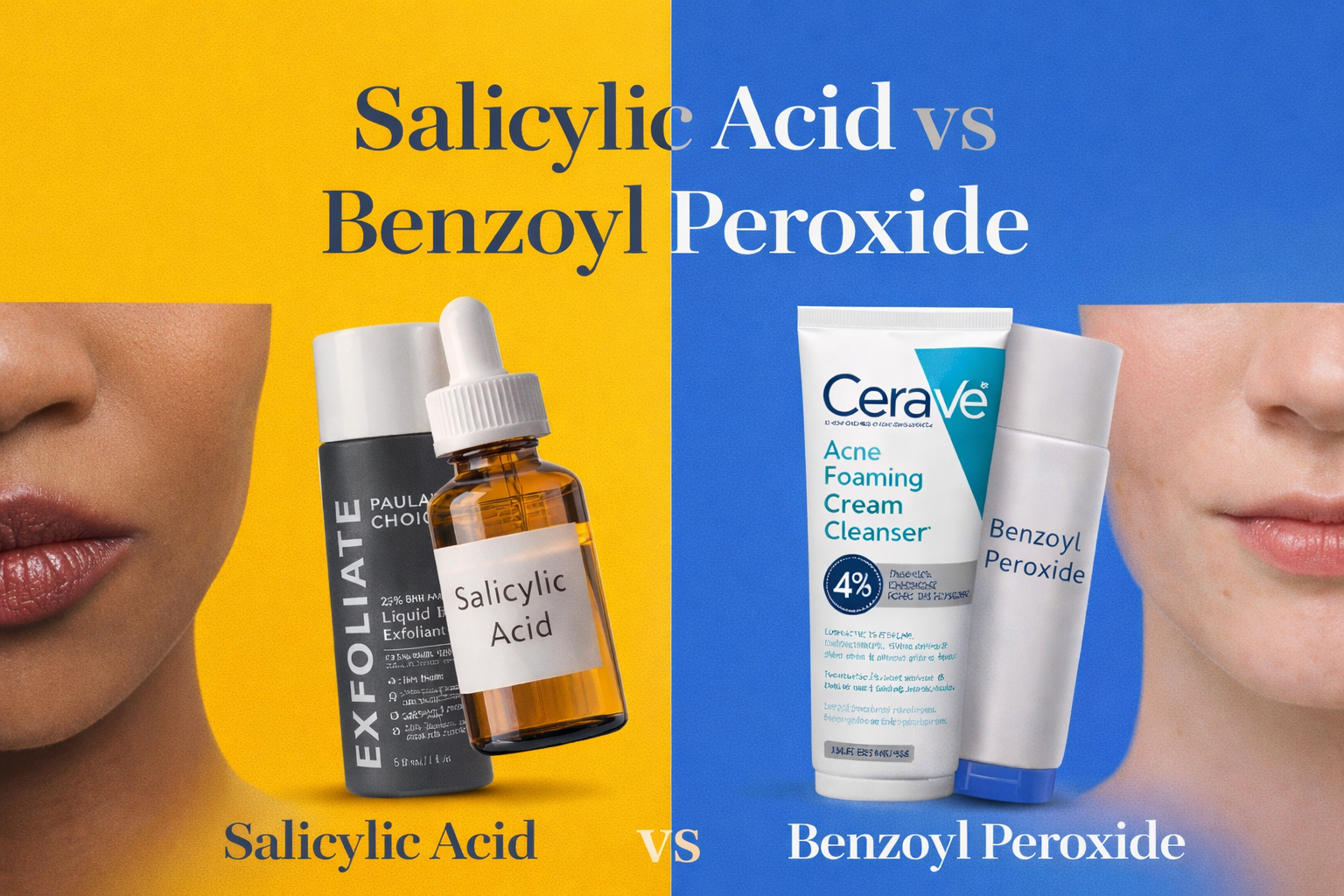
Choosing between salicylic acid vs benzoyl peroxide for hormonal acne depends on whether you are fighting clogged pores or active inflammation. Salicylic Acid is a lipophilic BHA for oily skin that focuses on comedolytic properties meaning the dissolution of pore-clogging debris. Benzoyl Peroxide is an antimicrobial that targets pathogenic bacteria (C. acnes). For clear skin, you must balance these actives to maintain skin barrier integrity while managing post-inflammatory erythema (PIE) treatment.
Table of Contents
The Biological Mechanisms (Foundations of Acne Control)
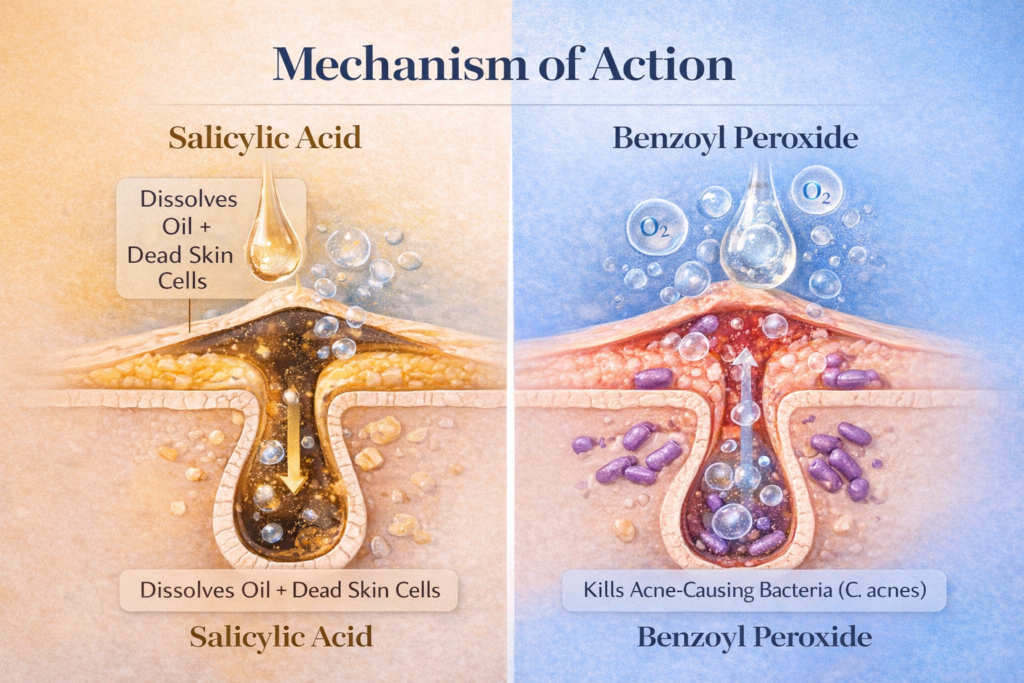
To understand which active ingredient your skin needs, we must first look at the “birth” of a pimple. Acne is not a singular event; it is a four-stage process involving oil production, pore clogging, bacterial overgrowth, and inflammation. In modern dermatology, the goal is “precision skincare”—matching the molecule to the specific stage of the breakout.
If you want a deeper understanding of how oil production, pore behavior, and inflammation interact, see our complete science-backed guide to oily and acne-prone skin.
When choosing between salicylic acid or benzoyl peroxide for hormonal acne, the real difference isn’t strength—it’s biology. We have to look at the two dominant pathways that acne forms through:
- comedonal congestion driven by thickened oil and sticky dead skin cells, and
- inflammatory lesions driven by overgrowth of pathogenic bacteria (C. acnes) deep within the pore.
Understanding which pathway dominates your breakouts determines which active will work—and which one may quietly damage skin barrier integrity without solving the problem.
Comedolytic Properties Meaning: How BHA Clears Pores
You may have heard the term “comedolytic,” but what does it actually mean for your skin?
To understand why BHA for oily skin works so well for congestion, we need to clarify comedolytic properties meaning. Comedolytic refers to an ingredient’s ability to break down and prevent comedones (clogged pores).
Salicylic acid is a lipophilic beta-hydroxy acid, meaning it dissolves in oil. This allows it to move through sebum viscosity inside the pore rather than sitting on the skin’s surface. This process is closely related to why skin oil turns black when exposed to air, a phenomenon explained in our deep dive on the science of sebum oxidation.
At a biological level, salicylic acid has a desmolytic action: it “unglues” the bonds holding dead skin cells together within the stratum corneum and the pore lining. By loosening these bonds, a BHA exfoliant for oily skin prevents the initial clog from forming in the first place.
Clinical literature published in the Journal of Clinical & Aesthetic Dermatology notes that salicylic acid’s comedolytic action helps prevent follicular blockage by reducing cohesion between dead skin cells inside the pore.
This is why BHA for pores is most effective for:
- Blackheads and whiteheads
- Texture irregularities
- Persistent congestion without redness
If you’re unsure whether what you’re seeing are true blackheads or normal sebaceous filaments, our guide on how to tell the difference can help you avoid unnecessary over-treatment.
Importantly, BHA works before inflammation begins—making it a preventive active rather than a reactive one.
Killing Pathogenic Bacteria (C. acnes): How Benzoyl Peroxide Works
While Salicylic Acid manages the “traffic jam” of skin cells, Benzoyl Peroxide (BP) is the “enforcer” that handles the infection. Unlike SA, BP is not primarily an exfoliant; it is a potent oxidizing agent.
When you apply Benzoyl Peroxide to the skin, it penetrates the pore and releases active free-radical oxygen. This is the key to its success. The primary bacteria responsible for inflamed acne, known as pathogenic bacteria (C. acnes), are anaerobic. This means they thrive in environments with zero oxygen—like a pore clogged with sebum. This clogged environment is part of the biological process that causes acne in oily skin.
By flooding the pore with oxygen, Benzoyl Peroxide creates a “toxic” environment for pathogenic bacteria (C. acnes), killing them rapidly. This is why it’s particularly effective for:
- Red, swollen pimples
- Painful breakouts
- Hormonal flares that sit deep under the skin
According to the American Academy of Dermatology, benzoyl peroxide reduces acne by decreasing inflammation and targeting acne-causing bacteria within the follicle.
However, this oxygen-driven action also creates oxidative stress, which explains why benzoyl peroxide is more likely to compromise skin barrier integrity if used too frequently or without buffering hydration.
Salicylic Acid or Benzoyl Peroxide for Hormonal Acne?
For those struggling with deep, painful bumps along the jawline, the question of salicylic acid or benzoyl peroxide for hormonal acne is common.
Hormonal acne behaves differently from surface-level congestion. During hormonal fluctuations, androgen activity increases sebum viscosity, making oil thicker and slower-moving. This creates an ideal low-oxygen environment where inflammation can develop before a visible clog forms.
That’s why the question “salicylic acid or benzoyl peroxide for hormonal acne?” doesn’t have a universal answer.
- Salicylic acid helps by keeping pores clear and reducing micro-clogs that precede hormonal flares.
- Benzoyl peroxide helps by targeting inflammation and bacterial activity once a lesion has already formed.
In many hormonal patterns—especially jawline and chin breakouts—a single ingredient is rarely sufficient. Strategy matters more than strength.
Comparison Matrix: BHA vs. Benzoyl Peroxide
| Factor | Salicylic Acid (BHA) | Benzoyl Peroxide |
| Solubility | Lipophilic (oil-soluble) | Water-based, oxygen-releasing |
| Primary Target | Clogged pores, comedones | Pathogenic bacteria (C. acnes) |
| Acne Type | Comedonal, non-inflamed | Inflammatory, hormonal |
| Action Type | Comedolytic, desmolytic | Antimicrobial, oxidative |
| Best Role | Prevention | Active treatment |
| Barrier Impact | Low (when used correctly) | Moderate–high if overused |
Why this matters: Using benzoyl peroxide for congestion can trigger unnecessary irritation, while relying on BHA alone for inflamed hormonal breakouts may delay healing and worsen post-inflammatory erythema (PIE) treatment later.
The Benzoyl Peroxide Purging Process vs. BHA Purging
Transitioning into an active acne routine often feels like a “test of fire” for your skin. This is the phase where most people give up, but understanding the biological timeline of your pathogenic bacteria (C. acnes) purging process is the key to pushing through to the “Gentle Glow” phase.
“Purging” is often misunderstood—and frequently confused with irritation. In reality, purging only occurs when an active ingredient accelerates the life cycle of existing microcomedones already forming beneath the skin.
The benzoyl peroxide purging process differs significantly from BHA purging because each ingredient acts on a different biological target.
- BHA purging occurs when salicylic acid increases cellular turnover inside the pore, allowing pre-existing clogs to surface more quickly.
- Benzoyl peroxide purging is driven by bacterial disruption. As oxygen levels rise within the follicle, inflammatory pathways activate and push existing lesions upward.
Duration: A typical purge lasts 4 to 6 weeks, aligning with your natural skin cell turnover cycle.
The “Tell”: If the bumps appear in your usual “trouble zones” (like the chin or nose) and disappear faster than normal pimples, it’s a purge. If you see deep, painful cysts in new areas, it’s likely a breakout or a sign of compromised skin barrier integrity.
This distinction matters—because mistaking purging for irritation often leads people to over-treat, which compromises skin barrier integrity and worsens outcomes long-term.
The 6-Week Timeline: What to Expect During the Pathogenic Bacteria (C. acnes) Purging Process
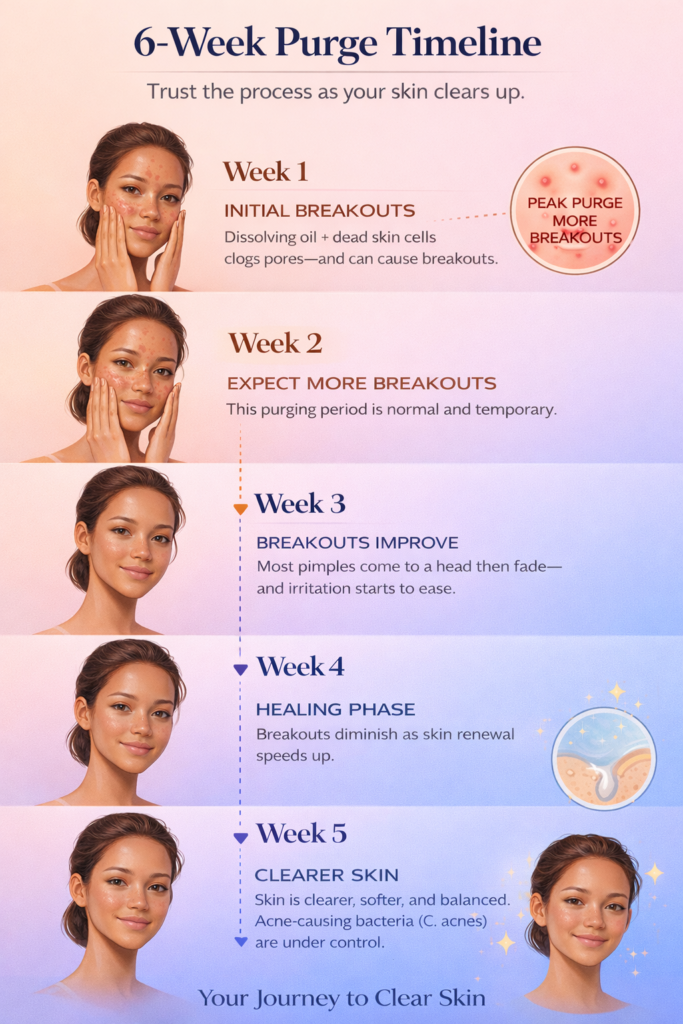
Understanding the pathogenic bacteria (C. acnes) purging process helps set realistic expectations and prevents premature product hopping.
Week 1–2: Initiation Phase
- Increase in redness or small inflammatory bumps
- Existing microcomedones begin surfacing
- Skin may feel warm or slightly tight (not burning)
Week 3–4: Active Clearing Phase
- Breakouts appear more quickly but resolve faster
- Fewer new lesions form between flares
- Oil production may temporarily increase as the skin adjusts
Week 5–6: Stabilization Phase
- Inflammation decreases
- Lesions heal more cleanly
- Reduced frequency of deep, painful breakouts
If symptoms intensify beyond week 6—or include stinging, peeling, or shiny redness—the issue is no longer purging but barrier disruption.
Managing Post-Inflammatory Erythema (PIE) Treatment
Even after a pimple heals, red marks often remain. This is known as post-inflammatory erythema (PIE)—a vascular response caused by lingering inflammation, not pigment.
Medical literature describes post-acne erythema (also called PAE) as erythematous lesions that can persist after inflammatory acne and may respond to various treatments.
The way each active affects post-inflammatory erythema (PIE) treatment is very different:
- Salicylic acid has mild anti-inflammatory properties that calm redness over time by reducing follicular swelling and preventing repeated irritation in the same pore.
- Benzoyl peroxide, while effective at killing bacteria, can prolong PIE if used aggressively due to its oxidative stress on surrounding tissue.
This is why many people notice that their acne improves—but redness worsens—when benzoyl peroxide is overused without adequate buffering or recovery days.
A strategic approach balances inflammation control with healing support, rather than focusing solely on lesion reduction.
The “Gold Standard” for PIE in 2026 is often pairing your BHA with Niacinamide or Azelaic Acid to support a calmer-looking finish over time.
Can You Use Salicylic Acid or Benzoyl Peroxide for Hormonal Acne?
Hormonal acne is the ultimate challenge because it is driven by internal triggers (androgens) that increase sebum viscosity.
The Salicylic Acid Role:
Use it as a preventative. Its comedolytic properties help keep the pore “slick” so that hormonally-thickened oil can exit the pore instead of getting trapped. If your skin is sensitive, start 2–3 nights per week and build up as tolerated.
For a more detailed breakdown of concentrations, usage frequency, and common mistakes, explore our complete guide to salicylic acid (BHA) for oily and acne-prone skin.
The Benzoyl Peroxide Role:
Use it as a targeted “fire extinguisher.” When a hormonal cyst begins to form, a 2.5% or 5% BP treatment helps reduce C. acnes and inflammation before it escalates.
Protecting Skin Barrier Integrity: The Gentle Glow Approach
Acne treatment fails when skin barrier integrity is sacrificed in the process.
A major shift in skincare philosophy is the protection of skin barrier integrity. In the past, the goal was to “dry out” the acne at all costs. However, we now know that a compromised barrier leads to leaky skin, which allows more bacteria to enter and causes more inflammation.
Whether you choose Salicylic Acid or Benzoyl Peroxide, your first priority is ensuring the stratum corneum (the outermost layer) remains hydrated. If you use 10% Benzoyl Peroxide without a barrier-supporting moisturizer, you will likely experience “reactive seborrhea”—where your skin produces even more oil to compensate for the extreme dryness, creating a never-ending cycle of breakouts.
This rebound oil pattern is often mistaken for “stubborn acne,” when in reality it may be a sign of dehydrated oily skin—a condition where increased water loss triggers reactive sebum production. Addressing hydration and barrier repair first can prevent this cycle from escalating.
Because oil regulation begins early in the day, pairing nighttime actives with a structured sebum-stabilizing morning routine helps prevent the rebound cycle that often follows aggressive treatment. Stabilizing oil before the late-morning peak reduces cumulative inflammation and supports long-term clarity.
Many dermatologists recommend “Short-Contact Therapy” with Benzoyl Peroxide—applying a 5% wash for only 2 minutes—to target bacteria while reducing the risk of barrier disruption.
Warning signs you’ve crossed the line
- Persistent stinging (not just tingling)
- Shiny, tight-looking skin
- Redness that spreads beyond breakout zones
These symptoms indicate disruption of the acid mantle and impaired barrier function—conditions that can actually increase acne susceptibility.
Barrier-Safe Tactics
- Introduce actives gradually (2–3x weekly initially)
- Never layer benzoyl peroxide and BHA in the same routine
- Pair actives with humectants and barrier-supportive ingredients
- Allow recovery days between treatments
Gentle Glow philosophy: Clear skin is not achieved by force. It’s achieved by consistency, restraint, and respect for the barrier. Most acne setbacks happen here—not because the active was wrong, but because it was used without strategy. Understanding purging timelines, inflammation behavior, and barrier signals allows actives to work with your skin biology rather than against it.
2026 Routine Integration & The “Gentle Glow” Verdict
Navigating the transition from “active breakouts” to “clear skin” requires a tactical approach. In 2026, many routines have moved away from aggressive “product cocktailing” toward better timing—using the right ingredient at the right time to respect recovery and protect your skin barrier integrity.
The 2026 Protocol: How to Use Both Safely
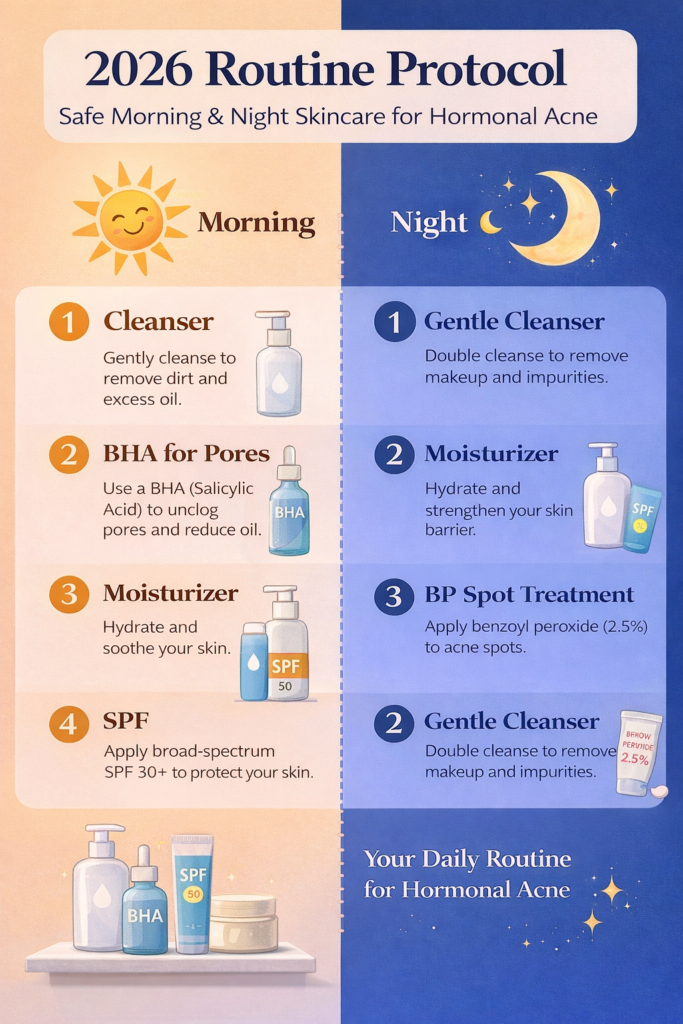
To maximize results without compromising your barrier, you should never layer high-strength Salicylic Acid and Benzoyl Peroxide directly on top of each other. Instead, use one of these three proven methods:
The “Day/Night Split” (Most Popular)
AM: Use a BHA exfoliant for oily skin (like a 2% liquid) 2–3 mornings per week to start, then increase only if your skin stays calm.
PM: Apply a Benzoyl Peroxide spot treatment after your moisturizer. This allows the BP to target C. acnes while you sleep, using the moisturizer as a “buffer.”
The “Short-Contact Therapy” Method
Apply a Benzoyl Peroxide wash to damp skin, leave it for 2 minutes, and rinse. This helps reduce bacteria while lowering the risk of excessive dryness and peeling.
The “Regional Approach”
Apply BHA for oily skin only to your “T-Zone” (forehead and nose).
Apply Benzoyl Peroxide only to active, red inflammatory bumps on the cheeks or jawline.
Product Selection: What to Look For in 2026
For Salicylic Acid: Look for BHA for pores formulas designed for slow release or buffered delivery to reduce stinging.
For Benzoyl Peroxide: Look for gentler, lower-strength options first (like 2.5% to 5%), and consider wash-off formats such as acne cleansers if you’re irritation-prone.
Post-Inflammatory Erythema (PIE) Treatment in Your Routine
As you clear the active acne, your focus will shift to post-inflammatory erythema (PIE) treatment. Because Benzoyl Peroxide is an oxidant, it can sometimes slow down the healing of these red marks if overused. To counter this, your routine must include “Barrier-Builders.”
Look for moisturizers containing Ceramides, Cholesterol, and Fatty Acids. These lipids mimic your natural skin structure and ensure that while the actives are fighting the acne, your skin barrier integrity remains unbreached.
2026 Ingredient Pairings: What Works With These Actives
Neither salicylic acid nor benzoyl peroxide should work alone. Supporting ingredients determine whether results are sustainable.
Barrier-Supportive Pairings
- Ceramides: reinforce the lipid matrix and reduce transepidermal water loss
- Hyaluronic acid: offsets dehydration without increasing oiliness
- Niacinamide (low to moderate %): supports oil regulation and redness control
These combinations allow actives to perform their job without undermining skin barrier integrity, which is critical for long-term acne control.
The “Gentle Glow” Verdict
If you are deciding between salicylic acid or benzoyl peroxide for hormonal acne, remember that these are tools, not cures.
Choose Salicylic Acid if your main struggle is “texture,” “oiliness,” or “blackheads.” It is your long-term maintenance partner for BHA for pores.
Choose Benzoyl Peroxide if you are dealing with “painful,” “red,” or “pus-filled” breakouts. It is your short-term emergency responder.
Because most active treatments are applied at night, following a structured night routine for oily and acne-prone skin can help you use salicylic acid or benzoyl peroxide more effectively while protecting your skin barrier.
Acne is a journey of patience. Whether you are currently in the middle of a pathogenic bacteria (C. acnes) purging process or you are finally seeing the light at the end of the tunnel, stay consistent. Your skin doesn’t need a miracle; it needs a respectful, science-backed routine.
Frequently Asked Questions (FAQ)
Can I use Salicylic Acid and Benzoyl Peroxide at the same time?
You can use both in the same overall routine plan, but don’t apply them on the same area in the same routine. To protect skin barrier integrity, it’s more effective to cycle them—using BHA for oily skin on scheduled days and Benzoyl Peroxide as a spot treatment at night.
Will Benzoyl Peroxide bleach my skin like it bleaches my towels?
No. Benzoyl Peroxide does not affect the melanin in your skin, so it will not “bleach” your complexion. However, it is a potent oxidizing agent that will bleach fabrics, including your towels, pillowcases, and even your hairline if you aren’t careful. Always wash your hands thoroughly after application and use a white pillowcase during your treatment weeks.
Why is my acne getting worse after starting a BHA exfoliant for oily skin?
You may be experiencing a comedonal purge. Because BHA for pores speeds up turnover inside the pore, it can push existing clogs to the surface all at once. This is a sign the product may be working. Stick with the routine for at least 6 weeks; if the breakout persists beyond that—or if you develop stinging, peeling, or widespread redness—scale back and consider consulting your dermatologist.
Is salicylic acid or benzoyl peroxide for hormonal acne more effective?
For the deep, painful cysts associated with hormones, Benzoyl Peroxide is often the winner because it targets C. acnes trapped deep in the follicle. However, Salicylic Acid is essential for maintenance to ensure that excess oil—common in hormonal cycles—doesn’t clog the pore in the first place.
How can I speed up my post-inflammatory erythema (PIE) treatment?
Patience and hydration. To speed up post-inflammatory erythema (PIE) treatment, you must stop “picking” and focus on anti-inflammatory ingredients. While BHA helps calm the area, the most important step is daily SPF 30+; UV rays can darken these red marks, making them much harder to fade. Choosing the right sunscreen matters here, which is why we’ve rounded up non-comedogenic sunscreens that protect healing skin without clogging pores.
I have sensitive skin; can I still use these actives?
Yes, by using “Short-Contact Therapy.” Apply your Benzoyl Peroxide wash or BHA for only 2–5 minutes, then rinse it off. This provides the therapeutic benefit to the pores without allowing the ingredients to dwell on the surface and cause a “chemical burn” or redness.
Medical Disclaimer
Gentle Glow guides are developed using peer-reviewed dermatology research and established clinical guidelines. The information provided is for educational purposes only and does not replace professional medical advice, diagnosis, or treatment. Always consult a board-certified dermatologist or qualified healthcare provider before starting new active skincare treatments.

About the Author
Founder, Gentle Glow | Evidence-Based Skincare & Skin Biology
Hi, I’m the Founder of Gentle Glow. After years of struggling with oily and acne-prone skin—and cycling through harsh products that disrupted my barrier rather than improving it—I began researching the science behind sebum regulation, skin biology, and non-comedogenic formulation.
Gentle Glow was created to simplify evidence-based skincare. Every routine shared here focuses on root causes: barrier function, oil balance, and ingredient compatibility. My goal is to translate dermatology-backed principles into realistic, sustainable routines that work with your skin—not against it.
Beyond topical care, I believe healthy skin reflects overall balance, including nutrition, climate awareness, and lifestyle habits. Gentle Glow is built to help you make informed decisions with clarity, consistency, and confidence.
.