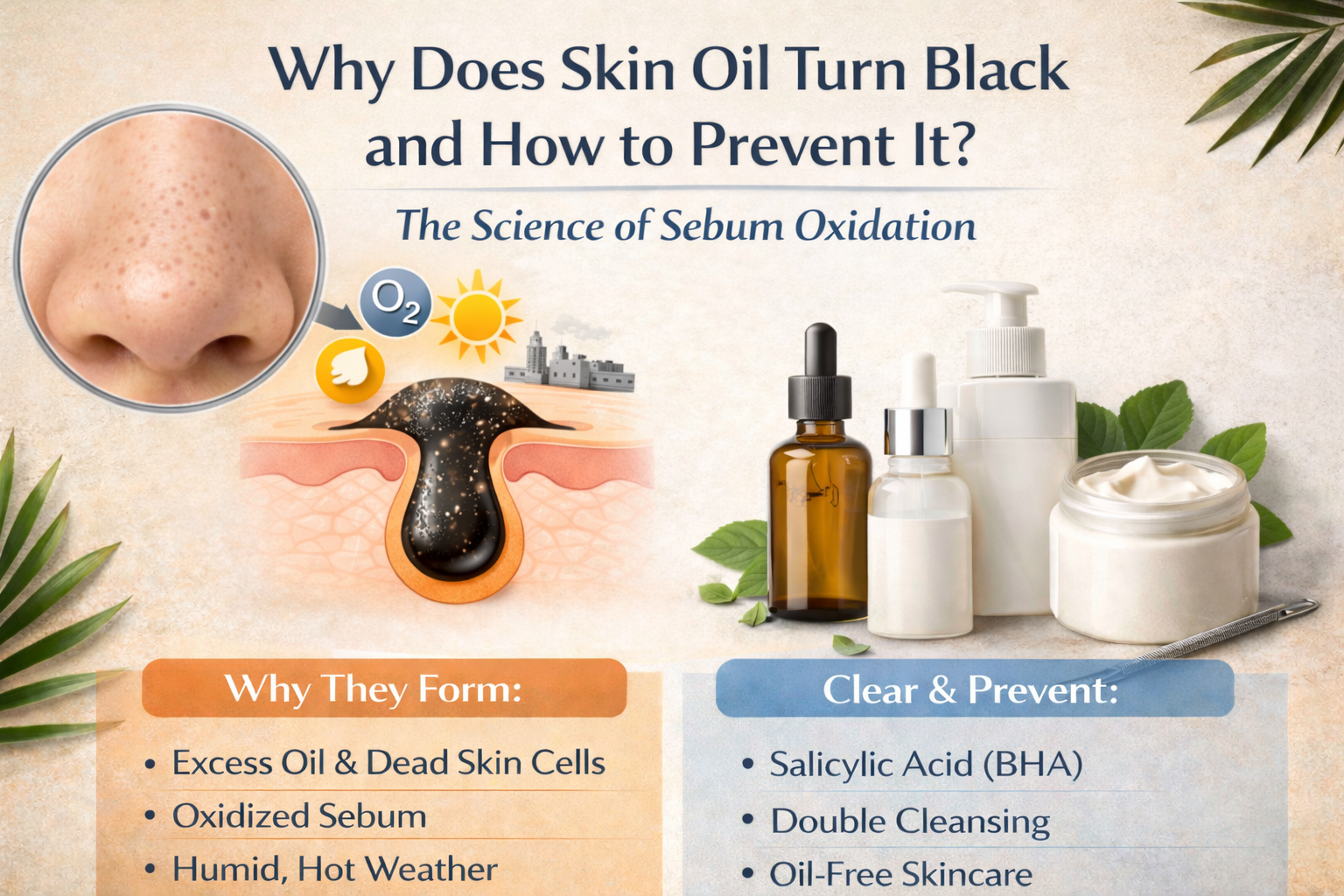

Skin oil, or sebum, turns black through a chemical process called sebum oxidation.
When excess oil inside a pore is exposed to oxygen in the air, it undergoes a reaction—similar to a sliced apple turning brown—that hardens the oil and darkens its color into a blackhead. It is not dirt. It is a chemical change in your skin’s natural oils.
This process explains why blackheads:
- Appear dark even on clean skin
- Return quickly in hot, sunny climates
- Are more common on oily and acne-prone skin
Understanding sebum oxidation is the key to preventing recurring blackheads—especially in high-heat, high-UV environments like the Middle East and North Africa (MENA).
Table of Contents
Key Facts About Sebum Oxidation
| Key Fact | Description |
| Main Trigger | Exposure to atmospheric oxygen. |
| Primary Victim | Squalene, a specific lipid in your sebum. |
| Visual Result | Open comedones (blackheads). |
| Accelerants | High UV index, heat, and environmental pollutants. |
This is why blackheads are not a hygiene issue—and why aggressive cleansing often makes them worse.
The Biology: What Is Sebum and Why Do We Have It?
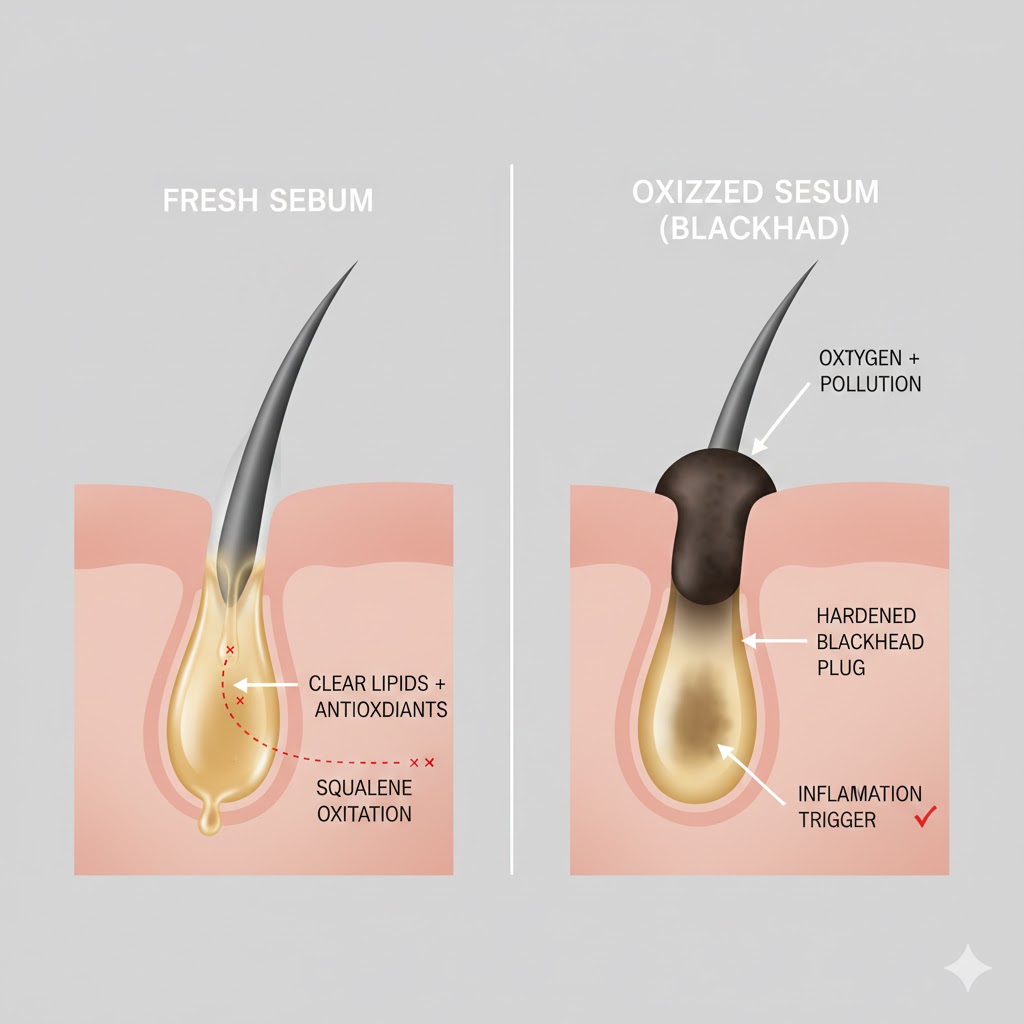
To understand why your oil turns black, we first have to appreciate why it exists. Your skin is a living organ, and its primary job is protection.
Sebum is a protective, lipid-rich substance produced by the sebaceous glands, which are attached to each hair follicle in the skin. Together, the hair follicle and oil gland form what’s known as the pilosebaceous unit.
In a perfect world, sebum is your best friend. It creates a waterproof barrier, locks in hydration, and even carries antioxidants like Vitamin E to the surface of your skin.
Sebum exists for important reasons:
- It lubricates the skin and hair
- It supports the skin barrier
- It reduces water loss (TEWL)
- It contains antimicrobial lipids
In balanced amounts, sebum is beneficial. However, for those of us with oily or acne-prone skin, the glands overproduce this oil. The problem begins when excess sebum becomes trapped inside the pore and exposed to environmental stressors.
Once sebum reaches the pore opening, chemistry—not cleanliness—takes over.
To understand how to manage this skin type holistically, see our [Complete Guide to Oily and Acne-Prone Skin: Everything You Need to Know].
Squalene: The “Weak Link” in Oily Skin
Not all oils are created equal. Sebum is made of triglycerides, wax esters, and a very specific compound called squalene, a naturally occurring lipid that helps keep skin flexible and protected (about 12-15% of your total oil).
While squalene is a brilliant moisturizer, it is highly unstable. Think of it as the “weak link” in your skin’s defense. Because of its chemical structure, it is the first thing to react when it touches the air. When squalene breaks down, it doesn’t just sit there—it turns into squalene peroxides, which are highly irritating to the pore lining and are the literal “spark” that starts blackhead formation and acne inflammation.
Squalene oxidizes very easily when is exposed to:
- Oxygen
- UV radiation
- Heat and pollution
Clinical research has shown that oxidized squalene is comedogenic, meaning it contributes directly to pore blockage and inflammation, even without bacteria present.
This is why blackheads:
- Darken over time
- Feel hard or “plug-like”
- Often return in the same pores
And why simply “removing” them does not solve the root cause.
The Chemistry of a Blackhead: Oxidation vs. Dirt
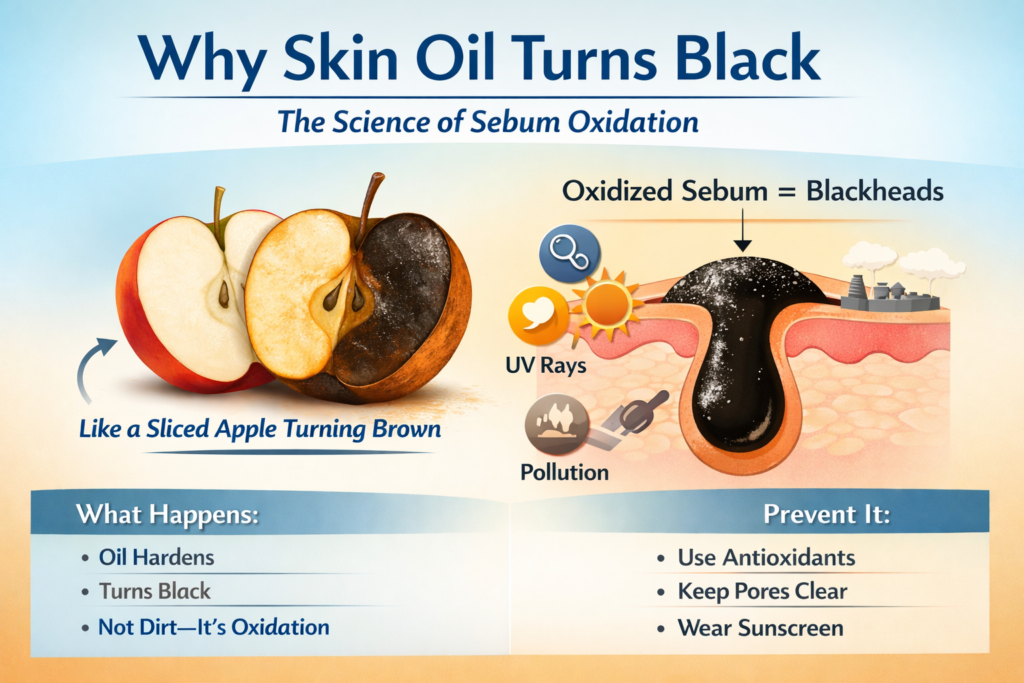
One of the most persistent myths in skincare is that blackheads are caused by “dirty skin” or poor hygiene. This leads many people to over-scrub their faces with harsh soaps, which actually makes the problem worse by irritating the skin.
The truth is: blackheads are not dirt trapped in the pore. You cannot wash away a blackhead with soap alone. They are oxidized sebum — one step in the larger biological process that explains what causes acne on oily skin.
Imagine you slice a fresh, white apple and leave it on the kitchen counter. Within twenty minutes, the surface turns a rusty, dark brown.
- Did the apple get “dirty”? No.
- Did you drop it in the soil? No.
The apple turned brown because the enzymes in the fruit reacted with the oxygen in the air. This is oxidation.
The same thing is happening on your nose right now. When a pore is “open” (an open comedone), the top of the oil plug is exposed to the atmosphere. The oxygen “rusts” the oil, turning it from a clear or yellowish liquid into a dark, hardened solid. This is why the bottom of a blackhead (the part inside the pore) is often still white or yellow, while the top is black.
Gentle Glow Tip: If you found the “Apple Metaphor” helpful, you’ll love our deep dive into [Blackheads vs. Sebaceous Filaments], which explains why those tiny dots on your nose might not be blackheads at all.
According to guidance from the American Academy of Dermatology, blackheads form when dead skin cells and oil block the follicle opening and the material inside becomes exposed to air.
No amount of scrubbing can prevent this chemical reaction once oil is trapped.
Why Your Environment Matters:
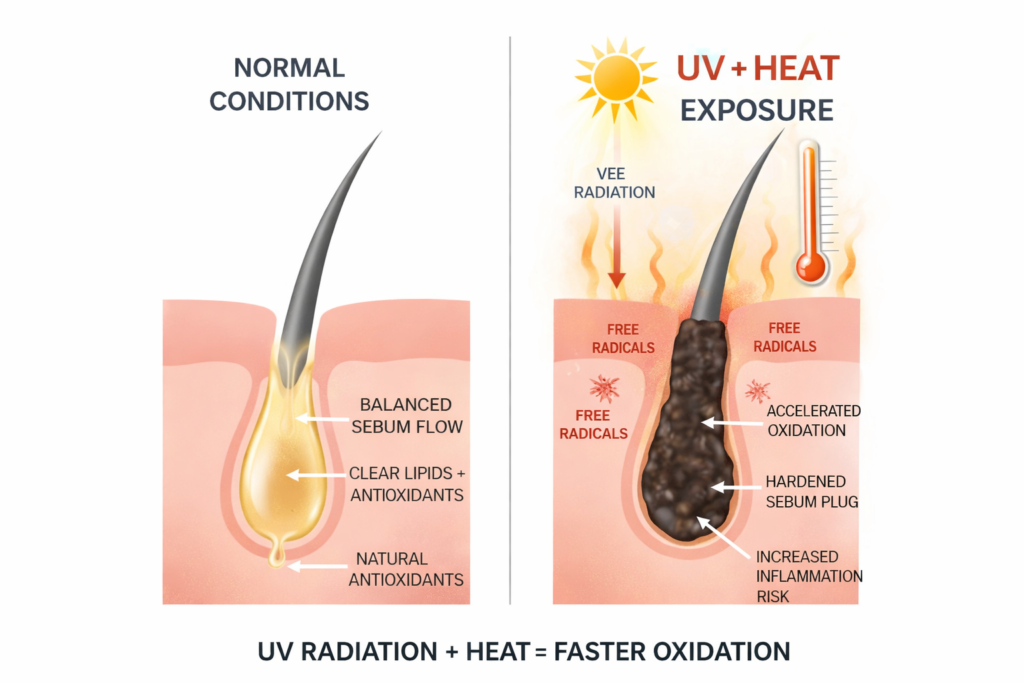
If you live in a region with high heat and a high UV index—like the Middle East or North Africa—sebum oxidation happens much faster.
How Heat and UV Rays Speed Up Oxidation
Think of heat as an “accelerant” for chemical reactions. In a cool climate, your sebum might stay liquid and flow out of the pore easily. In the intense heat of the MENA sun, the chemical reaction of oxidation is supercharged.
High temperatures increase:
- Sebum fluidity
- Sebaceous gland activity
- Pore openness
Furthermore, UV radiation acts as a catalyst. When the sun hits the oil on your face, it triggers “free radicals.” These tiny, unstable molecules attack your squalene, forcing it to oxidize and harden almost instantly. This is why many people notice their “blackheads” looking darker and more stubborn during the summer months or after a day at the beach.
In MENA regions, daily UV exposure makes sun protection a blackhead-prevention step, not just an anti-aging one.
Humidity’s Role in Trapping “Rusty” Oil
Humidity creates a second problem:
- Sweat mixes with oil
- Occlusion increases
- Oxidized lipids stay trapped longer
High humidity prevents your sweat and oil from evaporating. Instead of flowing off the skin, the oil sits, “cooks” in the heat, and has more time to react with the oxygen and pollutants in the air. This creates a “film” of oxidized lipids that can lead to widespread congestion.
Gentle Glow Perspective
Blackheads are not a failure of cleansing.
They are a chemical process influenced by oil biology and environment.
Once you understand sebum oxidation, prevention becomes smarter—and far gentler.
How to Prevent Sebum Oxidation (Before Blackheads Form)
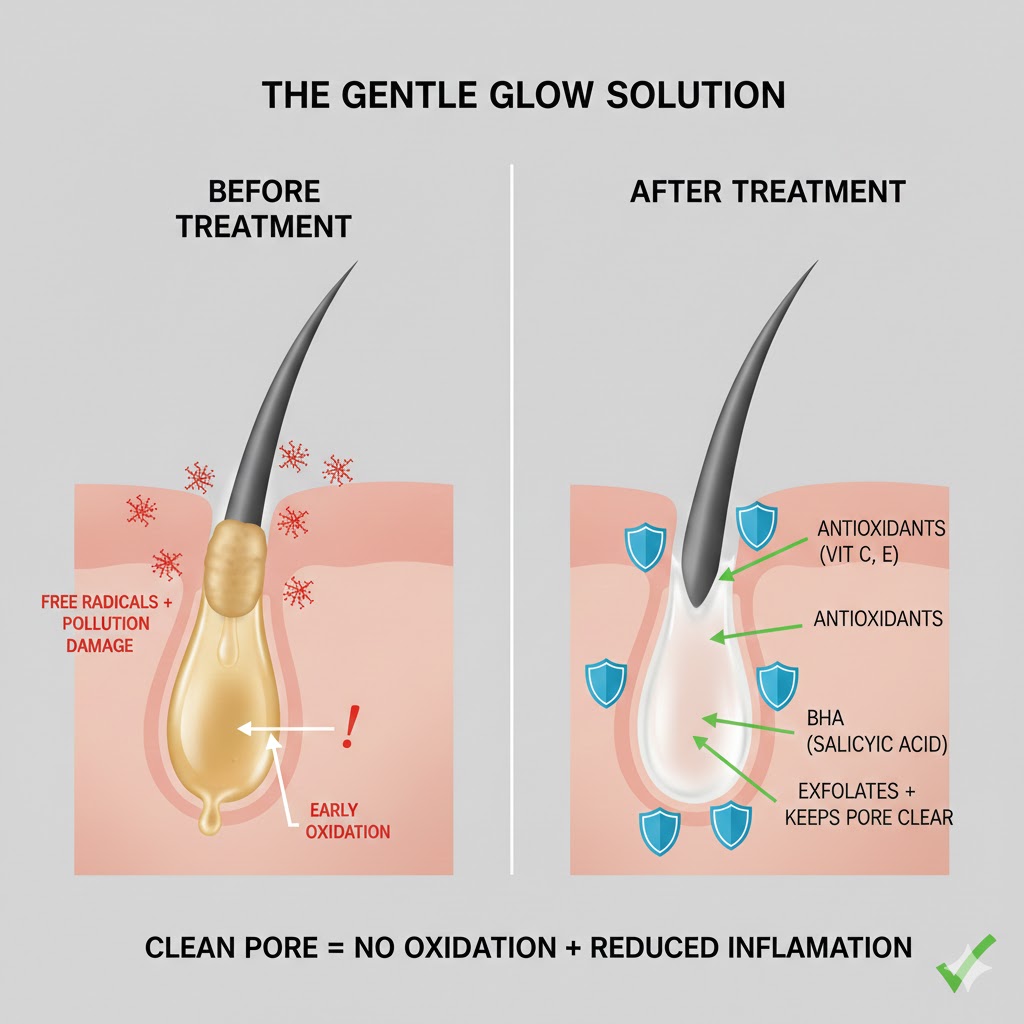
Since we know that blackheads are a result of a chemical reaction (oxidation), the solution isn’t just “cleaning”—it’s prevention through chemistry. Preventing blackheads isn’t about extracting what’s already there — it’s about stopping sebum from oxidizing in the first place.
Once oil has hardened and darkened inside the pore, removal becomes reactive. Prevention, on the other hand, works upstream, before oxidation occurs.
To stop your oil from “rusting,” you need to intervene at two stages: neutralising the oxygen reaction and keeping the oil moving.
The most effective strategy targets three points:
- Reduce oxidation
- Keep pores clear
- Remove oxidized lipids daily
While antioxidants help neutralize the oxygen reaction, prevention also depends on regulating how much oil reaches the surface in the first place. Ingredients that regulate sebum production at the gland level can reduce the volume of lipids exposed to air, lowering the risk of oxidation before it begins.
The Power of Antioxidants: Stopping Oxidation at the Source
If oxidation is the process of oxygen attacking your oil, antioxidants are the bodyguards that take the hit instead. Antioxidants work by neutralizing free radicals — unstable molecules created by UV exposure, heat, and pollution that trigger lipid oxidation.
By applying specific antioxidants, you prevent squalene from turning into the irritating “squalene peroxide” that hardens in the pore.
In oily skin, antioxidants play a crucial role in:
- Protecting squalene from oxidizing
- Keeping sebum more fluid
- Reducing the darkening of pore contents
Vitamin E (Tocopherol):
This is the gold standard for oily skin. Vitamin E is a lipid-soluble antioxidant, meaning it lives in the oil of your skin. Having a moisturizer or serum with Vitamin E ensures that the “apple” (your sebum) doesn’t turn brown.
Vitamin C (L-Ascorbic Acid or Derivatives):
While famous for brightening, Vitamin C works synergistically with Vitamin E to recharge it. Using a stable Vitamin C derivative in the morning provides a shield against UV-induced oxidation.
Green Tea Extract (EGCG):
Clinical studies on sebum regulation show that Green Tea can actually reduce the amount of oil your glands produce while simultaneously preventing that oil from oxidizing.
Clinical literature published in dermatology journals (including PubMed-indexed studies) consistently links oxidized squalene to comedone formation — reinforcing why antioxidants are not optional for oily skin, but essential.
BHA (Salicylic Acid): Keeping the Pathway Clear
You cannot stop oxygen from touching your face, but you can stop the oil from sitting in the pore long enough to harden. As we discussed in [our comprehensive guide to using BHA for clogged pores], Salicylic Acid is oil-soluble.
This is why dermatologists often recommend BHA as the first-line ingredient for blackheads, especially in oily and acne-prone skin.
It dives into the pore and breaks the “glue” holding the oxidized oil together. By using a BHA 2-3 times a week, you ensure that even if the top layer of oil oxidizes, it is exfoliated away before it can form a solid plug.
Double Cleansing (Supporting BHA by Removing Oxidized Lipids)
For those in humid or high-pollution environments, a single water-based wash is often not enough to remove oxidized sebum. Double cleansing is not about stripping oil. It’s about removing oxidized oil before it hardens.
Step 1 (Oil Cleanser):
Use a non-comedogenic oil (like the Anua Heartleaf Pore Control Cleansing Oil) to dissolve the hardened, oxidized oil. “Like dissolves like”—the fresh oil in the cleanser softens the “rusty” oil in your pores.
Step 2 (Water Cleanser):
Follow up with a gentle gel cleanser to wash away the debris.
This process ensures that oxidized oil is removed daily, reducing the chance it will remain inside pores long enough to darken and harden.
For a full step-by-step breakdown, see:
→ How to Double Cleanse for Oily & Acne-Prone Skin
Why Aggressive Methods Make Oxidation Worse
Many people unintentionally accelerate sebum oxidation by using harsh techniques.
Common mistakes include:
- Over-scrubbing
- Alcohol-heavy toners
- Pore strips
- Manual extraction
According to the American Academy of Dermatology, mechanical extraction can damage the pore opening and surrounding skin, making it easier for oil to become trapped — and oxidize faster.
When the skin barrier is compromised:
- Inflammation increases
- Oil production rises
- Oxidation accelerates
This creates a cycle where blackheads return larger and darker than before.
Blackheads vs. Sebaceous Filaments
Not every dark dot on the skin is a problem.
- Sebaceous filaments are normal oil channels
- Blackheads are oxidized plugs
Sebum oxidation is what transforms a normal oil channel into a visible blackhead — which is why prevention matters more than removal.
Gentle Glow Perspective
Blackheads aren’t stubborn because skin is “dirty.”
They’re stubborn because oxidation is constant.
The goal isn’t to eliminate oil — it’s to:
- Protect it from oxidation
- Keep pores clear
- Remove damaged lipids gently and consistently
This approach works with skin biology, not against it.
Routine Mechanics: Your Daily Anti-Oxidation Shield
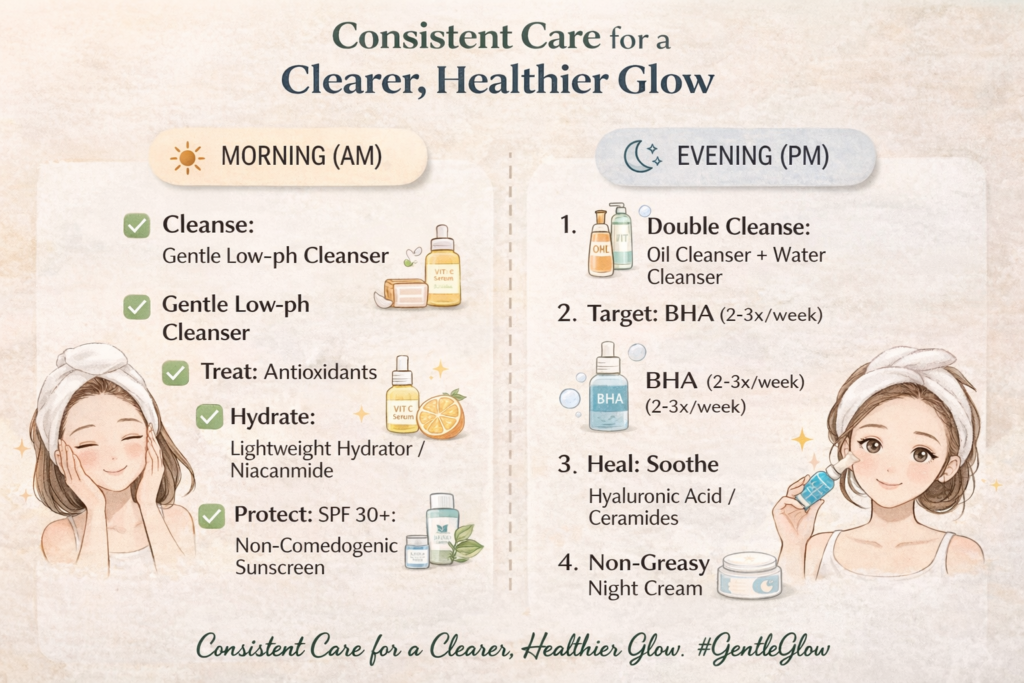
Preventing sebum oxidation requires consistency, not intensity. The goal is to protect oil from oxidizing during the day and remove damaged lipids at night—without disrupting the skin barrier.
Morning Routine: Prevent Oxidation Before It Starts
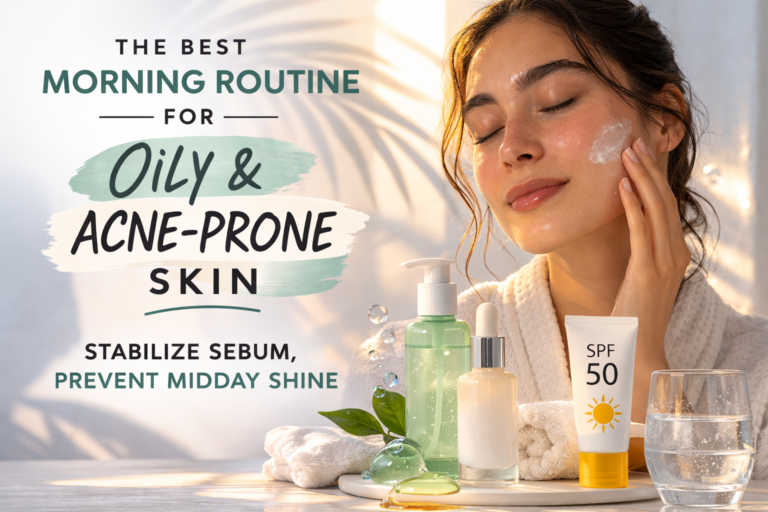
The morning routine focuses on defense. Oxidation is a daytime process driven by UV exposure and pollution. Following a structured oily skin morning routine that includes antioxidants and non-comedogenic SPF helps stabilize sebum before it darkens and thickens inside the pore.
Step 1: Gentle Cleanser
Use a low-pH gel or foam cleanser to remove overnight oil without stripping. Over-cleansing in the morning can trigger rebound oil production, increasing oxidation risk later in the day.
Step 2: Antioxidant Serum
Apply a lightweight antioxidant serum containing:
- Vitamin C (or a stable derivative)
- Vitamin E
- Optional: Green tea or ferulic acid
These ingredients help neutralize free radicals generated by UV exposure and pollution, which are major accelerants of squalene oxidation.
Step 3: Lightweight Moisturizer
Hydrated skin produces more balanced sebum. Choose a non-comedogenic formula that supports the barrier without trapping oil.
Step 4: Daily Sunscreen (Non-Negotiable)
UV radiation is one of the strongest triggers of sebum oxidation. A lightweight, non-comedogenic SPF helps prevent both blackheads and post-acne darkening.
In hot, high-UV regions, sunscreen is blackhead prevention, not just sun protection.
For high-heat environments, check out [our guide to the best sunscreens for oily skin], where we break down the formulas that won’t clog your pores.
Evening Routine: Remove Oxidized Lipids Gently
Nighttime is when you reset the pore environment.
Step 1: Double Cleanse
- Oil cleanser to dissolve oxidized sebum, sunscreen, and pollution
- Gentle water-based cleanser to remove residue
This prevents oxidized lipids from remaining inside pores overnight, where they harden and darken further.
Step 2: BHA (2–3 Nights Per Week)
Apply a salicylic acid (BHA) treatment to keep the pore lining clear and reduce oil stagnation. This lowers the time oil spends exposed to oxygen inside the pore.
To ensure you’re doing this correctly without stripping your barrier, follow our [Step-by-Step Guide to Double Cleansing for Acne-Prone Skin].
Step 3: Barrier-Supportive Moisturizer
Hydration reduces TEWL and signals sebaceous glands to slow oil production—lowering oxidation risk.
Climate-Specific Advice for MENA Skin
In Middle Eastern and North African climates, blackheads form faster because:
- UV exposure is high year-round
- Heat increases sebum fluidity
- Humidity traps oxidized oil in pores
Gentle Glow Rule for Hot Climates
- Use lower concentrations consistently, not strong actives daily
- Avoid alcohol-heavy products
- Prioritize antioxidants + sunscreen in the morning
- Never skip moisturizer, even if skin feels oily
When dehydration is ignored, oil becomes thicker, oxidation accelerates, and pores appear larger.
From Squalene to Squalene Peroxide
To understand why some blackheads lead to painful, red cysts while others just sit on the nose, we have to look at the “chemical ghost” of sebum: Squalene Peroxide.
As we established, Squalene is a natural part of your skin’s oil. However, once it oxidizes, it transforms into a highly unstable and aggressive version of itself called Squalene Peroxide. This isn’t just a color change; it’s a functional change.
Why Squalene Peroxide is the “Enemy” of Oily Skin:
- It’s Comedogenic: While pure sebum flows, oxidized squalene is thick and sticky. In conditions like dehydrated oily skin — where increased transepidermal water loss alters sebum viscosity — oil becomes even denser and more difficult for pores to regulate. This acts like a “glue” that traps dead skin cells inside the pore, creating a physical dam.
- It’s Inflammatory: Squalene Peroxide is a known skin irritant. It signals to your immune system that there is a “threat” in the pore, which triggers the redness and swelling we associate with inflammatory acne.
- It Feeds Bacteria: The bacteria responsible for acne, C. acnes, thrives in the low-oxygen, high-oxidized-lipid environment of a clogged pore.
By focusing on antioxidants and proper cleansing, you aren’t just cleaning your pores—you are preventing your skin’s own oil from turning into an inflammatory trigger.
Final Takeaway
Skin oil turns black because it oxidizes.
Not because it’s dirty. Not because you didn’t cleanse enough.
When you:
- Protect sebum with antioxidants
- Keep pores clear with BHA
- Remove oxidized lipids daily
- Support the skin barrier consistently
…blackheads become less frequent, less visible, and far easier to manage.
Not through force — but through chemistry.
Clinical Authority and Evidence
Our approach is rooted in peer-reviewed science. Dermatological research has shown that:
- Oxidized squalene plays a central role in comedone formation. [Study: Enhanced comedo formation by squalene peroxides]
- UV exposure increases lipid peroxidation inside pores, which directly accelerates the development of blackheads (comedogenesis). [Research: Effects of ultraviolet A and B irradiation on lipid peroxidation]
- Barrier-supportive routines reduce inflammatory acne and congestion by maintaining the skin’s natural defenses. [Clinical Efficacy: Skin barrier function in acne management]
These findings align with the global medical consensus from:
- The [American Academy of Dermatology (AAD)] guidelines for the management of comedonal acne.
- Clinical studies indexed on [PubMed/National Institutes of Health].
The Takeaway: This is why modern acne prevention focuses on oxidation control, not aggressive removal.
Frequently Asked Questions (FAQ)
Why do my blackheads keep returning even after a professional facial?
Blackheads return because your pores never stop producing oil (sebum). While a professional can clear a clog, they cannot “close” a pore permanently. If dead skin cells and oil aren’t managed daily, they will oxidize and turn black again. Consistency with a BHA exfoliant and antioxidants is key to keeping the “pathway” clear.
Can Vaseline remove blackheads?
No. While Vaseline is non-comedogenic (it doesn’t clog pores on its own), it acts as an occlusive. This means it seals everything into the skin. If you apply it over blackheads, you are trapping oil and bacteria, which can actually make clogs worse. It does not “melt” or dissolve sebum like BHA does.
Do pore strips enlarge pores?
Not exactly, but they can make them appear larger over time. Pore strips use a strong adhesive that pulls at the skin’s surface, which can damage the elasticity around the pore opening. If the skin loses its firmness due to this repeated trauma, the pores lose their support and look more “open” and visible.
Can toothpaste remove blackheads?
Definitely not. Toothpaste contains ingredients like menthol and hydrogen peroxide that can cause severe irritation or even chemical burns. While it might dry out the surface, it does nothing to remove the actual oil plug and can leave behind dark spots (hyperpigmentation).
Does squeezing blackheads prevent oxidation?
No. According to the American Academy of Dermatology, manual extraction and pore strips can damage the pore opening and surrounding skin. This makes pores more prone to trapping oil, which oxidizes faster and returns darker.
Are blackheads a sign of poor hygiene?
No. Blackheads are a chemical reaction involving oil and oxygen, not dirt. Over-cleansing often worsens the problem by increasing oil production and inflammation.
Medical Disclaimer
Gentle Glow guides are developed using peer-reviewed dermatology research and established clinical guidelines. The information provided is for educational purposes only and does not replace professional medical advice, diagnosis, or treatment. Always consult a board-certified dermatologist or qualified healthcare provider before starting new active skincare treatments.

About the Author
Founder, Gentle Glow | Evidence-Based Skincare & Skin Biology
Hi, I’m the Founder of Gentle Glow. After years of struggling with oily and acne-prone skin—and cycling through harsh products that disrupted my barrier rather than improving it—I began researching the science behind sebum regulation, skin biology, and non-comedogenic formulation.
Gentle Glow was created to simplify evidence-based skincare. Every routine shared here focuses on root causes: barrier function, oil balance, and ingredient compatibility. My goal is to translate dermatology-backed principles into realistic, sustainable routines that work with your skin—not against it.
Beyond topical care, I believe healthy skin reflects overall balance, including nutrition, climate awareness, and lifestyle habits. Gentle Glow is built to help you make informed decisions with clarity, consistency, and confidence.