Everything You Need to Know About Oily Skin

Retinol vs Retinal vs Granactive Retinoid: Which Is Best for Oily Acne-Prone Skin?

Medically reviewed by
Gamal Henin, B.Pharm
Pharmacist & Medical Reviewer at Gentle Glow
Reviewed August 18, 2026
Retinol vs retinal vs Granactive Retinoid for oily acne-prone skin: retinal is often the best overall choice. It requires only one conversion step to retinoic acid and has demonstrated direct antibacterial activity against C. acnes. Retinol is a well-established option for beginners, while Granactive Retinoid may suit people prioritizing tolerability, although its evidence base is more limited.
- Retinal → Faster results, better support for clogged pores and breakouts
- Granactive Retinoid → Lower irritation potential for sensitive oily skin
- Retinol → Slower conversion, reliable beginner option with strong long-term research
Table of Contents
Retinol vs Retinal vs Granactive Retinoid: At a Glance
All three ingredients belong to the retinoid family, a group of vitamin A derivatives commonly used to support clogged pores, acne, uneven texture, and skin turnover. In recent years, they’ve become increasingly popular for oily acne-prone skin not only for their role in improving visible signs of aging, but also because growing dermatology research continues to support their role in helping manage acne, congestion, and abnormal pore buildup over time.
If you’re still building your understanding of how oily skin develops congestion and breakouts over time, it helps to first understand the biology of excess oil production and pore blockage.
| Retinoid | Conversion Pathway | Speed of Results | Irritation Risk | Evidence Depth | Best For |
|---|---|---|---|---|---|
| Retinol | Retinol → Retinal → Retinoic Acid | Moderate | Moderate | Extensive (40+ years) | Beginners, long-term maintenance |
| Retinal (Retinaldehyde) | Retinal → Retinoic Acid | Faster | Varies depending on formula and skin tolerance | Strong | Oily acne-prone skin, clogged pores |
| Granactive Retinoid (HPR) | Direct receptor activity claims | Moderate-Fast | Potentially lower; depending on the formula | Limited compared to retinol | Reactive or sensitive oily skin |
What makes these ingredients feel so different on the skin is not just “strength,” but how much of the molecule successfully survives the retinoid conversion pathway before becoming active. That difference in bioavailability is one reason retinaldehyde vs retinol comparisons have become increasingly popular among people dealing with persistent breakouts and irritation at the same time.
If you want a deeper look at how topical retinoids behave on oily skin overall, you can also explore our guide to choosing and using retinoids safely on oily skin.
FREE RETINOID GUIDE
Starting a retinoid? Keep the routine simple.
Get our free Your Retinoid Routine, Simplified guide with a beginner schedule, what to do if your skin reacts, common mistakes to avoid, and a quick routine checklist.
Get the free guide and join Gentle Glow’s skincare emails. Unsubscribe anytime.
Retinol: The Proven Standard
Among cosmetic retinoids, retinol remains one of the most established and well-studied options. It has been used in dermatology research for decades and is often considered a practical starting point for people introducing vitamin A derivatives into their routine.
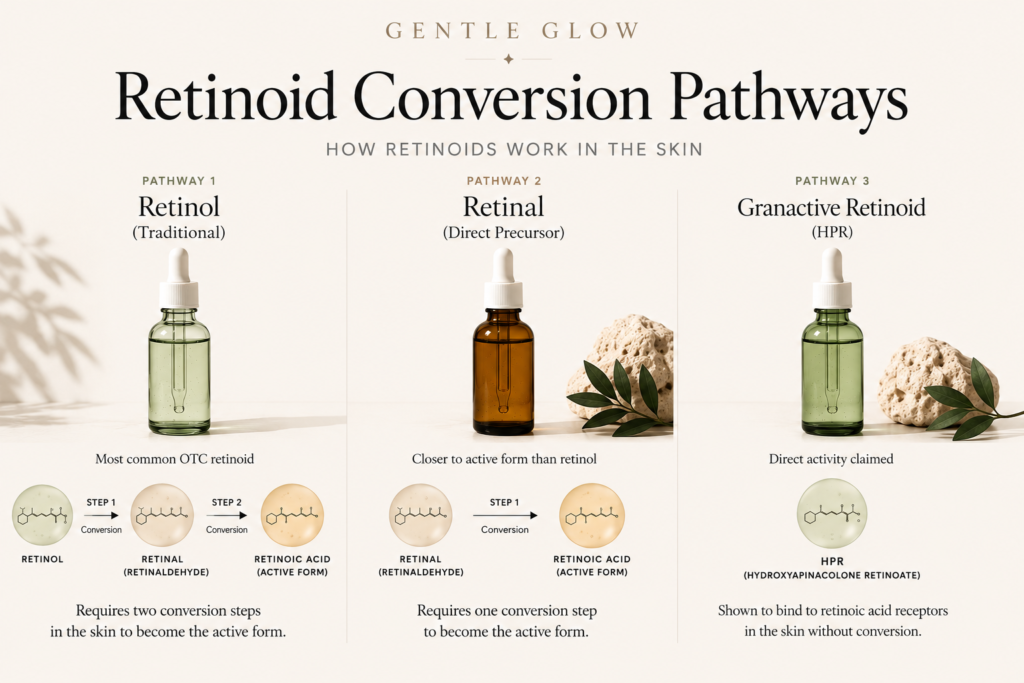
What makes retinol feel slower compared to newer-generation retinoids comes down to its conversion pathway. Before becoming active inside the skin, retinol first has to convert into retinal, then into retinoic acid — the biologically active form the skin can actually use.
Retinol→Retinal→Retinoic Acid
Because of this two-step metabolic conversion, part of the ingredient’s activity is lost during the process. That lower bioavailability is one reason retinaldehyde vs retinol comparisons have become more common among people looking for faster acne-focused results.
Still, slower does not necessarily mean ineffective. For many people with oily acne-prone skin, especially beginners or easily irritated skin types, retinol often feels more manageable and predictable over time. Formula design also matters enormously here — lightweight, well-balanced retinol serums tend to behave very differently from heavier cream-based formulas on oily skin.
If you want a deeper breakdown of textures, formulas, and beginner-friendly options, you can also explore our guide to choosing retinol products that work without triggering irritation or heaviness.
Retinal: Faster Conversion and Better Acne Support
Retinal, also called retinaldehyde, sits one step closer to retinoic acid than retinol. Instead of converting twice, it only needs a single conversion step before becoming active inside the skin.
Retinal→Retinoic Acid
That shorter retinoid conversion pathway improves bioavailability, meaning less of the ingredient is lost before reaching its active form. This is one reason retinal is often described as working faster and more efficiently than traditional retinol, especially on acne-prone skin dealing with persistent congestion and clogged pores.
What has made retinaldehyde vs retinol comparisons increasingly interesting for dermatology researchers is that retinal appears to offer more than simple skin turnover support alone. Research has also explored its direct antibacterial activity against C. acnes, the bacteria involved in acne formation. That added acne-focused activity is part of why retinal has become especially popular for oily acne-prone skin in recent years.
At the same time, faster conversion can also mean a higher chance of irritation if the formula is too aggressive or introduced too quickly. Oily skin is often mistakenly treated as “stronger” skin, but many acne-prone routines already involve exfoliants, strong cleansers, or barrier disruption underneath the surface.
This is why retinal tends to work best when introduced gradually and paired with a simple, barrier-supportive routine, especially if you’re already using exfoliants too frequently or struggling with irritation from overactive routines. For people dealing with persistent hormonal breakouts and recurring congestion patterns, retinal often feels like the middle ground between beginner-friendly retinol and prescription-strength retinoids.
Granactive Retinoid: Gentler, But Less Proven
Granactive Retinoid is the commercial name commonly used for Hydroxypinacolone Retinoate (HPR), a newer-generation retinoid designed to interact more directly with retinoid receptors in the skin.
Unlike traditional retinol, HPR is proposed to interact directly with retinoid receptors without requiring the same multi-step metabolic conversion process. That difference is one reason many people describe Granactive Retinoid as feeling gentler, especially on skin that becomes irritated easily from stronger actives.
HPR (Granactive Retinoid)→Direct Retinoid Receptor Activity Claims
For oily acne-prone skin, this potentially lower irritation profile can feel appealing, particularly if your routine already includes exfoliants, acne treatments, or a compromised skin barrier from overusing active ingredients. In these situations, reducing irritation sometimes matters more than choosing the “strongest” retinoid available.
At the same time, this is also where much of the confusion around Granactive Retinoid vs retinol begins. While HPR technology appears promising, it still lacks the same depth of long-term independent clinical research available for traditional retinol and retinaldehyde. Most of the strongest evidence surrounding cosmetic retinoids still comes from more established vitamin A derivatives with decades of dermatology research behind them.
That does not make Granactive Retinoid ineffective — only newer and less extensively studied. For highly reactive oily skin that struggles with peeling, irritation, or barrier disruption, it may still feel easier to tolerate consistently over time. If your skin is already showing signs of tightness, irritation, or sensitivity from overusing acids and retinoids together, it also helps to understand how to repair an over-exfoliated skin barrier before increasing retinoid strength further.
Which One Is Best for Oily Acne-Prone Skin?
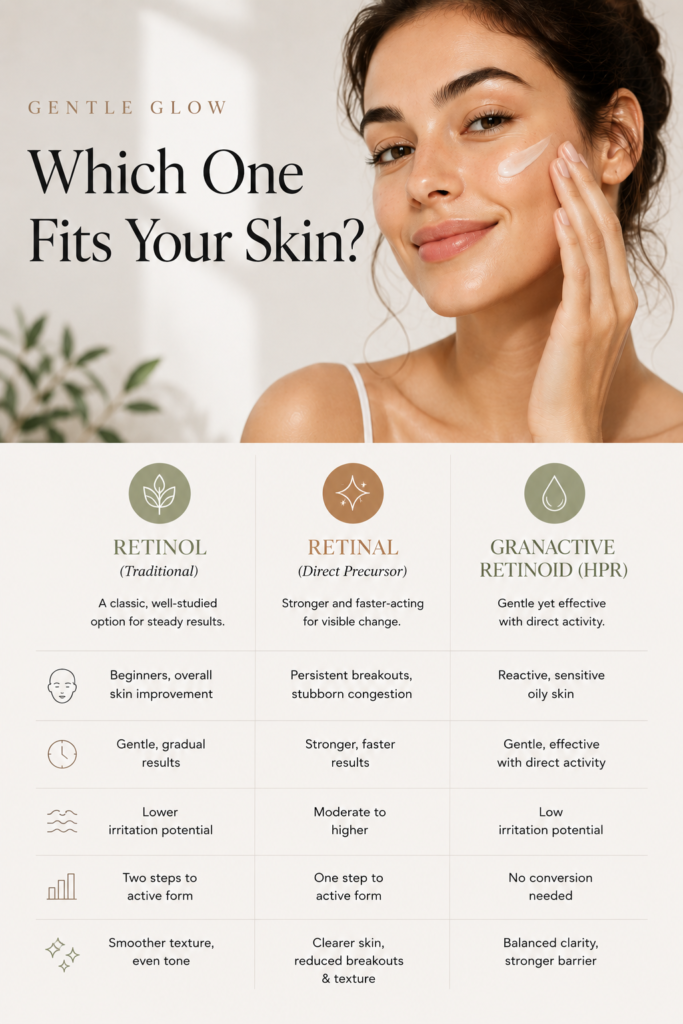
The “best” retinoid usually depends less on trends and more on how your skin balances breakouts, oil production, irritation, and long-term tolerance. On oily skin, stronger does not always mean better — especially when the skin barrier is already stressed underneath persistent congestion or inflammation.
If your skin struggles with persistent clogged pores and active breakouts
Retinal (retinaldehyde) is often considered the most balanced option for acne-prone skin because of its higher bioavailability and faster conversion into retinoic acid. Its additional antibacterial activity against C. acnes also makes it particularly interesting for oily skin dealing with recurring congestion and inflammatory acne patterns.
If your skin becomes irritated easily but still feels oily
Granactive Retinoid (HPR) may feel easier to tolerate consistently, especially if your skin reacts quickly to exfoliants, stronger retinoids, or aggressive acne routines. Lower irritation sometimes leads to better long-term consistency, which matters more than chasing high percentages your skin cannot comfortably handle.
If you are completely new to retinoids
Retinol still remains one of the safest starting points for beginners. While slower than retinal, it has the strongest long-term research history among cosmetic retinoids and often feels more predictable when introduced gradually into oily skincare routines.
Retinoid Strength vs Irritation: Why Conversion Efficiency Matters
One of the biggest misconceptions around retinoids is that a higher percentage automatically means better or faster results. In reality, the type of retinoid, its formulation, concentration, and how efficiently it converts into its active form can all influence its effects on the skin.
With retinol, part of the ingredient’s activity is naturally lost during its two-step metabolic conversion into retinoic acid. Retinaldehyde, on the other hand, requires only one conversion step, which improves bioavailability and often allows it to work more efficiently on acne-prone skin.
That difference helps explain why percentages cannot be compared directly across different retinoid molecules. In practice, the highest percentage is not necessarily the best choice — formulation and how well your skin tolerates consistent use also matter.
Environmental factors such as heat, sun exposure, humidity, and air conditioning can also affect how comfortable a retinoid routine feels throughout the year. If you’ve ever noticed that your retinoid seems to behave differently in warmer weather, it may help to understand why retinol can feel different during summer.
Final Thought
The conversation around retinol vs retinal vs Granactive Retinoid often focuses on which ingredient is “strongest,” but for oily acne-prone skin, the better question is usually which one your skin can tolerate consistently without becoming reactive or overwhelmed.
For many people dealing with persistent congestion and breakouts, retinaldehyde offers the most balanced combination of conversion efficiency and acne-focused support. Others may find that the lower irritation profile of Granactive Retinoid (HPR) feels easier to maintain long term, while retinol still remains one of the most reliable and extensively researched entry points into retinoids overall.
As research around topical retinoids continues to evolve, the differences between these molecules are becoming less about marketing claims and more about understanding how the skin actually responds to each conversion pathway over time.
FREE RETINOID GUIDE
Take your retinoid plan with you.
Save the routine, schedule, reaction checklist, and common mistakes so you do not have to remember everything from this article.
Get the free guide and join Gentle Glow’s skincare emails. Unsubscribe anytime.
Frequently Asked Questions
Is retinal better than retinol for acne-prone skin?
Yes, retinal (retinaldehyde) is generally considered more effective for acne-prone skin. Because it is only one conversion step away from retinoic acid, it is often described as working significantly faster than retinol because it requires one less conversion step before becoming active. Additionally, retinal is the only retinoid shown to have direct antibacterial properties against C. acnes bacteria.
Can I switch from retinol to retinal?
You can switch from retinol to retinal, but it should be done gradually. Since retinal is more potent, your skin may need a new adjustment period. Dermatologists generally recommend introducing retinoids slowly and monitoring for irritation or signs of a damaged skin barrier before increasing frequency.Start by using retinal 1–2 times per week and monitor for signs of a damaged skin barrier before increasing frequency.
Is Granactive Retinoid as effective as retinol?
While Granactive Retinoid (HPR) is highly effective at reducing the risk of irritation, it currently lacks the decades of independent, long-term clinical data that support retinol. It is an excellent choice for reactive or sensitive oily skin, but those seeking the most “proven” results may still prefer traditional retinol or retinal.
Does retinal cause more purging than retinol?
Like other retinoids, retinal can sometimes cause a temporary purging phase as the skin adjusts, particularly in acne-prone areas. However, this is a sign that the molecule is effectively bringing existing congestion to the surface more quickly. Pairing it with a barrier-supportive routine can help manage this transition.
Sources and References
- Pêchère M, Péchère JC, Siegenthaler G, Germanier L, Saurat JH. Antibacterial Activity of Retinaldehyde Against Propionibacterium acnes
- Mukherjee S, Date A, Patravale V, Korting HC, Roeder A, Weindl G. Retinoids in the Treatment of Skin Aging: An Overview of Clinical Efficacy and Safety
- Kolli SS, Pecone D, Pona A, Cline A, Feldman SR. Topical Retinoids in Acne Vulgaris: A Systematic Review
- Mayo Clinic Staff. Acne — Diagnosis and Treatment
- Duester G, Mic FA, Molotkov A. Cytosolic Retinoid Dehydrogenases Govern Ubiquitous Metabolism of Retinol to Retinaldehyde Followed by Tissue-Specific Metabolism to Retinoic Acid
- Oge’ LK, Broussard A, Marshall MD. Acne Vulgaris: Diagnosis and Treatment
- Creidi P, Vienne MP, Ochonisky S, et al. Profilometric Evaluation of Photodamage After Topical Retinaldehyde and Retinoic Acid Treatment
- Hu F, Yu J, Zheng C, et al. Hydroxypinacolone 9-cis Retinoate Mitigates UV-Induced Photoaging
Medical Disclaimer
Gentle Glow guides are developed using peer-reviewed dermatology research and established clinical guidelines. The information provided is for educational purposes only and does not replace professional medical advice, diagnosis, or treatment. Always consult a board-certified dermatologist or qualified healthcare provider before starting new active skincare treatments.