Everything You Need to Know About Oily Skin


Weekly Exfoliation Routine for Oily and Acne-Prone Skin (2026 Guide)

Founder & Editorial Lead at Gentle Glow
Gentle Glow Editorial Team • Updated May 2026 • Evidence-based skincare
A weekly exfoliation routine for oily and acne-prone skin uses salicylic acid (BHA) 1–3 times per week, spaced between recovery and treatment nights to keep pores clear while maintaining a stable skin barrier.
- 1–3 times per week → clears buildup without triggering over-exfoliation
- Salicylic acid (BHA) → penetrates oil to unclog pores and reduce congestion
- Recovery nights in between → prevent irritation and support barrier function
- Avoid combining strong actives in one routine → reduces inflammation and excess oil production
Table of Contents
Watch: A Visual Guide to Weekly Exfoliation
Choosing the Right Exfoliant for Oily Acne-Prone Skin
When your skin feels oily, congested, or prone to breakouts, exfoliation usually becomes the focus. It feels like the most direct way to clear pores and smooth texture.
But the type of exfoliant you use tends to matter more than how often you use it.
If you’ve been trying to understand why your skin reacts differently at different times, it often helps to look at how oil production, pore behavior, and breakouts develop together over time, rather than focusing on a single step in isolation.
For oily and acne-prone skin, chemical exfoliation is generally more effective than physical scrubs. Instead of relying on friction, it works by dissolving the buildup that forms inside the pore—where congestion and breakouts actually begin.
Within this category, one ingredient consistently stands out.
Salicylic Acid (BHA) is oil-soluble, which allows it to move through sebum and reach inside the pore rather than staying on the surface. This makes it particularly effective for blackheads, congestion, and recurring breakouts. This oil-soluble behavior is why dermatology guidelines often recommend it for clogged pores and comedonal acne, as it can penetrate the follicle rather than sitting on the surface.
Other exfoliating acids can still play a role—but they usually support the routine rather than replace it.
Which exfoliant is best for oily acne-prone skin?
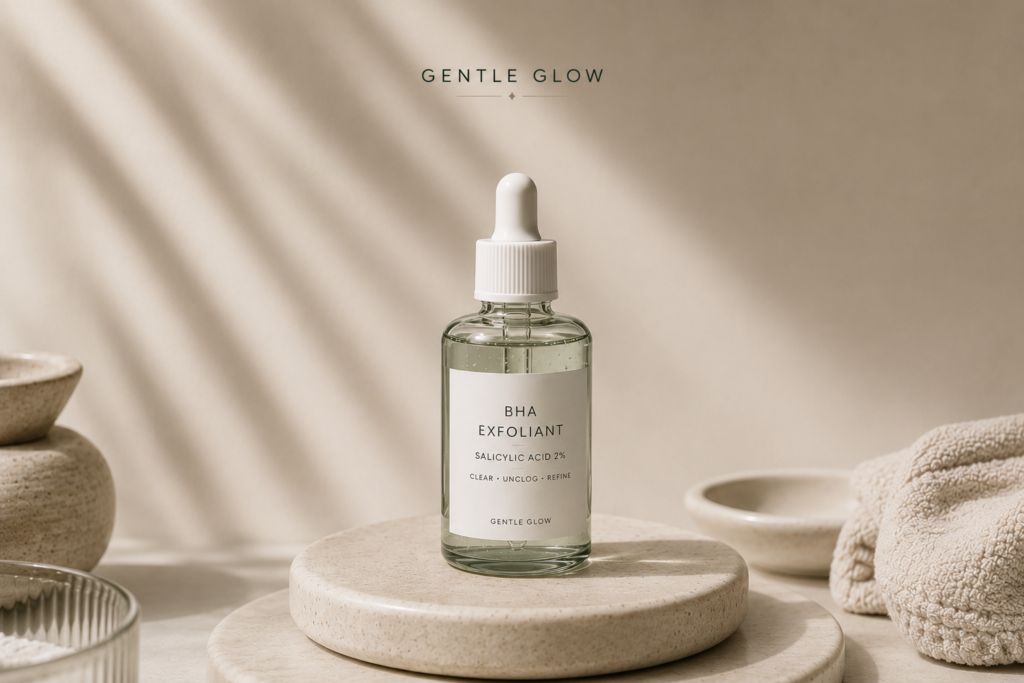
Salicylic Acid (BHA) is the most effective exfoliant for oily acne-prone skin because it is oil-soluble and can penetrate inside the pore to clear buildup where breakouts begin.
- Best for: blackheads, clogged pores, excess oil
- Works by: dissolving oil and dead skin inside the pore
- Why it matters: targets congestion at its source rather than only improving surface texture
To understand how Salicylic Acid (BHA) works specifically for oily skin and why it’s considered the gold standard for clogged pores, you can explore our detailed guide on how it clears buildup and prevents recurring breakouts.
Chemical vs physical exfoliation
For oily skin, exfoliation often feels more effective when you can physically “feel” it working. This is why scrubs remain appealing.
But with acne-prone skin, this approach can easily become disruptive.
Physical exfoliation—especially harsh scrubs—can create friction that weakens the skin barrier, leading to irritation and, over time, more breakouts. When this happens, skin can start to feel both oily and tight at the same time—a pattern often linked to dehydration rather than excess oil alone.
If that sounds familiar, it helps to understand how oil production and hydration are connected beneath the surface, and why a weakened barrier can actually make oily skin behave more unpredictably.
Chemical exfoliation, on the other hand, works without friction. It gradually dissolves buildup and helps keep pores clear in a more controlled and consistent way.
For those who still prefer a tactile step, a softer approach—sometimes referred to as gentle mechanical assistance—can be used. This might include a soft cloth or silicone brush used lightly alongside a chemical exfoliant, rather than replacing it.
A Simple Weekly Exfoliation Routine for Oily and Acne-Prone Skin
Once you have the right exfoliant, the next step is understanding how to use it without overwhelming your skin.
This is where many routines start to feel inconsistent—not because the product is wrong, but because it’s used too often or too close to other active ingredients.
A more balanced approach is to space exfoliation across the week, allowing time for recovery and treatment in between.
How often should you exfoliate oily acne-prone skin?
Most oily, acne-prone skin responds best to exfoliating 1–3 times per week, depending on how well your skin tolerates active ingredients.
- 1 time per week → if your skin feels sensitive or easily irritated
- 2 times per week → a balanced routine for most people
- 3 times per week → only if your skin is more resilient and already used to actives
Exfoliating more frequently doesn’t necessarily lead to clearer skin. In many cases, it can disrupt the skin barrier and trigger reactive seborrhea, where the skin produces more oil to compensate.
A simple weekly structure you can follow
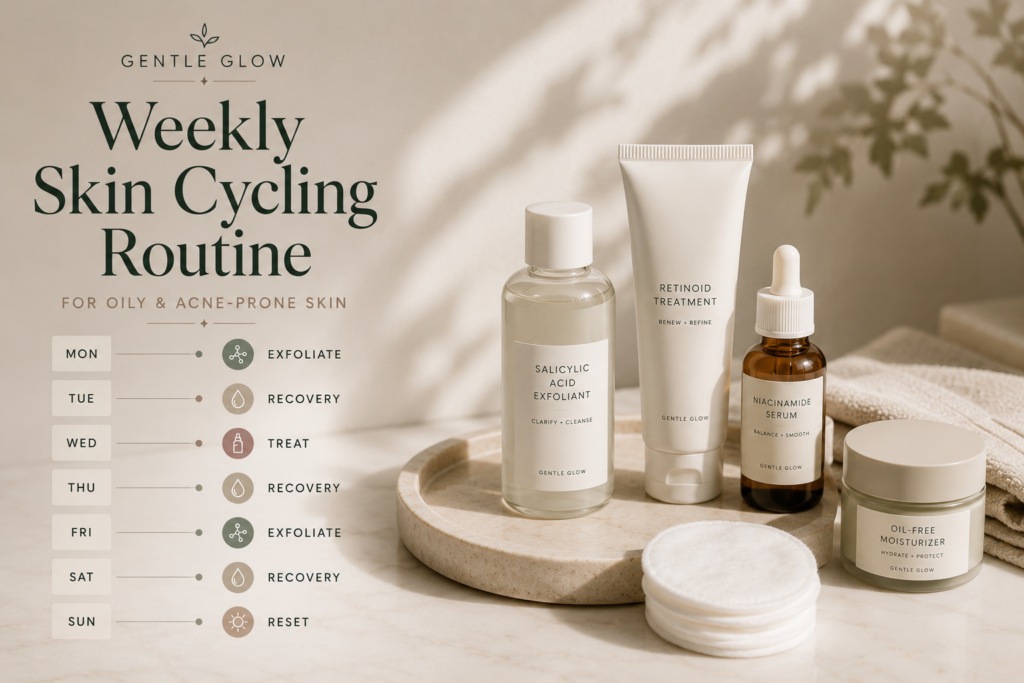
A consistent routine works best when exfoliation is spaced across the week, rather than repeated too closely together. This allows the skin to clear buildup while still having enough time to recover and maintain a healthy balance.
| Day | Focus | Routine |
|---|---|---|
| Monday | Exfoliation | Salicylic Acid (BHA) |
| Tuesday | Recovery | Gentle cleanser + non-comedogenic moisturizer + Niacinamide |
| Wednesday | Treatment | Retinoid (if using) |
| Thursday | Recovery | Barrier-support routine |
| Friday | Exfoliation | BHA or gentle acid |
| Saturday | Recovery | Hydration-focused routine |
| Sunday | Reset | Minimal routine |
A barrier-support routine focuses on keeping the skin calm and hydrated rather than treating it aggressively. This usually means using a gentle cleanser, a non-comedogenic moisturizer, and supportive ingredients like Niacinamide that support the skin’s natural lipid barrier during recovery, as studies on epidermal barrier repair have shown this process plays an important role in maintaining skin stability after irritation.
Spacing exfoliation this way allows the skin to recover between active nights, which helps maintain a more stable balance instead of triggering cycles of irritation and excess oil. Over time, this approach—often referred to as skin cycling—helps regulate how the skin responds, rather than constantly pushing it to react.
Should You Exfoliate in the Morning or at Night?
Exfoliation is best done at night, especially for oily and acne-prone skin. Freshly exfoliated skin can be more sensitive to sunlight, so applying exfoliating acids in the evening helps reduce the risk of UV-related irritation. It also gives the skin time to recover overnight, when natural repair processes are more active.
If your routine includes a Vitamin C serum in the morning, it’s usually better to keep Salicylic Acid (BHA) in your evening routine rather than layering multiple active ingredients at once. Spacing them out allows each step to work more effectively while keeping the routine easier for the skin to tolerate.
The Biggest Mistake in Weekly Exfoliation Routines
Exfoliation often feels like something you should do more of when your skin looks oily or congested. It gives the impression that buildup needs to be removed quickly and consistently.
That instinct is understandable—but it’s also where many routines start to become less effective over time.
Because when exfoliation is repeated too frequently, or used without enough recovery in between, the skin doesn’t simply become clearer. Instead, it can start to feel more reactive, more sensitive, and sometimes even more oily than before.
This is where the focus needs to shift.
The goal isn’t to remove as much oil as possible—it’s to help the skin maintain a more stable balance across the week.
When that balance is disrupted, the skin often responds by producing more oil to compensate, a pattern sometimes described as reactive seborrhea. This is one of the reasons why increasing exfoliation doesn’t always lead to better results.
A more effective approach is to think in terms of rhythm rather than repetition.
Instead of asking how often exfoliation should be repeated, it becomes more useful to consider how it fits between recovery, hydration, and other active treatments.
Why Exfoliation Alone Doesn’t Work
Even when the right exfoliant is used, results can feel inconsistent if it isn’t balanced with the rest of your routine.
This is especially common when multiple active ingredients are involved.
For example, using Salicylic Acid (BHA) alongside retinoids can be highly effective—but only when they are spaced correctly. When used too close together, they can increase irritation and weaken the skin barrier, which can lead to more breakouts rather than fewer.
This doesn’t mean these ingredients shouldn’t be used. It simply means they need to be coordinated.
If your skin has ever felt clearer for a few days and then suddenly more reactive, it may be a sign that your routine is working against itself rather than together.
In many cases, what looks like stubborn acne or excess oil is actually the result of overlapping active treatments, rather than a lack of exfoliation.
Once that becomes clear, the focus shifts again—from adding more products to structuring them more effectively.
How to Balance BHA and Retinoids in a Weekly Routine
Using Salicylic Acid (BHA) and retinoids in the same routine can be highly effective for oily, acne-prone skin—but only when they are spaced correctly.
Both ingredients work in different ways. BHA helps clear buildup inside the pore, while retinoids support longer-term skin renewal and help prevent clogged pores from forming in the first place.
When used too close together, however, they can increase irritation and weaken the skin barrier, which may lead to more breakouts rather than fewer.
This is why timing matters more than intensity.
A simple way to use BHA and retinoids without overloading your skin
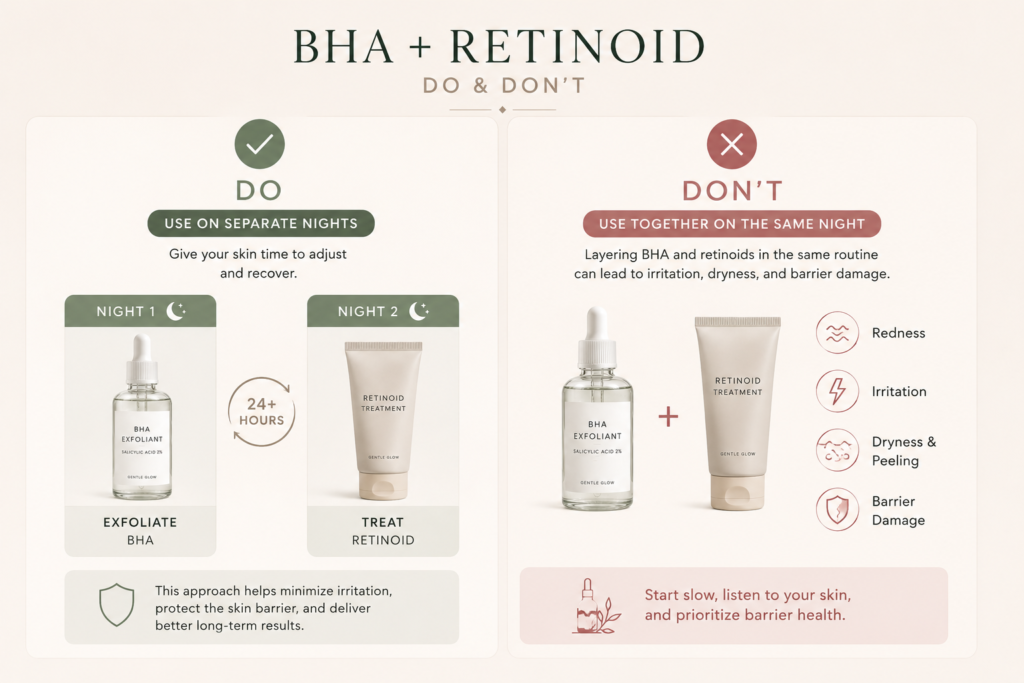
Use BHA and retinoids on separate nights, with recovery in between.
- Do use BHA on designated exfoliation nights
- Do use retinoids on separate treatment nights
- Do leave at least one recovery night in between when possible
- Don’t use BHA and retinoids in the same routine
- Don’t increase both at the same time
- Don’t layer multiple strong actives late at night
Some oily skin routines also rotate exfoliation nights with lower-strength benzoyl peroxide treatments for inflammatory breakouts instead of stacking everything into the same routine.
Spacing these ingredients allows each one to work effectively without overwhelming the skin. Over time, this leads to more consistent results and reduces the likelihood of irritation.
If you’re already using retinoids, following a structured routine like this can make a noticeable difference in how your skin responds. This becomes even more important when using faster-converting retinoids like retinaldehyde, which may feel more active on oily acne-prone skin compared to traditional retinol.
What to Apply After Exfoliating Acne-Prone Skin
After exfoliating, the focus should shift from treatment to balance.
After exfoliating acne-prone skin, apply a lightweight, non-comedogenic moisturizer and barrier-supporting ingredients like Niacinamide to maintain hydration and reduce irritation.
- Non-comedogenic moisturizer → restores hydration without clogging pores
- Niacinamide → helps regulate oil and supports the skin barrier. It’s often combined with Zinc PCA, which complements Niacinamide by supporting balanced sebum production and helping maintain a healthier skin environment after exfoliation.
- Gentle cleanser (if needed earlier in routine) → avoids over-stripping
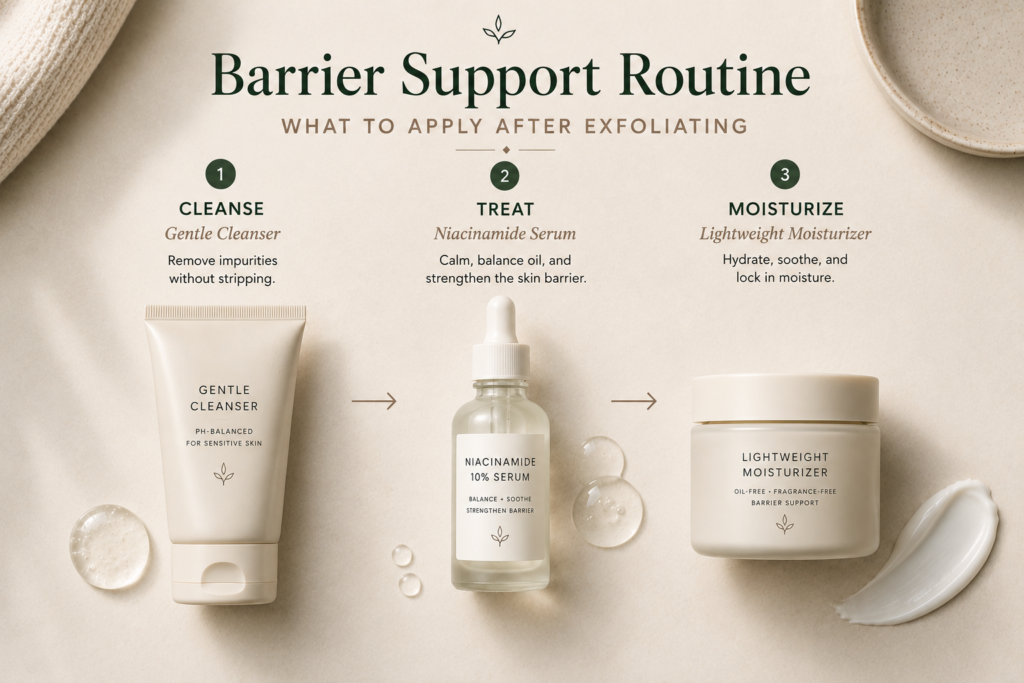
Avoid layering additional strong actives immediately after exfoliation, as this can increase sensitivity rather than improve results.
Avoiding the Over-Exfoliation Trap
Exfoliation becomes less effective when it’s used too frequently or without enough recovery in between.
Over time, this can weaken the skin barrier, making the skin more reactive, less predictable, and sometimes more prone to breakouts.

Signs of a damaged skin barrier
- Skin feels tight and oily at the same time
- Increased sensitivity or stinging
- More frequent breakouts despite treatment
- Redness or uneven texture
If you’re noticing these patterns, it usually means the routine needs to be adjusted rather than intensified.
A more balanced approach—reducing exfoliation and focusing on recovery—can help restore stability.
If you want a step-by-step approach to recovery, it helps to follow a structured method for repairing the skin and restoring balance, especially after over-exfoliation.
How Exfoliation Helps Prevent Clogged Pores
Exfoliation plays an important role in managing oily, acne-prone skin—but its effect is gradual rather than immediate.

By removing buildup before it accumulates, ingredients like Salicylic Acid (BHA) help keep pores clearer over time. This reduces the likelihood of blackheads and congestion forming, rather than treating them after they appear.
If you want to understand this process more deeply, it helps to look at how oil and dead skin interact inside the pore, and how this can lead to visible buildup when left unmanaged.
Final Takeaway
A weekly exfoliation routine doesn’t need to be complicated to be effective.
What matters most is how each step fits into the rest of your routine.
Using Salicylic Acid (BHA) consistently—but not excessively—helps keep pores clear. Allowing time for recovery helps maintain a stable skin barrier. And spacing active ingredients correctly prevents the cycle of irritation and over-correction that often leads to inconsistent results.
Over time, this more balanced approach tends to feel less reactive and more predictable—allowing the skin to respond rather than constantly adjust.
Frequently Asked Questions
Can I exfoliate every night if my skin is very oily?
No, you should not exfoliate every night. Even for very oily skin, daily exfoliation can lead to reactive seborrhea, a condition where the skin produces excess oil to compensate for a damaged barrier. Stick to 1–3 times per week to keep pores clear without triggering inflammation.
Should you exfoliate in the morning or at night?
It is best to exfoliate at night. Chemical exfoliants like Salicylic Acid (BHA) can make your skin more sensitive to UV rays. Exfoliating in the evening allows your skin to recover and regenerate while you sleep, away from sun exposure.
Which acid is best for blackheads on the nose?
Salicylic Acid (BHA) is the gold standard for blackheads on the nose. Because it is oil-soluble, it can penetrate deep into the sebaceous filament to dissolve the hardened plug of oil and dead skin that causes the blackhead.
Can I use Vitamin C and BHA together?
It is best to separate them. Use your Vitamin C serum in the morning for antioxidant protection and your BHA exfoliant in the evening. Using them at the same time can disrupt the pH balance of the products and increase the risk of skin irritation.
Why does my skin feel “tight but oily” after exfoliating?
This “tight but oily” sensation is a classic sign of dehydrated oily skin. It happens when you have stripped away the skin’s moisture barrier through over-exfoliation. To fix this, reduce your exfoliation frequency and focus on non-comedogenic hydration and barrier-repair ingredients like Ceramides and Niacinamide.
Sources and References
BHA / exfoliation mechanism
- Acne: Diagnosis and treatment
https://www.aad.org/public/diseases/acne/derm-treat/treat - Topical salicylic acid as a peeling agent: a comprehensive review
https://pubmed.ncbi.nlm.nih.gov/26347269/ - Acne vulgaris: A review of the pathophysiology, treatment, and recent nanotechnology based advances
https://pmc.ncbi.nlm.nih.gov/articles/PMC10709101/
Skin barrier repair and recovery
- Nicotinamide increases biosynthesis of ceramides as well as other stratum corneum lipids to improve the epidermal permeability barrier
- https://pubmed.ncbi.nlm.nih.gov/10971324/
This article is based on dermatology research and peer-reviewed studies on acne pathogenesis, hormonal signaling, and skin barrier function.
Medical Disclaimer
Gentle Glow guides are developed using peer-reviewed dermatology research and established clinical guidelines. The information provided is for educational purposes only and does not replace professional medical advice, diagnosis, or treatment. Always consult a board-certified dermatologist or qualified healthcare provider before starting new active skincare treatments.