كل ما تحتاجين معرفته عن البشرة الدهنية

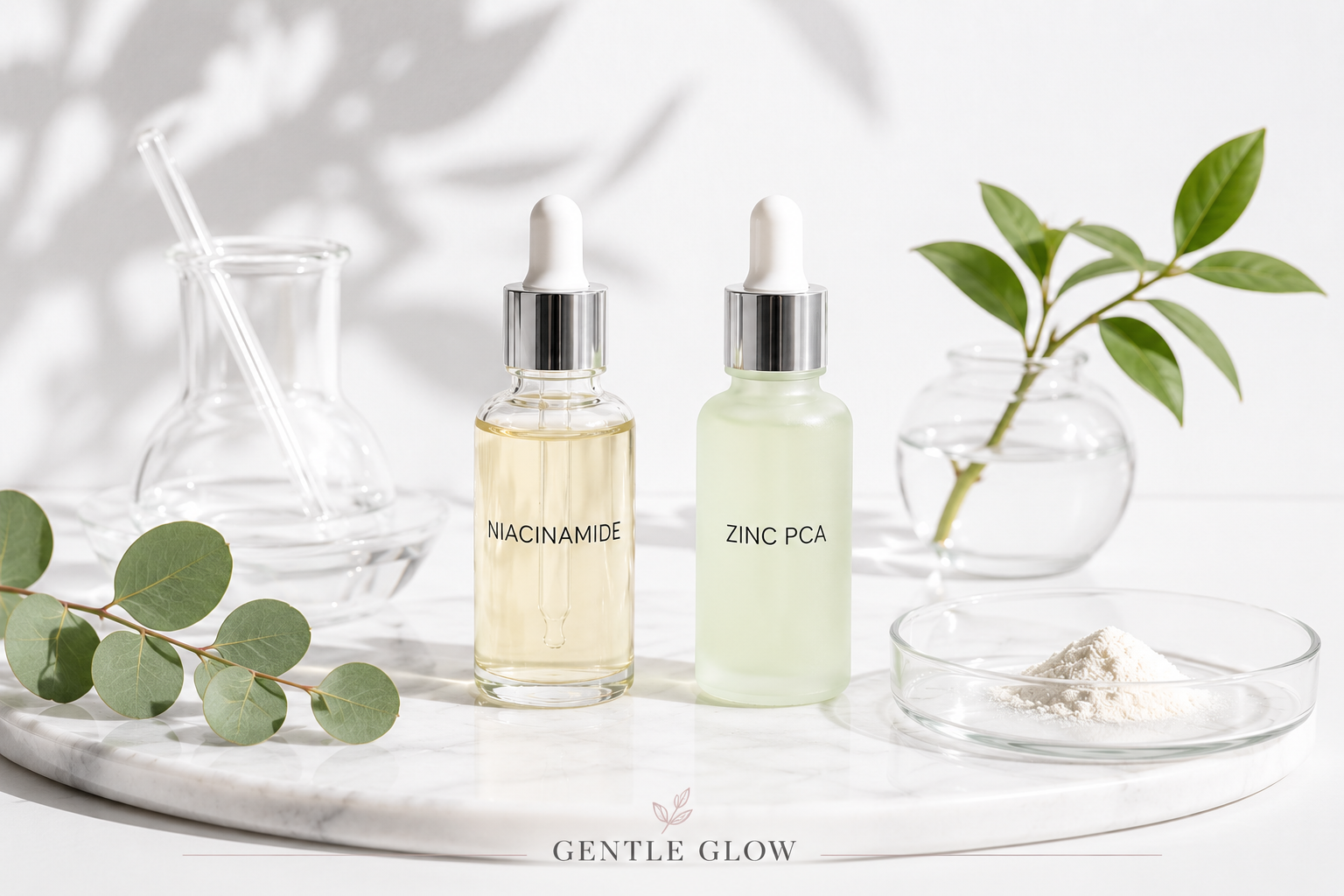
How Niacinamide and Zinc PCA Regulate Sebum Production (2026 Guide)

راجع المحتوى طبيًا
جمال حنين، بكالوريوس صيدلة
صيدلي ومراجع طبي لدى Gentle Glow
Reviewed يوليو 21, 2026
Niacinamide and Zinc PCA help support balanced sebum production through different but complementary mechanisms. النياسيناميد supports the biological processes involved in sebum regulation while strengthening the skin barrier, whereas Zinc PCA combines zinc with Pyrrolidone Carboxylic Acid (PCA) to support hydration, skin comfort, and balanced oily skin care.
- Balanced Oil Support: Niacinamide helps support balanced sebum production while reinforcing the skin barrier instead of simply removing surface oil.
- Complementary Mechanisms: Zinc PCA provides anti-inflammatory, antibacterial, and hydration-supporting benefits that complement Niacinamide’s role in supporting oily and acne-prone skin.
- Long-Term Results: Visible improvements in excess shine typically develop gradually over several weeks of consistent use rather than overnight.
جدول المحتويات
Watch: Why You Should Use Niacinamide and Zinc PCA Together for Oily Skin
Why Regulating Sebum Is Different from Simply Removing Oil
If you’ve ever searched for ways to reduce oily skin, you’ve probably come across products that promise to “control oil,” “mattify,” أو “shrink pores.” While those claims sound appealing, they often overlook how sebum production actually works.
تشير الأبحاث حول sebaceous gland physiology shows that excess facial oil originates deeper within the skin, not from oil simply sitting on the surface. The sebaceous glands produce sebum—a natural mixture of lipids that helps lubricate the skin, strengthen the حاجز البشرة أو تهيّجها, and reduce transepidermal water loss (TEWL).
That’s why removing oil و تنظيم إفراز الزهم وحماية الحاجز الجلدي. are not the same thing.
Cleansers, blotting papers, and mattifying powders can temporarily remove excess shine that’s already on the skin’s surface. While they can be useful as part of an oily skin routine, they don’t influence how much sebum your sebaceous glands produce over the hours and days that follow.
Niacinamide and Zinc PCA take a different approach. Instead of focusing on the oil you can already see, they help support the biological processes involved in تنظيم إفراز الدهون. Over time, this can encourage a healthier balance between oil production, حاجز البشرة أو تهيّجها function, and hydration rather than relying on repeated oil removal throughout the day.
This distinction is especially important because healthy skin isn’t oil-free skin. Sebum plays an essential role in protecting the skin and keeping the barrier functioning properly. When routines become overly focused on stripping away oil, some people notice a cycle where their skin feels tight after cleansing yet becomes noticeably shinier again later. Supporting balanced sebum production and maintaining the skin barrier may help reduce reliance on repeated oil removal, and encourage a healthier long-term approach to managing oily skin.
The sections below explain how Niacinamide and Zinc PCA influence different stages of sebum production, what current research shows, and how to use them as part of a balanced routine for oily and acne-prone skin.
How Sebum Is Produced: Understanding the Sebaceous Gland
To understand how النياسيناميد و Zinc PCA help regulate sebum production, it helps to first understand where sebum comes from and why your skin produces it in the first place.
تشير الأبحاث حول sebaceous gland physiology shows that sebaceous glands are small oil-producing glands found throughout the skin, with the highest concentration on the face, scalp, chest, and upper back. Most are connected to a hair follicle, forming what dermatologists call the الوحدة الشعرية الدهنية،. This is where sebum is produced and released onto the skin’s surface.
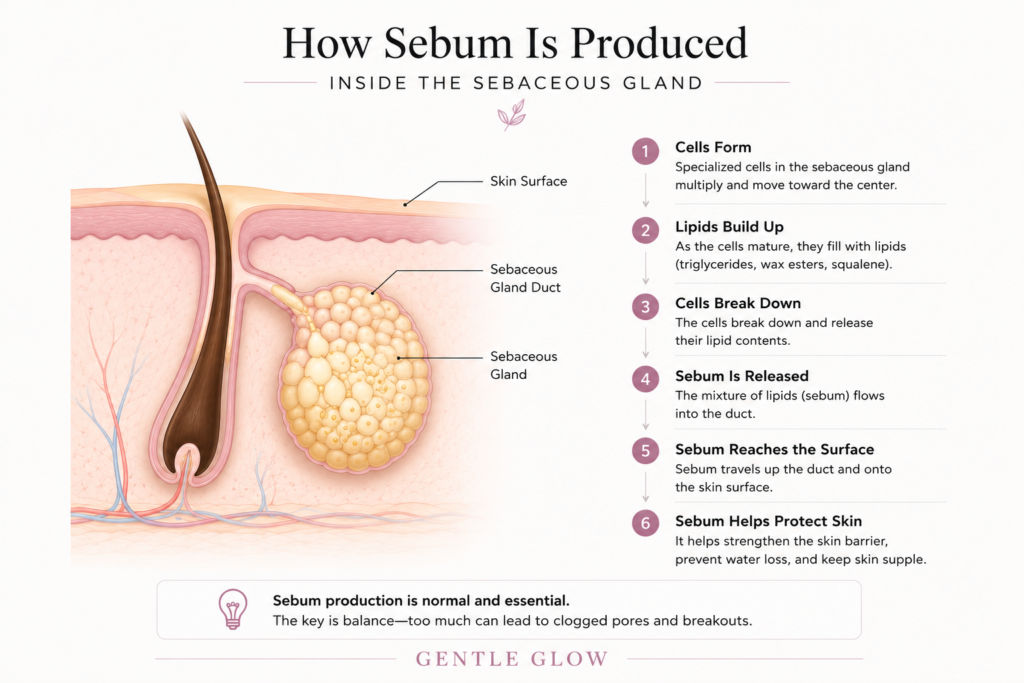
Inside each sebaceous gland are specialized cells called الخلايا الزهمية (Sebocytes). These cells gradually fill with lipids before breaking down and releasing their contents as الزهم (Sebum)، through a natural process known as holocrine secretion. Unlike sweat, which is secreted continuously, sebum is produced through the life cycle of these cells and then carried to the skin’s surface through the hair follicle.
Far from being something your skin should eliminate completely, sebum serves several essential functions. It helps lubricate the skin, supports the حاجز البشرة أو تهيّجها, reduces فقدان الماء عبر البشرة (TEWL)., and contributes to the skin’s natural defense against environmental stressors and certain microorganisms.
The challenge isn’t that oily skin produces sebum—it’s how much is produced and how it behaves once it reaches the surface.
When sebaceous glands become overactive, excess sebum can mix with dead skin cells inside the follicle. This creates an environment where pores are more likely to become congested, particularly if the oil thickens or oxidizes after being exposed to air. Over time, this can contribute to الرؤوس السوداء, الخيوط الدهنية, inflammatory acne, and the appearance of مسام واسعة.
This is why effective oil management isn’t simply about removing excess shine throughout the day. The most sustainable approach is to support healthier sebum regulation before excess oil reaches the skin’s surface. That’s exactly where ingredients such as النياسيناميد و Zinc PCA begin to make a meaningful difference.
How Niacinamide Helps Regulate Sebum Production
Niacinamide helps regulate sebum production by supporting the biological processes that influence how much oil the sebaceous glands produce over time. Rather than removing excess oil that’s already on the skin’s surface, it helps promote balanced sebum production while also supporting the skin barrier. As a result, improvements in oily skin typically develop gradually with consistent use rather than immediately after application.
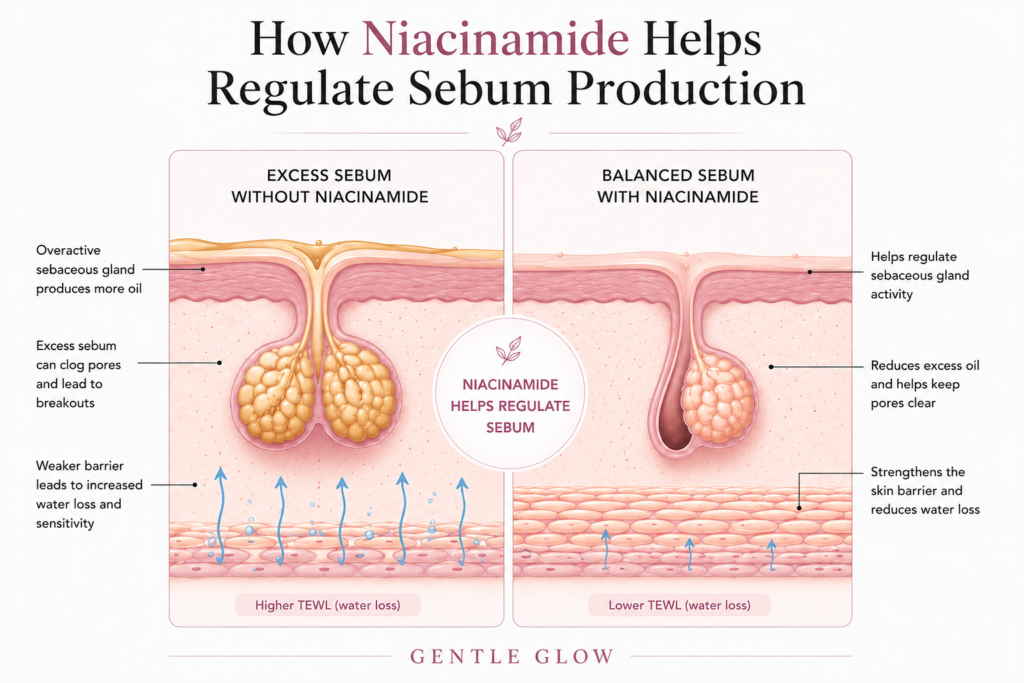
One of the biggest misconceptions about النياسيناميد is that it simply “reduces oil.” In reality, research suggests its effects are much more nuanced.
Instead of acting like an oil-absorbing ingredient, النياسيناميد helps regulate several biological processes involved in sebum production. This approach supports healthier oil balance over time rather than temporarily removing the shine that’s already visible on the skin.
Niacinamide Helps Regulate Lipid Production Inside Sebaceous Glands
تشير الأبحاث حول topical niacinamide and sebum production suggests that Niacinamide can help reduce sebum excretion rates in people with oily skin following consistent use. Rather than simply absorbing oil from the skin’s surface, Niacinamide helps support the natural processes that regulate sebum production over time. Clinical studies have shown that it can reduce excess oil in people with oily skin, while laboratory research suggests it may influence how sebaceous glands produce the lipids that become sebum. Researchers are still learning exactly how these effects occur.
Inside each sebaceous gland, sebocytes continuously manufacture lipids such as triglycerides, wax estersو السكوالين before releasing them as sebum. When this process becomes overactive, excess oil reaches the skin’s surface, increasing shine and making pores more likely to become congested.
Niacinamide doesn’t switch this system off. Instead, current evidence suggests it helps support more balanced sebum production while allowing the skin to retain the protective functions of sebum.
This distinction is important because healthy skin still needs sebum. The goal isn’t to eliminate oil entirely but to support a healthier balance between sebum production, حاجز البشرة أو تهيّجها function, and hydration.
Supporting the Skin Barrier May Help Support Healthier Oil Balance
Niacinamide’s benefits extend beyond the sebaceous gland.
A growing body of research indicates that topical niacinamide helps strengthen the skin barrier by increasing the production of ceramides and other barrier lipids. A stronger barrier helps reduce فقدان الماء عبر البشرة (TEWL). and improves the skin’s ability to retain moisture.
While barrier support doesn’t directly reduce sebum production, it creates a healthier environment for oily skin.
When the skin becomes dehydrated or irritated, many people respond by cleansing more frequently or using increasingly harsh products in an attempt to remove excess shine. Over time, this can create a cycle where the skin feels tight after cleansing but still appears oily later in the day.
Supporting the skin barrier may encourage a more balanced skincare routine by reducing the tendency to rely on repeated cleansing or harsh oil-removing products.
Niacinamide Also Helps Calm Visible Inflammation
Excess sebum is only one factor involved in acne-prone skin.
Research indicates that النياسيناميد also has anti-inflammatory properties, helping reduce visible redness and supporting a calmer skin environment. Although this doesn’t directly control how much sebum the glands produce, reducing inflammation may help interrupt some of the processes that contribute to persistent breakouts.
This is one reason Niacinamide is frequently included in routines designed for للبشرة الدهنية والمعرضة لحب الشباب. Instead of targeting a single concern, it supports several interconnected processes—including تنظيم إفراز الدهون, حاجز البشرة أو تهيّجها function, and visible inflammation.
What the Research Actually Shows
Current clinical evidence suggests that النياسيناميد can contribute to more balanced sebum production, particularly when used consistently as part of a well-formulated skincare routine.
Studies have reported improvements in:
- Sebum excretion rates in people with oily skin.
- Visible facial shine, especially across the forehead, nose, and chin.
- Skin barrier function and hydration.
- The overall appearance of مسام واسعة, likely because better-controlled sebum production and reduced congestion make pores appear less noticeable rather than permanently changing their size.
It’s equally important to understand what the research doesn’t show.
Niacinamide isn’t an instant mattifying ingredient, and it doesn’t permanently shrink pores or stop the skin from producing oil. Instead, it helps support healthier تنظيم إفراز الدهون over time while preserving the protective functions that sebum naturally provides.
How Zinc PCA Helps Regulate Sebum Production
Zinc PCA helps regulate sebum production by combining two complementary ingredients with different roles. Zinc supports healthy sebum regulation while providing anti-inflammatory و antimicrobial benefits, whereas Pyrrolidone Carboxylic Acid (PCA) helps maintain hydration as a natural component of the skin’s عوامل الترطيب الطبيعية (NMF). Together, they support oily and acne-prone skin without relying on harsh oil removal.
Zinc PCA is a combination ingredient made from الزنك و Pyrrolidone Carboxylic Acid (PCA), a naturally occurring component of the skin’s عوامل الترطيب الطبيعية (NMF). Together, these two components help support balanced sebum production, maintain hydration, and support overall skin comfort in oily and acne-prone skin.
Each part contributes something different. Zinc is best known for its anti-inflammatory, antimicrobial, and potential sebum-regulating properties, while PCA helps attract and retain water within the outer layer of the skin, supporting the حاجز البشرة أو تهيّجها without leaving skin feeling heavy or greasy.
Unlike Niacinamide, which primarily helps regulate the biological processes involved in sebum production while strengthening the حاجز البشرة أو تهيّجها, Zinc PCA works through a different set of complementary mechanisms. Rather than targeting the same pathways, these ingredients support oily skin in different ways, which is why they’re frequently formulated together instead of being used as interchangeable alternatives.
Zinc May Help Moderate Excess Sebum Production
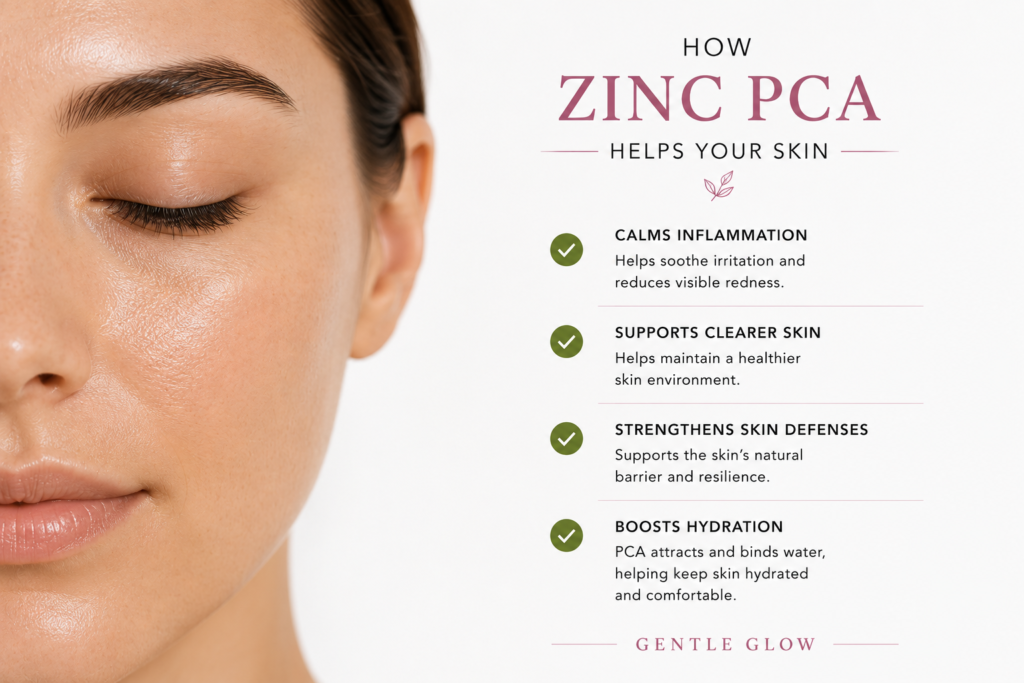
تشير الأبحاث حول zinc and the pathophysiology of acne suggests that zinc contributes to healthier skin through several complementary mechanisms, including anti-inflammatory, antibacterialو potential sebum-regulating effects.
Rather than acting as an ingredient that simply absorbs excess oil from the skin’s surface, zinc appears to help create a healthier environment for للبشرة الدهنية والمعرضة لحب الشباب by calming visible inflammation and helping limit the growth of acne-associated bacteria. These effects can complement other ingredients that target تنظيم إفراز الدهون more directly.
Laboratory research has also suggested that zinc ions may influence 5α-reductase activity, an enzyme involved in regulating sebum production within the sebaceous glands. However, much of this evidence comes from laboratory and mechanistic studies rather than large human clinical trials, and additional research is needed to determine how this contributes to the effects of topical Zinc PCA in everyday skincare.
PCA Helps Maintain Hydration While Supporting the Skin Barrier
The second part of Zinc PCA is often overlooked.
Pyrrolidone Carboxylic Acid (PCA) is a naturally occurring component of the skin’s عوامل الترطيب الطبيعية (NMF)—a collection of water-binding molecules found within the outermost layer of the skin.
تشير الأبحاث حول Natural Moisturizing Factor and skin hydration shows that components of the skin’s عوامل الترطيب الطبيعية (NMF) help maintain water within the stratum corneum, supporting skin hydration, barrier function, and overall skin resilience.
This means Zinc PCA isn’t simply delivering zinc. The PCA component also helps support the حاجز البشرة أو تهيّجها by maintaining hydration, making the ingredient particularly well suited to people with oily skin who want better oil balance without leaving their skin feeling dry or tight.
Why Zinc PCA Is Different from Other Forms of Zinc
Zinc PCA is different from other forms of zinc because it combines the skin-supporting properties of zinc with the hydrating benefits of Pyrrolidone Carboxylic Acid (PCA). Unlike forms of zinc designed primarily for sun protection or medical use, Zinc PCA is formulated to help support تنظيم إفراز الدهون, maintain hydration, and improve overall skin comfort in lightweight leave-on products.
Not all zinc-containing skincare ingredients behave the same way.
على سبيل المثال، قد يبدو أكسيد الزنك is primarily used as a UV filter in mineral sunscreens, while zinc sulfate is more commonly found in medical or pharmaceutical formulations.
Zinc PCA was developed with a different purpose. By combining الزنك ومكوّن Pyrrolidone Carboxylic Acid (PCA), formulators create an ingredient that helps support balanced sebum production, skin hydrationو حاجز البشرة أو تهيّجها function without leaving the skin feeling heavy or greasy.
What the Research Actually Shows
Current research suggests that Zinc PCA may contribute to healthier تنظيم إفراز الدهون through several complementary mechanisms.
Studies indicate that it may help:
- Moderate excess sebum production without completely eliminating the skin’s natural oils.
- Support a skin environment associated with acne management through zinc’s antimicrobial activity.
- Help calm visible inflammation, making it particularly useful for للبشرة الدهنية والمعرضة لحب الشباب.
- Maintain hydration through the PCA component, reducing the likelihood of skin feeling tight after application.
Like النياسيناميد, Zinc PCA should be viewed as a long-term supportive ingredient rather than an instant solution for excess shine. Consistent use as part of a balanced skincare routine is more important than expecting immediate changes after a few applications.
Why Niacinamide and Zinc PCA Work Better Together
Many serums combine Niacinamide and Zinc PCA because they bring different strengths to the same formula. Formulators often pair these ingredients because they support oil balance, hydration, and skin barrier function in complementary ways. Although each ingredient has independent evidence supporting its benefits, direct clinical studies evaluating the combination itself remain limited.
| Function | النياسيناميد | Zinc PCA |
|---|---|---|
| Primary role | Helps regulate the biological processes involved in sebum production | Helps create a healthier environment for oily skin through anti-inflammatory, antibacterial, and hydration-supporting properties |
| Skin barrier | Supports ceramide production and reduces فقدان الماء | Supports hydration through the PCA component, part of the skin’s عوامل الترطيب الطبيعية (NMF) |
| Oil management | Helps promote balanced sebum production over time | Complements sebum regulation while supporting overall skin comfort |
| Acne support | Helps calm visible inflammation | Helps limit acne-associated bacteria while supporting a calmer skin environment |
| Best approach | Long-term support | Works alongside Niacinamide rather than replacing it |
These ingredients address different factors that contribute to oily skin. النياسيناميد focuses on supporting the skin’s natural processes involved in تنظيم إفراز الدهون, while Zinc PCA helps create conditions that allow oily skin to remain balanced and comfortable.
For people with للبشرة الدهنية والمعرضة لحب الشباب, this balanced strategy is often preferable to using products designed solely to remove oil from the skin’s surface. Supporting تنظيم إفراز الدهون, حاجز البشرة أو تهيّجها function, hydration, and visible inflammation together addresses several interconnected factors that influence how oily skin behaves throughout the day.
Myth vs. Reality
| Myth | Reality |
|---|---|
| Niacinamide and Zinc PCA do the same thing. | They work through different biological mechanisms and are designed to complement each other. |
| Using both is unnecessary. | Combining complementary ingredients often provides broader support than relying on a single active ingredient. |
| More oil control always means better results. | Healthy oily skin still needs الزهم (Sebum)، to protect the حاجز البشرة أو تهيّجها. The goal is balance, not complete oil removal. |
How Long Does Niacinamide and Zinc PCA Take to Work?
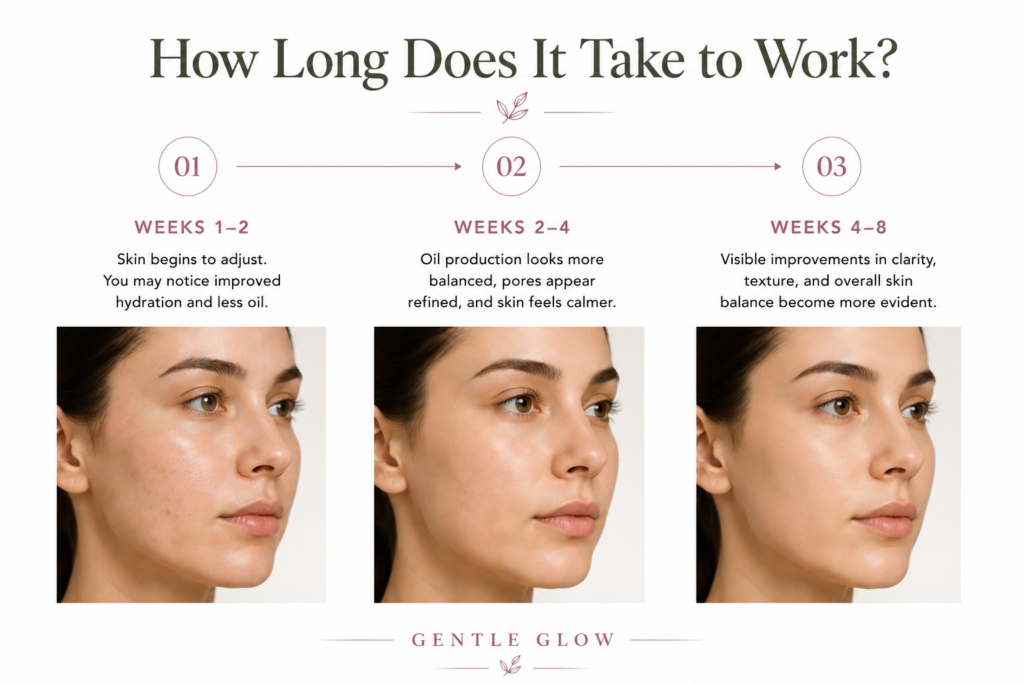
Niacinamide and Zinc PCA don’t reduce excess oil overnight. Most people notice gradual improvements over several weeks of consistent use as the skin adjusts and the biological processes involved in تنظيم إفراز الدهون respond to treatment. Improvements in hydration and skin comfort often appear before visible reductions in facial shine.
Like most leave-on skincare ingredients, using a well-formulated product consistently is likely to have a greater impact than simply choosing the highest available concentration. Using a well-formulated product daily is generally more effective than frequently switching products or choosing unnecessarily high percentages in the hope of faster results.
Although individual experiences vary depending on skin type, routine, and the underlying causes of excess oil production, the timeline below reflects what many people can realistically expect.
| Timeframe | What You May Notice |
|---|---|
| First 1–2 weeks | Skin often feels more comfortable and hydrated, particularly if the routine previously included harsh cleansers or over-drying products. |
| Weeks 2–4 | Midday shine may gradually become less noticeable as تنظيم إفراز الدهون begins to improve with consistent use. |
| Weeks 4–8 | Skin may appear more balanced overall, with less visible oiliness and a healthier-looking complexion. Some people also notice that pores appear less noticeable as excess sebum becomes better controlled. |
| Beyond 8 weeks | Continued use helps maintain results as part of a long-term routine focused on supporting the حاجز البشرة أو تهيّجها and balanced sebum production. |
It’s important to remember that النياسيناميد و Zinc PCA don’t permanently change the size of your sebaceous glands or stop your skin from producing oil. Instead, they help support healthier تنظيم إفراز الدهون while preserving the protective functions that sebum naturally provides.
If your skin continues to produce excessive oil despite a consistent skincare routine, factors such as genetics, hormonal influences, climate, medications, or underlying skin conditions may also be contributing. In those situations, skincare can help manage symptoms, but it may not completely eliminate oiliness.
How to Use Niacinamide and Zinc PCA in Your Skincare Routine
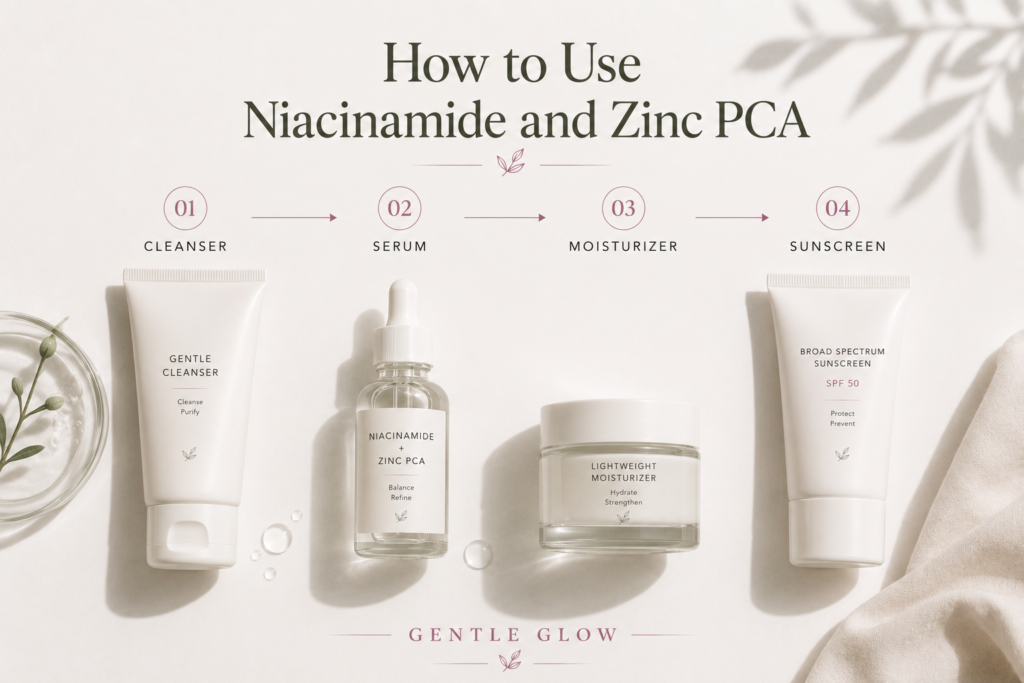
Niacinamide and Zinc PCA can be used together once or twice daily after cleansing and before moisturizer. Because both ingredients are generally well tolerated, they fit easily into most skincare routines and can be combined with other evidence-based ingredients for oily and acne-prone skin when introduced gradually.
Unlike أحماض التقشير أو الريتينويدات, النياسيناميد و Zinc PCA don’t increase skin cell turnover. This makes them suitable for both morning and evening routines, provided they are used as part of a balanced regimen that supports the حاجز البشرة أو تهيّجها.
Morning Routine
A simple morning routine might include:
- قد تكون غسول لطيف to remove overnight oil without disrupting the skin barrier.
- A serum containing Niacinamide and Zinc PCA.
- قد تكون مرطب خفيف if additional hydration is needed.
- قد تكون broad-spectrum sunscreen with at least SPF 30.
Using these ingredients in the morning may help support a more balanced complexion throughout the day while complementing your daily sun protection.
Evening Routine
In the evening, Niacinamide and Zinc PCA can be applied after cleansing and before moisturizer. If your routine also includes salicylic acid or a retinoid, these ingredients can help support the skin barrier and improve overall skin comfort.
على سبيل المثال:
- BHA exfoliants help clear excess oil and dead skin cells from inside the pore.
- الريتينويدات (مشتقات فيتامين A) help normalize skin cell turnover and reduce the formation of new clogged pores.
- Niacinamide and Zinc PCA complement these treatments by supporting balanced sebum production, hydration, and the حاجز البشرة أو تهيّجها.
Rather than replacing proven acne treatments, they work alongside them as supportive ingredients within a well-rounded routine.
Can You Use Niacinamide and Zinc PCA with Other Active Ingredients?
Yes. For most people with للبشرة الدهنية والمعرضة لحب الشباب, النياسيناميد و Zinc PCA pair well with many commonly used skincare ingredients.
| المكوّن | Can You Use It Together? | Why It Works |
|---|---|---|
| حمض الساليسيليك (BHA) | ✅ Yes | Helps unclog pores while النياسيناميد و Zinc PCA support oil balance and the skin barrier. |
| الريتينويدات (مشتقات فيتامين A) | ✅ Yes | Retinoids improve skin cell turnover, while النياسيناميد helps reduce irritation and supports barrier function. |
| البنزويل بروكسيد | ✅ Yes | Addresses acne-causing bacteria while النياسيناميد و Zinc PCA help maintain skin comfort and hydration. |
| Sunscreen | ✅ Yes | Daily sun protection complements any routine focused on long-term skin health. |
Avoid Chasing Too Many Active Ingredients
Adding more products doesn’t always lead to better results.
If your routine already contains النياسيناميد, Zinc PCAفقد يكون retinoid أو يخترق BHA, and a suitable المرطب و sunscreen, introducing multiple additional actives may increase the likelihood of irritation without providing meaningful extra benefit.
For most people with oily skin, consistency, barrier support, and patience are more important than building an increasingly complex routine.
Common Myths About Niacinamide and Zinc PCA
Niacinamide and Zinc PCA are well-studied ingredients, but they’re often surrounded by misconceptions. While both can help support balanced sebum production و البشرة الدهنية, they don’t permanently stop oil production, shrink pores, or replace a complete skincare routine.
Myth: Niacinamide Permanently Shrinks Pores
Reality: Niacinamide doesn’t change the physical size or number of your pores.
What many people notice instead is that pores become less visible as excess sebum is better regulated and congestion decreases. When less oil accumulates within the follicle, the pore opening often appears smaller, even though its underlying structure hasn’t changed.
Myth: Zinc PCA Dries Out Oily Skin
Reality: Unlike ingredients designed to strip away surface oil, Zinc PCA also contains Pyrrolidone Carboxylic Acid (PCA), a naturally occurring component of the skin’s عوامل الترطيب الطبيعية (NMF).
This means it can help support skin hydration while contributing to healthier تنظيم إفراز الدهون, making it well suited to oily skin that is also prone to dehydration.
Myth: Higher Percentages Always Work Better
Reality: More isn’t always better.
Clinical studies demonstrate that Niacinamide can support sebum regulation at concentrations around 2% and 5%. Although higher-strength formulations are widely available, there is currently limited evidence showing they consistently provide better results for most people, while they may increase the likelihood of irritation in some individuals.
Choosing a well-formulated product that you can use consistently is usually more beneficial than chasing the highest percentage available.
Myth: Niacinamide Causes Skin Purging
Reality: Niacinamide doesn’t cause true skin purging.
Purging occurs when ingredients that increase skin cell turnover, such as الريتينويدات أو chemical exfoliants, temporarily bring existing microcomedones to the surface more quickly.
Because النياسيناميد doesn’t work by accelerating cell turnover, new breakouts that appear after starting a product are more likely to be related to irritation, another ingredient in the formula, or a reaction to the product rather than true purging.
If irritation develops, consider reducing how often you use the product or choosing a formulation with a lower النياسيناميد concentration.
الخلاصة
Instead of trying to eliminate every trace of oil, النياسيناميد و Zinc PCA help support the biological processes that keep oily skin functioning at its best.
Understanding what these ingredients can و cannot do makes it easier to set realistic expectations and build a routine that focuses on long-term skin health rather than temporary shine control.
الأسئلة الشائعة
Can Niacinamide and Zinc PCA be used together?
Yes. Niacinamide and Zinc PCA can be used together because they support oily skin through different but complementary mechanisms, although direct clinical studies evaluating the combination remain limited. Niacinamide helps regulate the biological processes involved in sebum production while strengthening the حاجز البشرة أو تهيّجها, whereas Zinc PCA contributes anti-inflammatory, antibacterial, and hydration-supporting benefits. Together, they provide a balanced approach to managing oily and acne-prone skin.
For most people, products containing both ingredients can be used once or twice daily after cleansing and before moisturizer.
Does Zinc PCA reduce sebum production?
Research suggests that Zinc PCA may help support healthier sebum regulation, but it should not be viewed as an instant oil-control ingredient. Current evidence indicates that zinc contributes anti-inflammatory و antibacterial benefits, while laboratory studies suggest it may also influence biological pathways involved in sebum production.
Because much of this evidence remains mechanistic, Zinc PCA is best considered a supportive ingredient within a complete skincare routine.
Does Niacinamide cause skin purging?
No. Niacinamide does not cause true skin purging because it doesn’t increase skin cell turnover. If new breakouts develop after starting a niacinamide product, they are more likely to be related to irritation, another ingredient in the formulation, or an unrelated acne flare rather than purging.
If irritation occurs, reducing application frequency or choosing a lower concentration may help.
What percentage of Niacinamide is best for oily skin?
Current evidence suggests that concentrations between 2% and 5% are effective for supporting oily skin and sebum regulation. Higher concentrations don’t necessarily produce better results and may increase the likelihood of redness, flushing, or irritation in some individuals.
Choosing a well-formulated product that you can use consistently is generally more beneficial than selecting the highest percentage available.
Can Niacinamide and Zinc PCA replace Salicylic Acid or Retinoids?
No. Niacinamide and Zinc PCA support healthy sebum regulation, but they don’t replace ingredients such as Salicylic Acid or Retinoids that target clogged pores and abnormal skin cell turnover. Instead, they work well alongside these ingredients as part of a balanced routine for oily and acne-prone skin.
When used together appropriately, these ingredients address different aspects of acne development while helping maintain the حاجز البشرة أو تهيّجها.
المصادر والمراجع
- Hoover E, Aslam S, Krishnamurthy K. Physiology, Sebaceous Glands. StatPearls Publishing. Updated 2022.
- Elias PM. Skin Barrier Function. Experimental Dermatology. 2008.
- Draelos ZD, Matsubara A, Smiles K. تأثير النياسيناميد بتركيز 2٪ على إفراز الزهم في بشرة الوجه.. Journal of Cosmetic and Laser Therapy. 2006.
- Gehring W. Nicotinic Acid/Niacinamide and the Skin. Journal of Cosmetic Dermatology. 2004.
- Shalita AR, Smith JG, Parish LC, Sofman MS, Chalker DK. Topical Nicotinamide Compared with Clindamycin Gel in the Treatment of Inflammatory Acne Vulgaris. International Journal of Dermatology. 1995.
- Brandt S. The Clinical Effects of Zinc as a Topical or Oral Agent on the Clinical Response and Pathophysiologic Mechanisms of Acne: A Systematic Review of the Literature. Journal of Drugs in Dermatology. 2013.
- Verdier-Sévrain S, Bonté F. Skin Hydration: A Review on Its Molecular Mechanisms. Journal of Cosmetic Dermatology. 2007.
- Schleusener J, Salazar A, von Hagen J, Lademann J, Darvin ME. Retaining Skin Barrier Function Properties of the Stratum Corneum with Components of the Natural Moisturizing Factor—A Randomized, Placebo-Controlled Double-Blind In Vivo Study. Molecules. 2021.
تنويه طبي
يتم إعداد أدلة Gentle Glow استنادًا إلى أبحاث علمية محكّمة في مجال طب الجلدية وإرشادات سريرية معتمدة. المعلومات المقدَّمة هنا لأغراض تعليمية فقط، ولا تُعد بديلاً عن الاستشارة الطبية المهنية أو التشخيص أو العلاج. يُنصح دائمًا باستشارة طبيب جلدية معتمد أو مقدم رعاية صحية مؤهل قبل البدء باستخدام أي مكوّنات علاجية نشطة جديدة في روتين العناية بالبشرة.