كل ما تحتاجين معرفته عن البشرة الدهنية

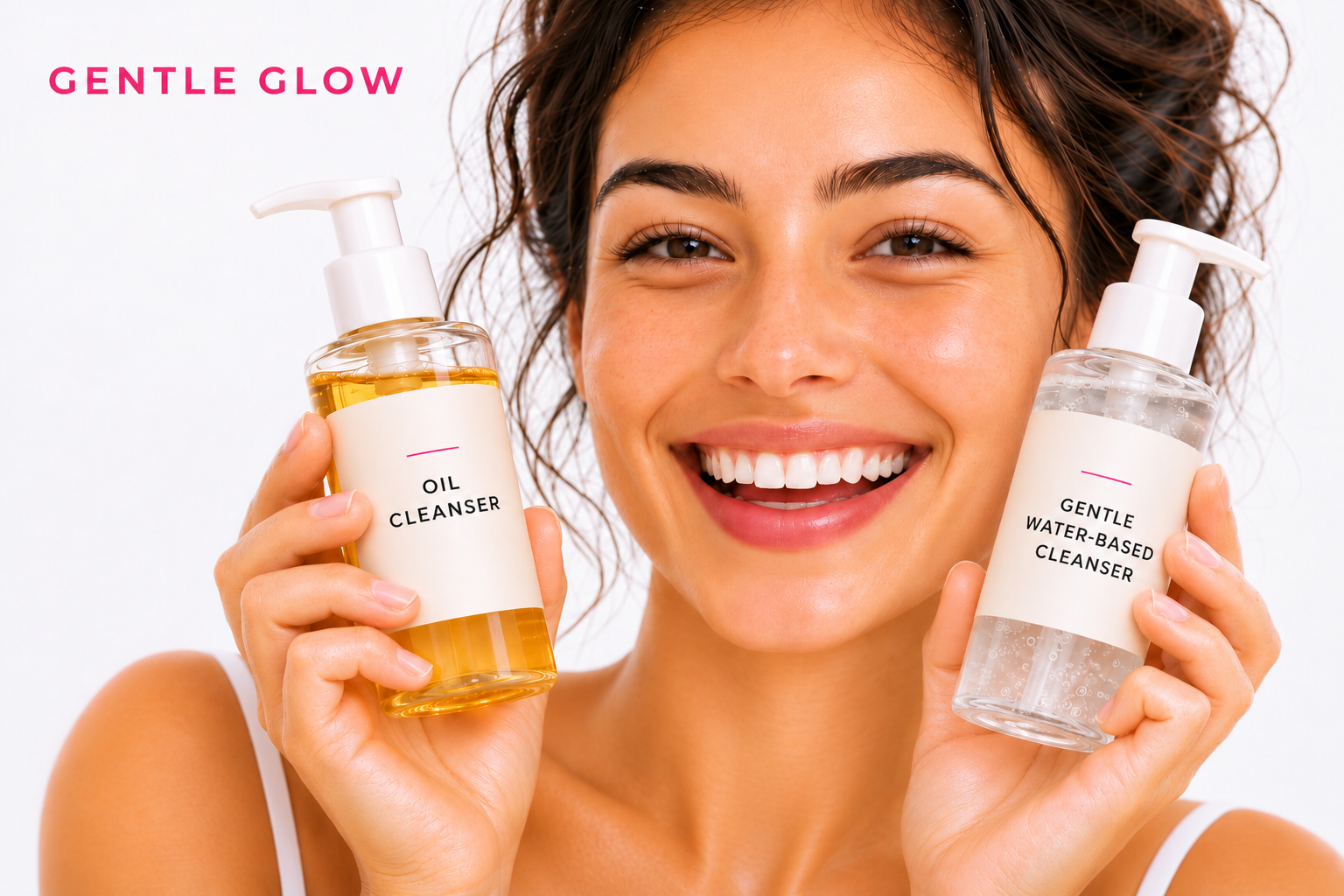
Double Cleansing for Oily Skin: How to Do It, When You Need It, and When You Don’t

Licensed Pharmacist & Scientific Content Writer at Gentle Glow
Double cleansing for oily skin involves using an oil-based cleanser, cleansing balm, or micellar water first, followed by a gentle water-based cleanser. You may need it to remove water-resistant sunscreen or long-wear makeup. You may not need it if one gentle cleanser effectively removes your daily products without irritating your skin, even if you’re oily or acne-prone.
- When you may need it: On days you wear heavy makeup, or silicone-rich products, like makeup primers, liquid foundations, concealers, and certain daily moisturizers that leave a lingering film after a single wash.
- When one cleanse may be enough: On no makeup days, light indoor mornings, or when using modern, water-soluble SPF products that easily rinse away with one gentle wash.
- What matters for acne-prone skin: Choosing emulsifying formulas that rinse completely, keeping friction minimal, and listening to how your skin barrier responds over time.
جدول المحتويات
Should You Double Cleanse If You Have Oily, Acne-Prone Skin?
Having oily or acne-prone skin doesn’t automatically mean you need to double cleanse. It’s easy to assume that more cleansing will lead to clearer skin, particularly when your face tends to look shiny throughout the day. In reality, washing too often can do more harm than good.
Over-cleansing can remove some of the protective lipids in the stratum corneum, the outermost layer of the epidermis. These lipids include cholesterol, ceramides, and fatty acids, which sit between skin cells and help maintain the حاجز البشرة أو تهيّجها. When too much of this protective layer is disrupted, the skin may become dry, tight, irritated, and more sensitive.
Excessive exposure to cleansing products or other substances disrupts the epidermal barrier, leading to increased transepidermal water loss (فقدان الماء) and potential flare-ups.
You should be aware that more isn’t always better in skincare. When skin is exposed to excessive cleansing and too many potentially irritating active ingredients, its barrier function can become impaired, leaving it more prone to dryness, irritation, and sensitivity.
However, double cleansing can still be useful for oily and acne-prone skin, particularly when removing heavy makeup or water-resistant sunscreen.
If you’re wondering how to double cleanse oily skin and what benefits this method offers, its main advantage is that it helps break down stubborn, oil-soluble impurities that might remain on your skin if you only use one, water-based product after wearing heavier makeup or sunscreen.
Many long-wear makeup and sunscreen formulas contain film-forming polymers designed to help the products stay in place throughout the day. Depending on the formula, a gel or foaming cleanser may not remove these products completely, and repeated rubbing to remove them can irritate the skin.
An oil-based cleanser or micellar water can help loosen this buildup, making it easier to remove without excessive rubbing.
The table below can help you decide when double cleansing may be worth adding to your routine:
| Situation | Recommended approach | Why it works |
|---|---|---|
| Heavy Makeup / Water-Resistant SPF | Consider a 2-Step Double Cleanse (oil-based cleanser, cleansing balm, or micellar water followed by a water-based cleanser) if one suitable cleanser is not enough | Can help remove long-wear products with less rubbing, especially when one gentle cleanser is not sufficient. |
| Active acne-prone skin (No makeup or SPF) | Single Gentle Cleanse (use a mild cleanser suited to your skin; acne-treatment ingredients are not necessary for cleansing) | Removes excess sebum, sweat, and everyday impurities while minimizing unnecessary friction. |
| Bare Skin / Indoor Days / Washable SPF | Single Gentle Cleanse (creamy, milky, or mild foaming face wash) | Can remove everyday buildup without adding an unnecessary cleansing step. |
| Tightness, flaking, or increased redness | Adjust Routine (Reduce irritating cleansing steps and choose a gentle routine while your skin recovers) | Reducing potentially irritating cleansing steps may help the skin barrier recover. |
When it comes to frequency, double cleansing for oily skin twice a day is generally unnecessary. A two-step cleanse is generally more useful in the evening, when you may need to remove sunscreen or makeup.
In the morning, rinsing with lukewarm water or using a single mild cleanser may be sufficient to remove overnight oil.
It’s interesting that during hot summer months, increased sweating and frequent sunscreen application often make us constantly feel the urge to wash our face. Still, doing so can lead to the summer double cleansing trap of washing away natural protective lipids too frequently.
How to Do Double Cleansing for Oily Skin
The key to double cleansing without aggravating acne-prone skin is to use two compatible, gentle cleansers and avoid spending too much time rubbing your face. Proper emulsification is particularly important when using a cleansing oil or balm.
Step 1: Oil-based cleanser or balm ➔ Emulsify with water as directed ➔ rinse
Step 2: Gentle water-based cleanser ➔ Rinse with lukewarm water ➔ pat dry
1. First Cleanse: oil, balm, or micellar water
If the product instructions specify dry application, apply the cleansing oil or balm to dry hands and a dry face. Gently massage in circular motions to help break down makeup, sunscreen, and surface impurities, following the product’s directions.
Crucial step: Emulsification
Learning how to emulsify a cleansing oil properly can help it rinse away more effectively and reduce unwanted residue. But first, let’s clarify what an emulsion is and how emulsification works.
An emulsion forms when tiny droplets of one liquid are dispersed in another liquid that does not normally mix with it. In a rinse-off cleansing oil or balm, emulsifiers help the oily formula mix with water so it can be washed away more easily.
For oily or acne-prone skin, a cleansing oil or balm formulated to emulsify and rinse off with water can be a practical choice. How completely it rinses depends on the product’s overall formulation.
It sounds paradoxical at first: if oil and water don’t mix, how can adding water wash away oil?
The answer lies in مواد تُسمى المنظِّفات السطحية (Surfactants). Oil and water do not readily mix on their own, but DermNet explains that surfactants help loosen oil and dirt so they can be washed away. When water is added, the emulsifiers in many cleansing oils help disperse the oil into small droplets that can be rinsed away.
Finally, wet your hands with lukewarm water and gently massage your face again, following the product’s instructions. Many cleansing oils turn milky as they mix with water, although not every formula does.
If you’re using micellar water instead, there’s no emulsification step. If the product calls for a cotton pad, soak a soft pad and gently press it against your skin before wiping away the product. Avoid repeatedly rubbing the same area and follow any rinsing instructions.
Choose cleansing oils or balms formulated to be wash-off / water-emulsifying. A واقعية وحلول غير مسببة لانسداد المسام label may be helpful, but it is not a guarantee against breakouts. Traditional plain oils (like pure coconut, olive, or castor oil) without built-in emulsifiers can be harder to rinse off with water and may leave residue behind.
2. Second cleanse: water-based foam or gel
Once you are done with the first step, rinse thoroughly with lukewarm water, then follow up with your regular gentle gel or foaming cleanser. Massage gently, following the product’s instructions, to lift away remaining sweat, water-soluble debris, and any residue.
Finally, rinse completely with lukewarm water and pat your skin dry with a clean, soft towel rather than rubbing. The American Academy of Dermatology recommends using a gentle, non-abrasive cleanser, avoiding scrubbing, and rinsing with lukewarm water.
Cleansing Oil, Balm, or Micellar Water: Which Is Better for Acne-Prone Skin?
Choosing between a cleansing oil, cleansing balm, or micellar water comes down to your personal preference for texture, convenience, the types of makeup and sunscreen you wear, and also how comfortably your skin tolerates each product.
Avoid choosing a product solely because its label says it is suitable for oily or acne-prone skin. Skin tolerance varies from person to person, and even products formulated for acne-prone skin may cause irritation, sensitivity, or breakouts in some individuals.
Instead, pay attention to the overall formulation, consider your skin’s individual needs, and monitor how it responds after introducing a new product. When cleansing oils and balms are formulated with suitable emulsifiers, they can rinse away with water without leaving a heavy oily residue.
Cleansing oils and balms can help remove heavy, water-resistant products, while micellar water offers a lightweight alternative.
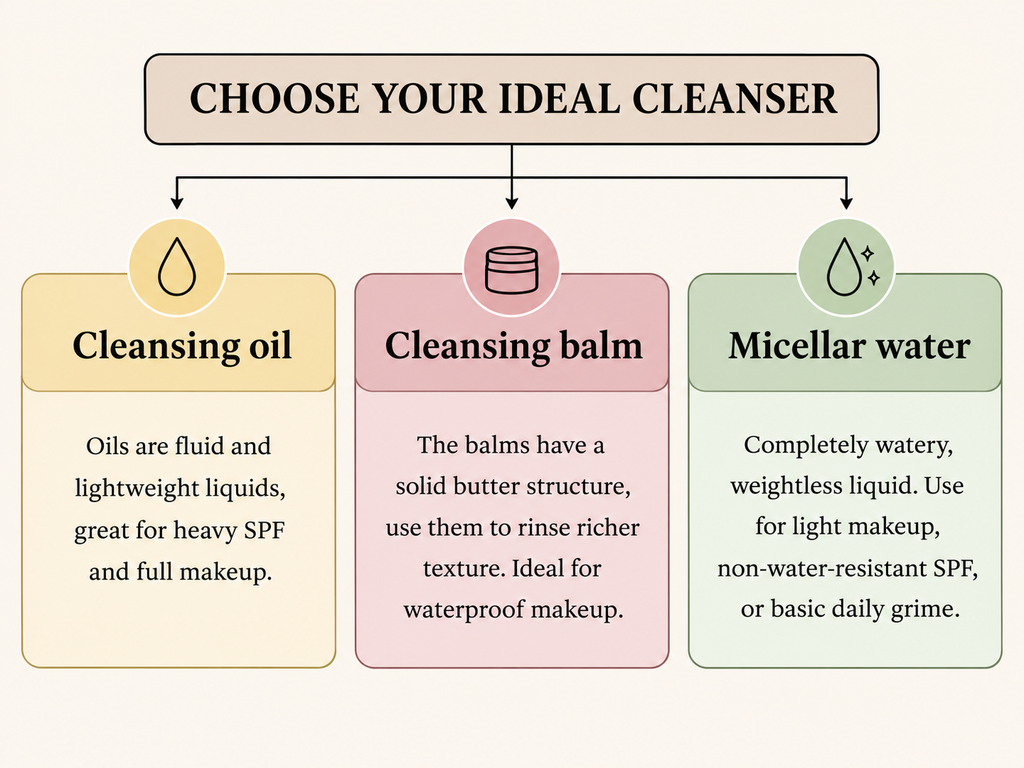
Cleansing oils have a fluid texture that spreads easily across the skin, whereas cleansing balms offer similar benefits in a thicker, solid texture that melts into an oil upon application. Their solid consistency can also make them convenient for travel, as they’re less likely to spill than liquid products.
Micellar water for acne-prone skin has a much lighter, water-like texture. As Cleveland Clinic explains, micellar water contains small clusters of cleansing molecules called micelles, which help capture and lift away dirt, oil, and makeup.
Note that micellar water isn’t limited to light makeup or non-water-resistant SPF only. It can also remove some water-resistant products, like sunscreens, long-wearing foundations, waterproof mascaras, and transfer-resistant makeup, but a cleansing oil or balm may be more effective for certain stubborn, water-resistant products, depending on the formulation.
The best choice depends on the products you need to remove, the cleanser’s formulation, and how well your skin tolerates it.
Can Oil Cleansers Clog Pores or Make Acne Worse?
Having acne doesn’t mean you need to avoid oil-based cleansers. However, formulations vary, so choosing a cleanser that effectively removes impurities while being well tolerated by your skin is essential.
Well-formulated rinse-off cleansing oils are generally designed to rinse away with minimal oily residue because emulsifiers help disperse the formula in water, but individual products may still cause irritation in some people, unlike leave-on facial oils that sit on the skin.
It’s completely normal to feel cautious about putting oil on oily skin. The key distinction lies in the chemical design:
- Leave-on facial oils (like pure rosehip or jojoba oil) remain on the skin rather than being rinsed away. Whether they contribute to clogged pores depends on the oil, the overall formulation, and individual skin tolerance.
- Rinse-off cleansing oils are made with surfactants and emulsifiers that help loosen sebum and makeup, allowing the cleanser to disperse in water and rinse away more easily.
Skincare is deeply personal. When choosing a cleansing oil for acne-prone skin, look for formulas with built-in emulsifiers that help the product rinse away with water.
Ingredients you may encounter include squalane, argan oil, high-linoleic safflower oil, and lightweight esters such as caprylic/capric triglyceride. These can be useful components of cleansing formulas, but their presence alone does not guarantee that a product won’t clog pores.
Some ingredients, including isopropyl myristate and isopropyl isostearate, have raised comedogenicity concerns in ingredient testing; others, such as ethylhexyl palmitate and coconut oil, are also sometimes flagged in ingredient lists.
However, a small human study of finished cosmetic formulations found that products containing ingredients previously considered comedogenic were not necessarily comedogenic themselves. The findings do not establish whether any particular rinse-off cleanser will cause breakouts.
After all, a product’s overall formulation matters more than any single ingredient, as the ingredients and their proportions influence its cleansing performance and skin tolerance. An ingredient that works well for one person might trigger breakouts, clogged pores, or redness in another – even if a product is generally rated as gentle or safe.
Keep in mind that “non-comedogenic” is a helpful guideline rather than a strict guarantee, as individual skin characteristics and responses vary. Testing a new product on a small area of your jawline for a few days is always a smart approach before deciding if that particular product works for you or not.
Can Double Cleansing Cause Acne or Skin Irritation?
Introducing double cleansing should ideally leave your skin feeling clean and balanced. If you notice new breakouts, dryness, tightness, or stinging after introducing double cleansing, your skin may be reacting to a product or to the additional cleansing.
Cleansing too frequently or rubbing your face too aggressively can irritate the skin and disrupt the stratum corneum. Harsh cleansing products and unnecessarily long washing sessions can also remove protective skin lipids, increasing moisture loss and leaving the skin feeling tight, dry, or uncomfortable.
If you are already using active treatments such as retinoids, exfoliating acids, or benzoyl peroxide, adding double cleansing may further aggravate sensitivity, particularly if your skin is already irritated.
قد تكون clinical study was conducted to investigate whether combining gentle facial cleansing with regular moisturization could improve mild acne in post-adolescent women with dry, sensitive skin. Over four weeks, 29 participants used a mild foaming cleanser alongside moisturizing products containing pseudo-ceramide and eucalyptus extract.
The results showed a significant reduction in acne lesions, improved skin dryness, and increased ceramide levels in the stratum corneum with no reported adverse events. The findings suggest that combining gentle cleansing with adequate moisturization can help manage mild acne while supporting the skin barrier, particularly in individuals with sensitive, dry skin.
Although the study did not investigate double cleansing specifically, it highlights the importance of gentle cleansing and moisturization.
Similarly, the dermatology guidelines from the American Academy of Dermatology emphasize gentle cleansing with a mild, non-abrasive cleanser rather than aggressive or excessive washing.
It is also important to distinguish these reactions from skin purging. Skin purging refers to a temporary increase in visible breakouts that some people report after introducing certain acne treatments, particularly retinoids. It may be associated with existing microcomedones becoming visible sooner.
Purging is most often discussed with treatments that affect skin cell turnover, such as الريتينويدات (retinol, retinal, tretinoin), and sometimes exfoliating acids such as glycolic acid or salicylic acid, although not everyone experiences this reaction.
Because cleansing oils and balms don’t speed up cellular renewal, any new breakouts after introducing double cleansing shouldn’t automatically be blamed on purging. New breakouts after introducing double cleansing may instead be related to irritation, an unsuitable product, changes elsewhere in the skincare routine, or the natural fluctuation of acne.
If you notice fresh bumps or redness after trying double cleansing, ask yourself these important questions:
- Are you emulsifying fully? If your cleansing oil or balm is designed to emulsify, follow its instructions for adding water and rinsing thoroughly. Incomplete rinsing may leave unwanted residue on the skin.
- Are you scrubbing too hard? Using harsh washcloths or applying too much pressure can irritate the skin and potentially aggravate existing acne. Use gentle fingertip movements instead.
- Is your skin barrier compromised? Cleansing for too long or using harsh products can wash away too much of the skin’s natural oils, leaving it feeling dry or irritated. Some people may also notice increased oiliness, although this isn’t necessarily a direct result of the skin trying to replace the oils that were removed. An impaired skin barrier can leave skin more prone to dryness, tightness, stinging, and sensitivity.
الخلاصة
Double cleansing for oily skin is generally most beneficial in the evening, particularly if you have worn water-resistant sunscreen, waterproof makeup, or long-wearing foundation throughout the day. If you have not worn makeup or water-resistant sunscreen, a single gentle cleanse may be sufficient.
In the morning, most people with oily, acne-prone skin only need one gentle cleanser to remove excess oil and any residue from their nighttime skincare routine. When double cleansing in the evening, start with an oil-based cleanser or cleansing balm to dissolve oil-soluble products, then follow with a gentle water-based cleanser to remove any remaining residue, sweat, and impurities.
However, double cleansing is not always necessary; if you use active ingredients such as retinoids, salicylic acid, or benzoyl peroxide, be especially careful of cumulative irritation. Adjust your cleansing routine according to what you have applied during the day and how your skin responds, rather than assuming that more cleansing will produce better results.
الأسئلة الشائعة
Do I Need to Double Cleanse If I Don’t Wear Makeup?
Not always. If you wear water-resistant sunscreen or spend most of your day outside, double cleansing may help remove sunscreen or other products that are difficult to wash off. However, if you wear light, washable SPF, or spend the day inside, a single gentle cleanser is usually enough.
Should I Double Cleanse Every Day?
Only if your skin requires it. If you wear full-coverage makeup or water-resistant sunscreen every day, daily evening double cleansing may be fine if your skin tolerates it well. Otherwise, reserve it for days when you actually need the extra cleansing power.
Can I Double Cleanse With the Same Cleanser?
Yes, you can wash twice with the same cleanser to remove surface sweat and oil. However, repeating a watery wash may not effectively remove some heavy, waterproof makeup or sunscreens. For traditional double cleansing, you typically use an initial oily cleanser to dissolve heavy impurities, followed by your regular wash.
Do Dermatologists Recommend Double Cleansing?
Some dermatologists may recommend double cleansing for patients who wear heavy makeup or water-resistant sunscreens. Clinical studies on acne cleansing routines support gentle, non-irritating cleansing to remove surface oil while minimizing disruption to the skin barrier.
Should I Double Cleanse in the Morning?
In most cases, no. A single gentle cleanse is enough to remove overnight sebum and skincare residue. If your skin isn’t particularly oily, rinsing with lukewarm water may be sufficient.
References
- Mukhopadhyay, P. (2011). Cleansers and their role in various dermatological disorders. Indian Journal of Dermatology, 56(1), 2-6.
- Ananthapadmanabhan, K. P., Moore, D. J., Subramanyan, K., Misra, M., & Meyer, F. (2004). Cleansing without compromise: the impact of cleansers on the skin barrier and the technology of mild cleansing. Dermatologic Therapy, 17(s1), 16-25.
- Isoda, K., Seki, T., Inoue, Y., Umeda, K., Nishizaka, T., Tanabe, H., Takagi, Y., Ishida, K. and Mizutani, H. (2015). Efficacy of the combined use of a facial cleanser and moisturizers for the care of mild acne patients with sensitive skin. The Journal of Dermatology, 42(2), pp.181–188.
- Choi, Y.S., Suh, H.S., Yoon, M.Y., Min, S.U., Kim, J.S., Jung, J.Y., Lee, D.H. & Suh, D.H. (2010). A study of the efficacy of cleansers for acne vulgaris. The Journal of Dermatological Treatment, 21(3), pp.201–205.
- Stringer, T., Nagler, A., Orlow, S.J. and Oza, V.S. (2018). Clinical evidence for washing and cleansers in acne vulgaris: A systematic review. Journal of Dermatological Treatment, 29(7), pp.688–693.
- Del Rosso, J.Q. and Kircik, L. (2023). The primary role of sebum in the pathophysiology of acne vulgaris and its therapeutic relevance in acne management. Journal of Dermatological Treatment, 35(1).
- Jung, I.S., Yun, S.J. and Lee, J.-B. (2019). The difference in sebum secretion affecting development of acne. Annals of Dermatology, 31(4), p.426.
- American Academy of Dermatology (AAD). Face washing 101.
- Cleveland Clinic (2022). Double Cleansing Method Explained: Should You Try It?. Cleveland Clinic Health Essentials.
- The INKEY List (2026). How Often Should You Double Cleanse?. The INKEY List Blog.
- Draelos, Z. D., & DiNardo, J. C. (2006). A re-evaluation of the comedogenicity concept. Journal of the American Academy of Dermatology, 54(3), 507–512.
- Oakley, A. (1999). Soaps and cleansers. DermNet.
- Cleveland Clinic (2026). Micellar Water: What It Is and How To Use It in Your Skin Care Routine. Cleveland Clinic Health Essentials.
تنويه طبي
يتم إعداد أدلة Gentle Glow استنادًا إلى أبحاث علمية محكّمة في مجال طب الجلدية وإرشادات سريرية معتمدة. المعلومات المقدَّمة هنا لأغراض تعليمية فقط، ولا تُعد بديلاً عن الاستشارة الطبية المهنية أو التشخيص أو العلاج. يُنصح دائمًا باستشارة طبيب جلدية معتمد أو مقدم رعاية صحية مؤهل قبل البدء باستخدام أي مكوّنات علاجية نشطة جديدة في روتين العناية بالبشرة.