كل ما تحتاجين معرفته عن البشرة الدهنية

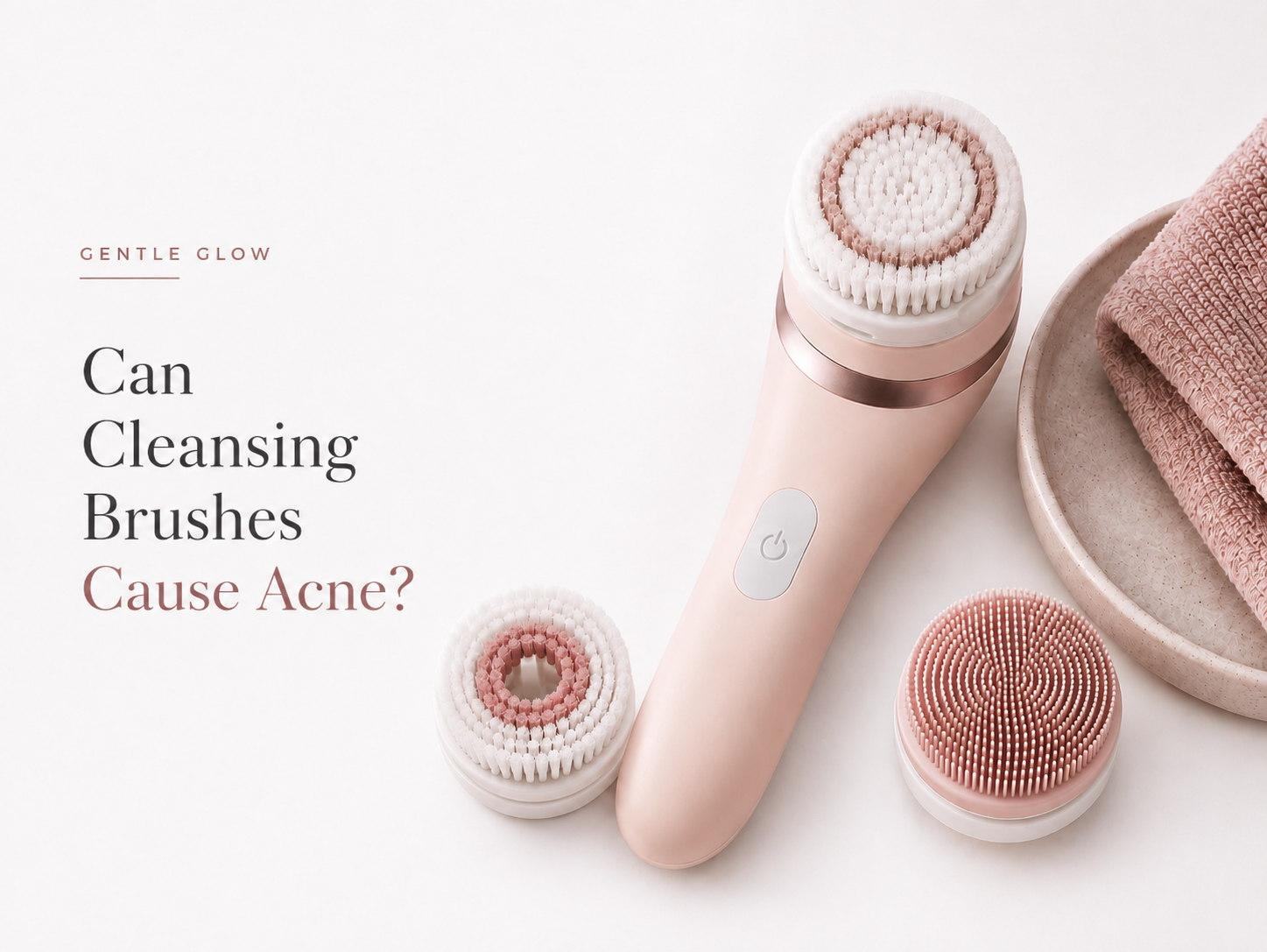
Can Cleansing Brushes Cause Acne?

Edited by
غادة حسن
Dermatologist, Medical Reviewer & Contributor at Gentle Glow
Can cleansing brushes cause acne? Not directly, but they can aggravate acne-prone skin when excessive friction, pressure, or over-cleansing causes irritation. Breakouts that begin after introducing a brush are worth investigating, especially if they appear with redness, stinging, tightness, peeling, or other signs of barrier disruption.
Signs the cleansing brush may be contributing include:
- Breakouts starting after introducing or increasing brush use
- Redness, stinging, tightness, peeling, or tenderness
- Using more pressure, longer cleansing, or repeated passes
- Recent changes to retinoids, acids, benzoyl peroxide, or cleansing frequency
جدول المحتويات
How Can You Tell If Your Cleansing Brush Is Contributing to Your Breakouts?
The first step is to look at the timing and pattern of the breakouts rather than assuming that a cleansing brush is the cause. Ask yourself:
Did the change happen after you
- first introduced the brush?
- started using it more frequently?
- increased the pressure?
- spent longer cleansing?
- repeatedly passed over the same areas?
Breakouts appearing after introducing or intensifying the use of a cleansing brush make it reasonable to investigate. But acne naturally fluctuates, so a breakout appearing afterwards does not establish that the brush caused it.
Look for irritation alongside the breakouts
Pay attention to whether your skin has also developed persistent redness, stinging, burning, unusual tightness, tenderness, peeling, or flaking. You may also notice that products you previously tolerated suddenly sting.
These symptoms can suggest that irritation is worth considering, particularly if they appear around the same time as the new breakouts.
Dermatologists generally recommend gentle cleansing for acne-prone skin and caution against scrubbing because mechanical irritation can worsen acne.
What else changed?
The brush may not be the only new variable. Around the same time, you may have:
- introduced or increased a retinoid
- increased salicylic acid
- started benzoyl peroxide
- added another exfoliating product like glycolic acid
- changed your cleanser or started cleansing more frequently
This matters because it is easy to assume that because the brush came first and the breakout followed, the brush caused the acne. In reality, several changes may have contributed to the irritation your skin was experiencing.
If your skin is irritated, temporarily discontinuing the brush and returning to gentle manual cleansing can help. Then observe your skin for changes in redness, tightness, stinging, and the overall pattern of breakouts.
Improvement after stopping the brush makes its contribution more plausible, but it still does not prove that the brush directly caused the acne.
Can a Cleansing Brush Cause Purging?
A cleansing brush is not a direct cause of true treatment-related purging.
If breakouts appear together with stinging, redness, peeling, tightness, or tenderness, irritation is a more useful possibility to consider than assuming the device is contributing to the mechanism of purging.
If you suspect your routine has become overly irritating, simplifying it may be more useful than adding another product in response, particularly if you are also noticing signs of an over-exfoliated or damaged skin barrier.
Why Can a Cleansing Brush Make Breakouts Worse?
A cleansing brush may become problematic when the mechanical intensity and frequency exceed what your skin currently tolerates. That does not mean the brush itself is inherently harmful.
Adding Excessive Pressure or Friction
Pressing firmly, repeatedly scrubbing one area, or making multiple passes can increase mechanical irritation. This is particularly relevant when the skin is already inflamed or acne-prone.
The broader concept is supported by the literature on acne mechanica, in which repeated pressure, friction, rubbing, stretching, or occlusion can contribute to localized acne flares. However, there is no evidence that every brush-related breakout is acne mechanica. A facial cleansing brush is simply another possible source of repeated mechanical contact.
The American Academy of Dermatology advises people with acne to avoid scrubbing and to cleanse gently because irritation can worsen breakouts.
Repeatedly Going Over Inflamed or Tender Areas
If an area is tender, irritated, or visibly inflamed, repeatedly passing a cleansing brush over it may add unnecessary physical stress. There is no need to scrub a lesion more aggressively in an attempt to make it disappear.
Making Cleansing More Intensive
A cleansing device can turn a simple cleansing step into a longer or more intense process. You may spend more time cleansing, make additional passes, or wash more frequently because the device makes cleansing feel more thorough.
Even oily skin can become tight and dehydrated, irritated, or uncomfortable when cleansing becomes too aggressive.
Adding Mechanical Cleansing to an Already Irritating Routine
A cleansing brush may also become harder to tolerate when it is added to a routine that already contains potentially irritating treatments such as الريتينويدات, salicylic acid, benzoyl peroxide, or other exfoliating products.
The issue may therefore be the total irritation load, rather than the existence of the brush itself. If you are also using multiple cleansing steps, an overly complicated cleansing routine can add even more irritation.
Do You Have to Stop Using Your Cleansing Brush Completely?
Not necessarily. Having acne is not, by itself, a reason to permanently stop using a cleansing device. In fact, a small four-week cohort study evaluated a specific sonic cleansing system with an acne cleansing brush head and gel cleanser in people with mild-to-moderate acne and acne-prone skin. Among the 46 participants who completed the study, inflammatory and non-inflammatory lesions improved, and no adverse events were reported during the study period.
However, this was a small cohort without a manual-cleansing control group. Participants also used the cleansing gel and continued their usual skincare, and the study evaluated one particular cleansing system. It therefore cannot establish that the brush itself improved acne or that every cleansing brush will have the same results.
If using the device is followed by irritation, discomfort, tenderness, or new breakouts, it should be temporarily discontinued. It can be reintroduced later, but with caution.
What Should You Do If You Start Breaking Out After Using a Cleansing Brush?
If you start breaking out after using a cleansing brush, temporarily stop using the brush, return to gentle manual cleansing, and simplify your routine while you watch for changes in irritation and breakouts.
- Temporarily discontinue the brush
Temporarily switch to gentle manual cleansing with clean fingertips. The AAD recommends gentle, non-abrasive cleansing and specifically cautions against using scrubbing tools on acne-prone skin.
- Keep the routine simple
Avoid adding multiple “repair” products. This makes it harder to identify what contributed to the problem.
- Review your skincare routine
Consider whether you recently introduced or increased a retinoid, salicylic acid, benzoyl peroxide, exfoliant, cleanser, or cleansing frequency.
- Observe your acne and skin comfort
Do not judge the situation solely by counting individual pimples. Also watch for redness, stinging, tightness, flaking, and tenderness.
- Seek appropriate medical care when needed
Persistent, severe, painful, nodular or cystic acne should not automatically be blamed on a cleansing brush. A dermatologist can help determine whether the breakouts represent acne or another skin condition and whether treatment needs to change.
GENTLE GLOW PRODUCT COMPARISON
Still thinking about using a cleansing brush?
If a brush appears to be aggravating your skin, focus on resolving the irritation first. When your skin feels comfortable, explore which device features may suit you and when a device is unnecessary.
How Can You Use a Cleansing Brush Without Aggravating Acne?
To use a cleansing brush without aggravating acne, keep mechanical irritation to a minimum by using light pressure, avoiding repeated passes, and paying attention to how your skin responds. Cleansing should remove products, sweat, and surface debris without turning the process into an unnecessarily irritating step. A few adjustments can help:
- Use a gentle touch. Let the brush do the work rather than pressing it firmly against your skin.
- Keep movements light and consistent. Avoid vigorous scrubbing or repeatedly working over the same area.
- Be cautious around active breakouts. Particularly tender or irritated spots may be more sensitive to repeated contact.
- Keep cleansing time reasonable. Spending longer with the brush does not necessarily mean a better cleanse.
- Consider your entire routine. If you are already using retinoids, salicylic acid, benzoyl peroxide, or other potentially irritating products, adding mechanical cleansing may be harder for your skin to tolerate.
- Pay attention to your skin’s response. If you notice increasing redness, stinging, tightness, peeling, or tenderness, consider reducing or pausing mechanical cleansing.
Can a Dirty Cleansing Brush Cause Acne?
A dirty cleansing brush is not a proven direct cause of acne, but good device hygiene still matters. All cleansing devices should be cleaned and dried according to the manufacturer’s instructions, and brush heads or removable components should be replaced as recommended.
It is also sensible not to share a cleansing device or brush head.
However, current evidence does not establish bacterial transfer from a facial cleansing brush as a proven cause of acne. Acne is not simply an infection that a dirty brush spreads from one part of the face to another.
The more established concern with mechanical devices is unnecessary irritation. In other words, good device hygiene matters, but “dirty brush = acne” is an oversimplification.
الخلاصة
Breakouts after introducing a cleansing brush are a reason to investigate whether the device is contributing, but timing alone does not prove that it caused the acne. Consider how the brush is being used, whether signs of irritation are present, what else has changed in your skincare routine, and whether your skin improves after temporarily stopping mechanical cleansing. The goal is to identify the possible source of irritation without automatically blaming the device.
الأسئلة الشائعة
Can Silicone Face Brushes Cause Acne?
Silicone alone does not make a cleansing device acne-safe. Tolerance also depends on the device’s design, pressure, movement, frequency, contact time, your current skin condition, and the rest of your skincare routine.
There is not enough evidence to say that silicone cleansing brushes are universally safer for acne-prone skin.
Is It Better to Wash Your Face With a Brush or Your Hands?
A cleansing brush is optional. Gentle cleansing with clean fingertips is an appropriate option, particularly when the skin is irritated or does not tolerate mechanical cleansing well. The AAD specifically recommends applying cleanser with your fingertips and avoiding scrubbing tools when cleansing acne-prone skin.
Is It Good to Use a Facial Cleansing Brush Every Day?
There is no universal answer. Daily use may be well tolerated with some devices and routines, but it may be too intensive for other people or skin conditions.
The appropriate frequency depends on factors such as the device design, pressure, cleanser, other skincare treatments, current skin condition, and individual tolerance.
المصادر والمراجع
- Gold MH, Ablon GR, Andriessen A, Bucay VW, Goldberg DJ, Green JB, Hooper D, Mandy SH, Nestor MS, Ortiz A. A Cohort Study Using a Facial Cleansing Brush With Acne Cleansing Brush Head and a Gel Cleanser in Subjects With Mild-to-Moderate Acne and Acne-Prone Skin
- American Academy of Dermatology Association. Acne: Tips for Managing
- American Academy of Dermatology Association. 10 Skin Care Habits That Can Worsen Acne
- Mills OH Jr, Kligman AM. Acne Mechanica. Archives of Dermatology.
تنويه طبي
يتم إعداد أدلة Gentle Glow استنادًا إلى أبحاث علمية محكّمة في مجال طب الجلدية وإرشادات سريرية معتمدة. المعلومات المقدَّمة هنا لأغراض تعليمية فقط، ولا تُعد بديلاً عن الاستشارة الطبية المهنية أو التشخيص أو العلاج. يُنصح دائمًا باستشارة طبيب جلدية معتمد أو مقدم رعاية صحية مؤهل قبل البدء باستخدام أي مكوّنات علاجية نشطة جديدة في روتين العناية بالبشرة.