Everything You Need to Know About Oily Skin

Salicylic Acid Cleanser vs Leave-On BHA: Which Actually Works Better for Clogged Pores

Medically reviewed by
Gamal Henin, B.Pharm
Pharmacist & Medical Reviewer at Gentle Glow
Reviewed November 7, 2026
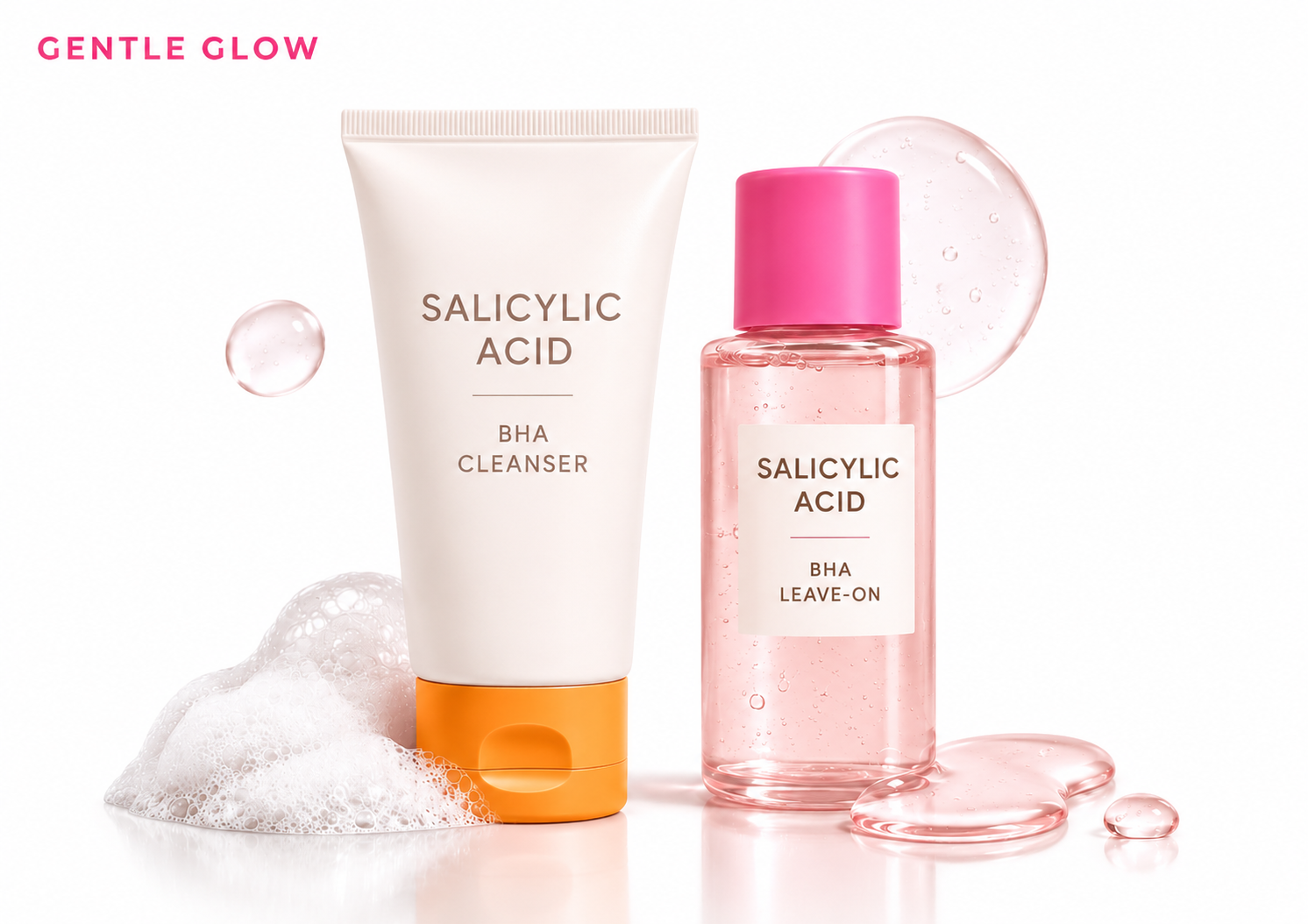
For salicylic acid cleanser vs leave-on BHA, neither format is universally better for clogged pores. A cleanser may be enough for mild congestion or a simpler routine, while a leave-on BHA may be worth considering for more persistent blackheads. The better choice depends on formulation, skin tolerance, congestion type, and the rest of the routine.
- A salicylic acid cleanser can still help clogged pores even though it is rinsed off.
- Longer contact time does not prove that every leave-on BHA works better.
- Persistent congestion may justify trying a leave-on format, but it is not automatically the stronger or better option.
Table of Contents
What is the difference between Salicylic Acid Cleanser and Leave-On BHA
If you are choosing between a salicylic acid cleanser and a leave-on BHA for your clogged pores, the main difference between both format is the contact time. The leave-on BHA gives a longer contact time by nature, but the main questions here is whether a longer contact time actually gives you better results for your clogged pores.
Both formats use the same active ingredient and they both can be beneficial, but they fit into a routine differently and may suit different skin needs.
The salicylic acid cleanser vs leave-on BHA comparison below shows the main differences between the two formats, helping you decide which option may fit your routine better.
Quick Comparison
| Feature | Salicylic acid cleanser | Leave-on BHA |
|---|---|---|
| Contact time | Briefly applied; rinsed off according to product directions | Remains on the skin |
| Practical advantage | Combines cleansing with salicylic acid treatment | Provides longer exposure without a rinse-off step |
| Best fit | People who prefer a wash-off product or want a simpler routine | People who tolerate leave-on exfoliants and want a dedicated treatment step |
| Main limitation | Shorter contact time, but effectiveness still depends on the formula | Longer exposure can also increase irritation |
| What determines results? | Concentration, formulation, use, and tolerance | Concentration, formulation, use, and tolerance |
Although this comparison gives facts about both products, it also shows that neither format is universally better.
- A leave-on product offers longer exposure, but that fact alone does not establish that it clears more clogged pores.
- A cleanser may be a reasonable option for someone who wants a wash-off treatment, especially if leaving an exfoliant on the skin causes discomfort.
When Should You Use a Salicylic Acid Cleanser?
Research and dermatology guidance describe salicylic acid as a keratolytic beta hydroxy acid (BHA). It helps loosen excess dead skin cells and can reduce the buildup inside follicles that contributes to blackheads and whiteheads. If you are dealing with either of these concerns, adding a BHA product to your routine may be worth considering.
If you decide to use salicylic acid and are not sure which format may be a good fit for your routine, a salicylic acid cleanser may suit you if:
- your skin tends to feel congested but you prefer not to add another leave-on active.
- You want to keep your routine simple, particularly if you already use other acne treatments or your skin becomes irritated easily.
The important detail is that a cleanser is not automatically gentle just because you rinse it off. Its concentration, surfactants, fragrance, and overall formulation can all affect how your skin responds.
However, if you decide to use this format, follow the product’s directions. Leaving it on the skin longer than recommended may result in leaving your skin dry, tight, or irritated.
When Should You Use a Leave-On BHA?
A leave-on BHA may be a practical choice if:
- Your skin tolerates leave-on exfoliants and you want salicylic acid as a dedicated treatment step in your routine.
- You already have a cleanser you like and want to keep using it while adding salicylic acid separately.
- You prefer a more supportive leave-on formula. BHA products can come as toners, serums, gels, lotions, and creams, and some may include moisturizing or barrier-supporting ingredients that suit your skin better.
However, it is worth noting that longer exposure does not necessarily mean better results. There is limited direct clinical evidence showing that a leave-on BHA clears clogged pores better simply because it stays on the skin longer. Contact time is only one factor in how a salicylic acid product performs. The formulation, concentration, pH, vehicle, and skin tolerance also matter. In fact, research on 2% leave-on salicylic acid formulas found differences in salicylic acid penetration between two formulations. Because the product base and pH differed at the same time, the study cannot show which factor caused the difference.
If you are new to leave-on exfoliants, start according to the product instructions and pay attention to dryness, stinging, or persistent redness.
When Should You Avoid Both for Now?
Avoid both a salicylic acid cleanser and a leave-on BHA if your skin is already burning, peeling, unusually red, or irritated. Adding more exfoliation can worsen irritation and make it harder for the skin barrier to recover.
Pause exfoliating products until your skin settles, and keep your routine simple with a gentle cleanser, moisturizer, and sunscreen. If irritation is severe, persistent, or accompanied by swelling, seek medical advice.
Can a Salicylic Acid Cleanser Work with Such a Short Contact Time?
A salicylic acid cleanser can still help even though you rinse it off after a short time. How much benefit it provides depends on the product’s formulation, including factors such as salicylic acid concentration and pH, as well as how the product is used. For example, one clinical study found that a 2% salicylic acid cleanser significantly reduced comedones in people with acne.
During cleansing, some salicylic acid may be delivered to the skin, so rinsing the product off does not mean it has no effect. More recent clinical research on a specific 2% salicylic acid cleanser also reported reductions in acne lesions starting at week four while maintaining measures of skin-barrier function. Because this study tested one specific formula, the results should not be assumed to apply to every 2% cleanser.
When comparing salicylic acid cleanser vs leave-on BHA for clogged pores, direct clinical research is limited. A systematic review of acne cleansers found that the overall cleanser evidence base was small and that there were too few well-performed studies to make reliable recommendations. So it is more accurate to say that a cleanser can still be useful rather than assuming it is less effective simply because it is rinsed off.
Does Salicylic Acid Need 30–60 Seconds to Work?
There is no established universal rule that a salicylic acid cleanser must stay on the skin for 30–60 seconds to work. Contact-time instructions vary by product, and the recommended duration should come from the product label.
Leaving a cleanser on longer than directed does not guarantee better results and may increase irritation. If the product specifies a contact time, follow it; otherwise, use the cleanser as directed.
Does Longer Contact Make Leave-On BHA Better for Clogged Pores?
Longer exposure is one reason a leave-on product may be appealing, but it is not enough to conclude that it works better.
A leave-on BHA stays in contact with the skin after application, whereas a cleanser is removed during rinsing. That difference affects how the products are used. It does not, by itself, establish which format produces greater improvements in blackheads, whiteheads, or other forms of acne.
Longer exposure may give salicylic acid more time in contact with the skin, but it can also increase the chances of dryness, stinging, peeling, or irritation. Because direct head-to-head evidence is limited, that longer contact should be viewed as a difference in how the product is used and not a proof that a leave-on BHA clears clogged pores better than a cleanser.
Which Salicylic Acid Format Is Better for Your Type of Clogged Pores?
When choosing salicylic acid cleanser vs leave-on BHA for clogged pores, the type and persistence of your congestion can help guide which format may suit you better.
- Mild or occasional congestion: A salicylic acid cleanser may be enough if you prefer a simple wash-off step and your skin responds well to it.
- Persistent blackheads: Either format may help, but if a cleanser has not improved them enough after consistent use, a leave-on BHA may be worth trying.
- Persistent whiteheads or closed comedones: A leave-on BHA may be worth considering if you want longer contact time, but switching formats does not guarantee better results.
- Easily irritated clogged skin: A cleanser may be the more practical option if you prefer shorter contact time, although the full formula still matters.
The best choice is the format you can use consistently and comfortably without irritating your skin.
How to Tell If You’re Using Too Much BHA?
Persistent tightness, burning, stinging, redness, flaking, or peeling can be signs that you are using too much BHA. These symptoms suggest that your skin may not be tolerating the current routine.
If they develop, reduce the frequency or pause the salicylic acid rather than adding another exfoliant. Give your skin time to settle before considering whether to restart. If symptoms are severe or do not improve, seek professional advice.
How Often Should You Use a Salicylic Acid Cleanser or Leave-On BHA?
How often you should use salicylic acid depends on the specific product and how your skin responds. Salicylic acid products vary in concentration and formulation, so a schedule suitable for one product may not be appropriate for another.
If you’re new to salicylic acid or your skin is easily irritated, introducing it gradually can help you assess how well your skin tolerates it. Starting out slower is a great way to see how your skin handles it. Increase use only if the product instructions allow it and your skin remains comfortable.
Acne treatments often need several weeks before you can judge whether they are helping. The American Academy of Dermatology advises that it can take at least six to eight weeks before you start to see fewer breakouts. This is a general acne-treatment timeframe, not a fixed deadline for every salicylic acid product. Changing products every few days can make it difficult to judge results and may worsen irritation.
What Should You Never Mix with Salicylic Acid?
There is no universal list of ingredients that can never be used with salicylic acid. The main concern is often the combined potential for irritation, and not usually the chemical incompatibility.
For example, using salicylic acid, a retinoid, benzoyl peroxide, and other exfoliating acids in the same routine may be too irritating for some people, especially if you introduce more than one active at once. However, these ingredients are not automatically incompatible. The main concern is how much irritation your skin can tolerate.
Which Ingredients Can Make Salicylic Acid More Irritating?
Retinoids, benzoyl peroxide, and other exfoliating acids can make salicylic acid more irritating in some routines. That does not mean they can never be used together. Consider the strength, frequency, and total number of active products you are using in the same routine.
If you use prescription acne treatment, ask your prescriber or pharmacist how to fit salicylic acid into your routine. Avoid applying it to broken or already irritated skin, and follow the product label carefully.
Final Takeaway
When comparing a salicylic acid cleanser vs leave-on BHA, neither one is automatically better for clogged pores. A cleanser gives you salicylic acid in a simple wash-off step, while a leave-on BHA stays on the skin longer as a separate treatment. But longer contact time does not necessarily mean better results.
Salicylic acid can be useful for acne and clogged pores, but there is still limited research directly comparing cleansers with leave-on BHA products. How well a product works can also depend on its formula, strength, how often you use it, and how well your skin tolerates it.
The better choice is usually the one that fits your routine and that you can use consistently without irritating your skin. If one format is not helping after a reasonable trial, it may be worth reassessing your routine.
Frequently Asked Questions
Is a salicylic acid cleanser less effective than a leave-on BHA?
Not necessarily. A leave-on product provides longer exposure, but there is limited direct clinical evidence proving that it clears clogged pores better than a cleanser. The formulation and your skin’s tolerance also matter.
Should I leave a salicylic acid cleanser on my face for a minute?
Only if the product instructions recommend it. There is no universal rule that every salicylic acid cleanser needs to stay on your face for one minute. Follow the recommended contact time listed on the label, and avoid leaving it on longer than directed.
Can I use a salicylic acid cleanser every day?
Yes, some salicylic acid cleansers can be used every day, but it depends on the product and how your skin responds. Follow the label directions, and reduce how often you use it if you notice dryness, stinging, redness, or peeling.
Can I use a salicylic acid cleanser and a BHA serum together?
You may be able to use a salicylic acid cleanser and a BHA serum together, but using both is not automatically more effective. Using both may increase irritation in some people, so consider whether one product is enough before adding the other.
Does salicylic acid reduce oily skin?
Salicylic acid can help reduce clogged pores, but it is not proven to significantly reduce how much oil your skin produces. It may make oily skin feel less congested, but it should not be treated as a true oil-control ingredient.
How long should I try salicylic acid before changing products?
Give salicylic acid several weeks before deciding whether it is helping, provided your skin tolerates it. At least six to eight weeks is a useful general acne-treatment timeframe before you may start to see fewer breakouts, but it is not a fixed deadline for every salicylic acid product. Stop or reduce use sooner if significant irritation develops.
Sources and References
- Shalita, A. R. (1989). Comparison of a salicylic acid cleanser and a benzoyl peroxide wash in the treatment of acne vulgaris. Clinical Therapeutics, 11(2), 264–267.
- Stringer, T., Nagler, A., Orlow, S. J., & Oza, V. S. (2018). Clinical evidence for washing and cleansers in acne vulgaris: A systematic review. Journal of Dermatological Treatment, 29(7), 688–693. https://doi.org/10.1080/09546634.2018.1442552
- Davies, M. A. (2017). An in vivo confocal Raman spectroscopic investigation of salicylic acid penetration: Variation with formulation parameters. Journal of Cosmetic Science, 68(1), 55–58.
- Hussain, R., Miller, D., Shyr, T., Friscia, D., Li, W.-H., Parsa, R., & Zeichner, J. (2025). Novel 2% salicylic acid cleanser with polymeric cleansing technology treats acne without compromising skin barrier. Journal of Drugs in Dermatology, 24(6), 570–578. https://doi.org/10.36849/JDD.9019
- American Academy of Dermatology Association. Acne: Diagnosis and treatment.
- DermNet. Salicylic acid. DermNet New Zealand.
Medical Disclaimer
Gentle Glow guides are developed using peer-reviewed dermatology research and established clinical guidelines. The information provided is for educational purposes only and does not replace professional medical advice, diagnosis, or treatment. Always consult a board-certified dermatologist or qualified healthcare provider before starting new active skincare treatments.