Everything You Need to Know About Oily Skin

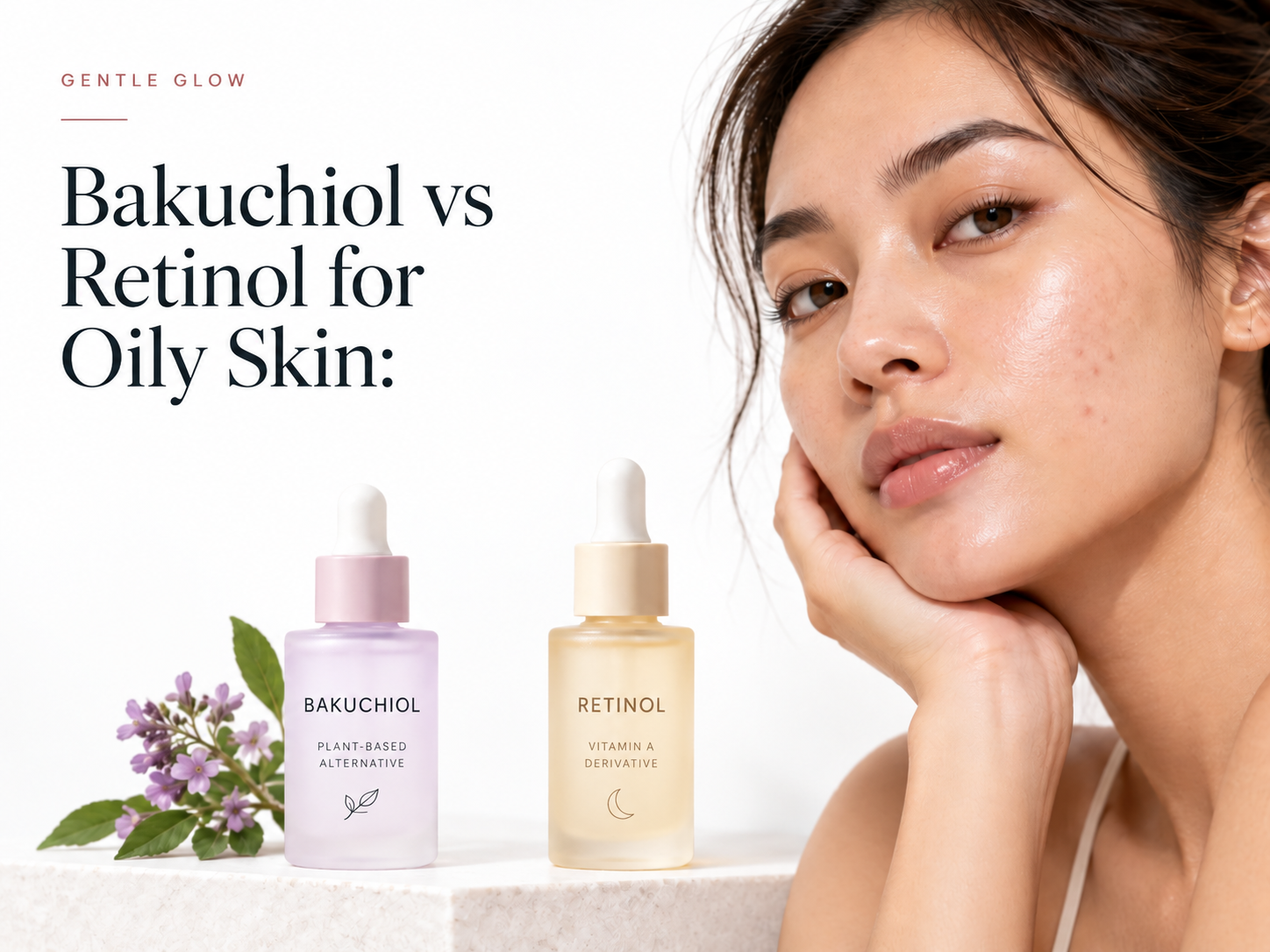
Bakuchiol vs Retinol for Oily Skin: Which Is Better?

Medically reviewed by
Gamal Henin, B.Pharm
Pharmacist & Medical Reviewer at Gentle Glow
Reviewed September 14, 2026
When comparing bakuchiol vs retinol for oily skin, retinol has stronger evidence for clogged pores, texture, pigmentation, and photoaging, while bakuchiol may be a more tolerable alternative. Neither is well established as a direct sebum-control ingredient, so the better choice depends on your main concern, irritation tolerance, and current routine.
- For clogged pores, texture, and pigmentation: retinol has the stronger overall evidence, although the strongest acne evidence belongs to established topical retinoids.
- For skin that struggles with retinol irritation: bakuchiol may offer a more comfortable alternative, but it is not universally irritation-free.
- For excess oil alone: neither should be chosen primarily to reduce sebum production.
Table of Contents
Watch: Which Is Better for Oily Skin: Bakuchiol or Retinol?
Is Bakuchiol Really an Alternative to Retinol?
Bakuchiol can be considered an alternative to retinol for some skin concerns, but it is not a retinoid and the two ingredients are not equivalent. Retinol is a vitamin A derivative with a much larger clinical evidence base, while bakuchiol is a plant-derived ingredient that can have some similar effects on the skin.
Despite being marketed as “plant-based retinol,” bakuchiol is not a retinoid. Retinol is a vitamin A derivative that converts within the skin through the retinoid pathway. Bakuchiol, by contrast, is a meroterpene phenol extracted from the seeds and leaves of the Psoralea corylifolia (Babchi) plant.
Think of bakuchiol as a plant-derived ingredient that can mirror some functional effects of retinol without belonging to the retinoid family.
Despite their structural differences, cellular pathway profiling studies (Chaudhuri & Bojanowski, 2014, International Journal of Cosmetic Science) indicate that bakuchiol produces some similar gene-expression effects to retinol, including effects on collagen-related markers.
However, comparable cellular activity does not guarantee identical clinical performance. Retinol is supported by a much larger body of human research, whereas bakuchiol’s clinical literature is newer and based on smaller study cohorts.
Here is a quick snapshot comparing how these two actives align across key parameters:
| Comparison Marker | Bakuchiol | Retinol |
|---|---|---|
| Ingredient Classification | Meroterpene phenol; not a retinoid | Vitamin A derivative; cosmetic retinoid |
| Overall Scientific Evidence | Limited, preliminary, but promising | Larger and more established clinical evidence base |
| Direct Sebum Regulation | Limited direct clinical evidence | Limited direct cosmetic evidence |
| Acne & Congestion Support | Small pilot studies; limited proof | Some supporting evidence, although the strongest acne evidence belongs to established topical retinoids |
| Hyperpigmentation & PIH | Promising evidence for hyperpigmentation; limited PIH evidence | More established evidence for pigmentation; evidence specifically for PIH is more limited |
| Texture & Fine Lines | Early comparative clinical support | More established clinical evidence |
| Irritation Potential | May be better tolerated; irritation can still occur | Greater irritation potential depending on formulation, frequency, and individual tolerance |
| Pregnancy Guidance | Lacks sufficient safety data for definitive claims | Generally avoided during pregnancy |
What Did the Direct Comparison Study Actually Find?
In the 12-week head-to-head trial, both 0.5% bakuchiol and 0.5% retinol significantly improved wrinkle surface area and hyperpigmentation, with no statistically significant difference between the groups. Retinol users reported more scaling and stinging.
Much of the comparative research stems from a randomized 12-week head-to-head clinical trial (Dhaliwal et al., 2019, British Journal of Dermatology). In this study, 44 participants applied either 0.5% bakuchiol twice daily or 0.5% retinol once daily to evaluate efficacy and tolerability.
| 12-Week Trial Result | Bakuchiol 0.5% Twice Daily | Retinol 0.5% Once Daily |
|---|---|---|
| Wrinkles & Pigmentation | Significant improvement | Significant improvement |
| Difference Between Groups | No statistically significant difference | No statistically significant difference |
| Scaling & Stinging | Less reported | More reported |
Using high-resolution facial imaging and clinical grading, researchers observed that both ingredients significantly improved wrinkle surface area and hyperpigmentation by week 12.
The main difference observed was in tolerability. Participants using retinol reported more scaling and stinging than those using bakuchiol.
Several study limitations are important to keep in mind:
- Small Sample Size: The trial evaluated 44 participants, limiting broad generalizability.
- Different Dosing Frequency: Bakuchiol was applied twice daily, while retinol was applied once daily, so the study did not compare the ingredients at the same application frequency.
- Study Duration: The trial lasted 12 weeks, so it does not tell us whether the two ingredients would perform similarly over much longer periods.
- Specific Endpoint Focus: The trial focused on facial photoaging and hyperpigmentation, rather than persistent acne or excess sebum production.
Additionally, a 2024 systematic review of human bakuchiol trials (Fanning et al., 2024, Journal of Drugs in Dermatology, PMID: 38564402) found that although bakuchiol remains promising, the overall evidence base has important limitations. Of the 15 human trials reviewed, 12 were unblinded open-label studies without a control group, and 10 tested combination formulations containing bakuchiol. This makes it difficult to attribute all reported benefits specifically to bakuchiol and reinforces that its clinical evidence remains much more limited than retinol’s.
FREE RETINOID GUIDE
Starting a retinoid? Keep the routine simple.
Get our free Your Retinoid Routine, Simplified guide with a beginner schedule, what to do if your skin reacts, common mistakes to avoid, and a quick routine checklist.
Get the free guide and join Gentle Glow’s skincare emails. Unsubscribe anytime.
Can Bakuchiol Replace Retinol for Your Specific Skin Concern?
Bakuchiol may be a reasonable alternative to retinol for some pigmentation and photoaging concerns when tolerability is a priority, but the evidence is not equally strong across outcomes. For acne and clogged pores, the strongest evidence belongs to established topical retinoids.
The choice between these ingredients depends on your primary skin target and your skin’s tolerance for active ingredients.
Does Bakuchiol or Retinol Reduce Sebum Production?
Neither cosmetic retinol nor topical bakuchiol is well established as a direct sebum-suppressing treatment.
Although many people assume that applying retinol or bakuchiol will stop your skin from producing excess oil, in reality neither active is well established as a treatment for shrinking oil glands or reducing daily shine. While oral isotretinoin can strongly suppress sebum production, that evidence should not be applied to cosmetic retinol or bakuchiol. Ingredients like niacinamide, zinc PCA, or green tea may be more suitable for addressing surface shine.
Is Bakuchiol as Effective as Retinol for Acne and Clogged Pores?
Established topical retinoids have stronger evidence for preventing clogged pores than bakuchiol, although the strongest acne evidence belongs to acne treatments such as adapalene, tretinoin, tazarotene, and trifarotene rather than cosmetic retinol.
Bakuchiol has shown antibacterial and anti-inflammatory activity in laboratory research, and newer clinical research is beginning to strengthen its potential for acne-prone skin. A 2026 randomized trial in 70 people with mild-to-moderate acne found that a cream combining bakuchiol and salicylic acid was noninferior to 0.025% tretinoin for reducing acne lesions over 12 weeks, while causing less dryness and fewer acne flares. However, because the tested formula combined bakuchiol with salicylic acid, the results cannot be attributed to bakuchiol alone.
Topical retinoids have a well-documented history of supporting follicular desquamation, helping prevent dead skin cells from accumulating within the pore lining.
For persistent or severe acne, cosmetic ingredients may offer limited support; evaluation by a dermatologist remains the most reliable path forward.
Can Bakuchiol Help Prevent Sebum Oxidation and Blackheads?
Bakuchiol acts as a lipid antioxidant that reduces squalene oxidation in laboratory models, though clinical proof that this alone stops blackheads remains limited.
Laboratory testing (Trompezinski et al., 2016) demonstrated that bakuchiol helped protect squalene from oxidation. However, the clinical portion of this research tested a formula containing bakuchiol, Ginkgo biloba extract, and mannitol rather than bakuchiol alone.
Oxidized squalene has been linked to processes involved in acne, including inflammation and abnormal follicular keratinization.
While preventing oil oxidation may be beneficial in theory, human clinical trials have not established that bakuchiol’s antioxidant activity alone prevents comedone formation.
Which One Works Better for Dark Spots and Post-Acne Marks?
Both ingredients help fade dark spots, but bakuchiol may offer an advantage for reactive or hyperpigmentation-prone skin because it carries a lower risk of triggering irritation.
Post-inflammatory hyperpigmentation (PIH) frequently occurs following skin irritation or acne breakouts. Clinical testing demonstrates that twice-daily application of 0.5% bakuchiol and once-daily 0.5% retinol both significantly improved facial hyperpigmentation, with no statistically significant difference between the groups. However, this trial evaluated hyperpigmentation associated with photoaging rather than specifically post-acne PIH.
While retinol effectively improves excess pigmentation, the initial peeling and redness it may induce can occasionally exacerbate dark spots in darker skin tones (Fitzpatrick types IV–VI). Bakuchiol offers a suitable alternative by addressing hyperpigmentation with potentially less irritation than retinol.
Which Has Stronger Evidence for Texture and Visible Pores?
Retinol possesses stronger clinical evidence for refining uneven texture, while evidence that bakuchiol improves visible pores specifically remains limited.
Neither ingredient alters genetically determined pore size. However, improving skin texture and supporting the surrounding skin matrix may help pores appear more refined, while established topical retinoids can also help address follicular congestion.
Can Bakuchiol Match Retinol for Fine Lines and Photoaging?
The 12-week clinical trial found that both 0.5% bakuchiol and 0.5% retinol significantly improved wrinkle surface area, with no statistically significant difference between the groups, but retinol has far more extensive long-term research backing its anti-aging benefits.
Short-term trials support that bakuchiol can visibly improve fine lines. However, retinol remains the more established option for long-term clinical evidence in collagen support and photoaging.
Is Bakuchiol Gentler Than Retinol?
In the direct 12-week clinical trial, bakuchiol was better tolerated than retinol, with retinol users reporting more scaling and stinging.
Despite its milder profile, bakuchiol is a botanical extract and can still cause localized sensitivity or contact reactions in susceptible individuals. Gradual introduction remains recommended when adding any new active ingredient.
Bakuchiol vs Retinol for Oily Skin: Which Fits Your Main Concern?
To help synthesize these findings, the following breakdown maps out which option aligns best with specific skin concerns:
| Skin Concern | Better Choice | Primary Reasoning |
|---|---|---|
| Excess Surface Shine | Neither Active | Neither ingredient reliably reduces sebum production |
| Persistent Acne | Medical Evaluation | Moderate-to-severe acne warrants evidence-based medical care |
| Texture & Congestion | Retinol | Stronger overall evidence, although the strongest evidence for clogged pores belongs to established topical retinoids |
| PIH / Sensitive Skin | Bakuchiol may be preferable if retinol causes irritation | Promising pigmentation evidence and may be better tolerated than retinol |
| Maximum Clinical Research | Retinol | Larger and more established clinical evidence base |
Does Bakuchiol Cause Purging or Breakouts?
There is no good clinical evidence that bakuchiol causes a classic retinoid-like “purging” phase. If breakouts appear after starting a bakuchiol product, irritation, individual sensitivity, the finished formulation, or the natural fluctuation of acne may all be possible explanations.
New breakouts after starting a bakuchiol product should not automatically be labelled as purging. They may be related to irritation, individual sensitivity, the finished formulation, or changes in the underlying acne itself, rather than a proven increase in cellular turnover caused by bakuchiol.
Can Bakuchiol or Retinol Clog Pores? Why the Formula Matters
The finished formulation can influence how a bakuchiol or retinol product feels and performs on oily skin, but pore-clogging potential cannot be determined by the active ingredient or formula base alone.
Because bakuchiol is oil-soluble, it is often incorporated into oil-based serums, emulsions, or formulas containing emollients.
A rich oil-based formula may feel too heavy for some oily skin types, while others may tolerate it perfectly well. Likewise, squalane and other oils are not automatically pore-clogging, and a water-based or gel formula is not automatically better.
When trying a new formula, patch test it first and pay attention to how your skin responds over time. If the product consistently feels too heavy, greasy, or seems to coincide with new congestion, a lighter texture may suit you better. If your skin tolerates it comfortably without increased breakouts, there is no need to avoid it simply because it contains oils.
Can You Use Bakuchiol or Retinol With Other Acne Ingredients?
Bakuchiol can be used alongside many common skincare ingredients, while retinol may require more careful scheduling to limit cumulative irritation.
| Ingredient Pair | Compatibility | Key Guideline |
|---|---|---|
| Bakuchiol + Niacinamide | Generally compatible | Niacinamide supports barrier function; direct research on this specific combination remains limited |
| Retinol + Niacinamide | Generally compatible | Niacinamide supports barrier function and can be included in the same routine |
| Bakuchiol + Salicylic Acid (BHA) | Use based on tolerance | Can be used in the same routine, but monitor for dryness or irritation |
| Retinol + Salicylic Acid (BHA) | Use with caution | Combining both may increase irritation; alternating application nights can help if needed |
| Retinol + Benzoyl Peroxide | Use with caution | Using them at separate times may help limit irritation; formulation and product instructions also matter |
When Should You Avoid Both Bakuchiol and Retinol?
Avoid introducing either active if your skin barrier is compromised, if your routine already contains multiple strong treatments, or if your sole goal is stopping surface oil.
- Primary Goal Is Oil Control: Neither ingredient is well established as a direct sebum-reducing treatment.
- Severe or Cystic Acne: Moderate-to-severe acne may warrant medical assessment rather than relying on cosmetic actives alone.
- Compromised Skin Barrier: Active peeling or inflammation should be resolved with barrier-repairing ingredients before adding active treatments.
- Overloaded Routine: Adding further actives to a regimen high in exfoliating acids increases cumulative irritation.
Can You Use Bakuchiol or Retinol During Pregnancy?
Retinol and other topical retinoids are generally avoided during pregnancy, while bakuchiol lacks sufficient human safety data for a definitive recommendation.
Although bakuchiol is not a retinoid, that does not automatically make it pregnancy-safe. Human data on its use during pregnancy and breastfeeding remain limited, so anyone who is pregnant, trying to conceive, or nursing should discuss its use with their healthcare provider rather than treating it as a proven safe alternative to retinol.
Do You Need Sunscreen With Bakuchiol or Retinol?
Daily broad-spectrum sunscreen is important when using retinol or bakuchiol, especially when your goal is improving hyperpigmentation or photoaging.
Retinol can cause dryness, peeling, or irritation, which may make skin feel more vulnerable during sun exposure. Bakuchiol is not known to cause the same retinoid-related sun sensitivity, but sunscreen is still essential because UV exposure contributes to collagen breakdown and persistent hyperpigmentation. Without adequate sun protection, UV damage can work against the improvements you are trying to achieve with either ingredient.
Final Takeaway
When comparing bakuchiol vs retinol for oily skin, retinol has the stronger overall evidence for clogged pores, texture, pigmentation, and photoaging, while bakuchiol may be a more comfortable alternative if retinol causes persistent irritation.
For oily or acne-prone skin, the better choice depends less on oiliness itself and more on what you are trying to treat, how reactive your skin is, and what else is already in your routine. Neither ingredient should be chosen primarily to control sebum, and bakuchiol should not be viewed as a direct replacement for retinol in every situation.
If your priority is the stronger clinical evidence base, retinol remains the more established option. If maintaining skin comfort is becoming the limiting factor, bakuchiol may be a useful alternative without giving up every potential benefit.
FREE RETINOID GUIDE
Take your retinoid plan with you.
Save the routine, schedule, reaction checklist, and common mistakes so you do not have to remember everything from this article.
Get the free guide and join Gentle Glow’s skincare emails. Unsubscribe anytime.
Frequently Asked Questions
Can You Use Bakuchiol Every Day?
Yes, many bakuchiol products are designed for daily use. However, if your skin is sensitive or you are introducing bakuchiol for the first time, starting three to four times per week can help you assess tolerance before increasing frequency.
Does Bakuchiol Cause Sun Sensitivity?
Current evidence does not indicate that bakuchiol causes the same retinoid-related sun sensitivity. Daily broad-spectrum sunscreen is still important to protect against UV damage and help prevent hyperpigmentation from becoming darker.
Can You Use Bakuchiol and Retinol Together?
Bakuchiol and retinol can be used in the same routine if your skin tolerates them, but there is not enough clinical evidence to show that combining them provides better results than using a well-formulated retinol or bakuchiol product alone.
Is Bakuchiol Good for Acne-Prone Skin?
Bakuchiol may be useful for acne-prone skin because it has shown anti-inflammatory and antibacterial activity, but clinical acne research remains limited. It should not be considered equivalent to established acne treatments such as topical retinoids, benzoyl peroxide, or salicylic acid.
How Long Does Bakuchiol Take to Work?
Visible changes from bakuchiol take time. In the main 12-week clinical comparison with retinol, improvements in wrinkles and hyperpigmentation were measured after 12 weeks. How quickly you notice results will depend on the concern being treated, the formulation, and consistent use.
References:
- Chaudhuri, R. K., & Bojanowski, K. (2014). Bakuchiol: A retinol-like functional compound revealed by gene expression profiling and clinically proven to have anti-aging effects. International Journal of Cosmetic Science, 36(3), 221–230. Funding/affiliation note: The study author was affiliated with Sytheon Ltd., a cosmetic-ingredient manufacturer.
- Dhaliwal, S., Rybak, I., Ellis, S. R., Notay, M., Trivedi, M., Burney, W., Vaughn, A. R., Nguyen, M., Reiter, P., Bosanac, S., Yan, A., Foolad, N., & Sivamani, R. K. (2019). Prospective, randomized, double-blind assessment of topical bakuchiol and retinol for facial photoaging. British Journal of Dermatology, 180(2), 289–296.
- Fanning, J. E., McGee, S. A., & Ibrahim, O. I. (2024). Human clinical trials using topical bakuchiol formulations for the treatment of skin disorders: A systematic review. Journal of Drugs in Dermatology, 23(4), 239–243.
- Trompezinski, S., Weber, S., Cadars, B., Larue, F., Ardiet, N., Chavagnac-Bonneville, M., Sayag, M., & Jourdan, E. (2016). Assessment of a new biological complex efficacy on dysseborrhea, inflammation, and Propionibacterium acnes proliferation. Clinical, Cosmetic and Investigational Dermatology, 9, 233–239. Funding/affiliation note: This research evaluated a multi-ingredient complex associated with a Bioderma/NAOS commercial formulation.
- Kumtornrut, C., Rujirawan, P., Chongpison, Y., & Noppakun, N. (2026). The efficacy and safety of dermocosmetic cream containing bakuchiol and salicylic acid in mild-to-moderate acne vulgaris: A noninferiority randomized controlled trial. Dermatologic Therapy.
Medical Disclaimer
Gentle Glow guides are developed using peer-reviewed dermatology research and established clinical guidelines. The information provided is for educational purposes only and does not replace professional medical advice, diagnosis, or treatment. Always consult a board-certified dermatologist or qualified healthcare provider before starting new active skincare treatments.