Everything You Need to Know About Oily Skin

Best Cleanser for Oily and Acne-Prone Skin (2026): Stop Over-Stripping, Start Balancing

Founder & Editorial Lead at Gentle Glow
Evidence-based: This guide follows current dermatological understanding of the skin barrier, the acid mantle (your skin’s natural protective film), surfactant behavior, and acne formation biology.
The best cleanser for oily and acne-prone skin is a pH-balanced, non-stripping formula that removes excess sebum without damaging the skin barrier. Harsh, high-foam or alkaline cleansers may temporarily reduce shine, but they often increase oil production over time by disrupting the acid mantle and triggering reactive seborrhea.
Table of Contents
Some links in this guide are affiliate links. This means Gentle Glow may earn a small commission if you purchase through them — at no extra cost to you. We only recommend products that are suitable for oily and acne-prone skin.
What Makes a Cleanser Barrier-First?
A balanced cleanser should:
- Maintain a skin-friendly pH (around 4.5–5.5)
- Use gentle surfactants instead of harsh sulfates
- Remove excess oil without stripping structural lipids
- Leave skin comfortable — not tight or squeaky
For years, I believed the tighter my skin felt after washing, the cleaner it was.
If it didn’t foam aggressively — if it didn’t leave that squeaky finish — I assumed it wasn’t doing enough. So I switched to stronger cleansers. Oil-control formulas. Acne washes that promised to “deep clean” my pores.
By noon, my face was shiny again.
So I washed more.
If you have oily or acne-prone skin, this cycle probably feels familiar — tight in the morning, greasy by afternoon, breakouts that don’t seem to respond no matter how “strong” the cleanser is.
Here’s what most of us misunderstood:
Oily skin doesn’t need to be stripped. It needs to be stabilized.
When cleansers are too harsh, they increase transepidermal water loss (TEWL), disturb the acid mantle, and signal your sebaceous glands to produce more oil — not less.
In 2026, dermatologists are shifting away from the “strip the oil” mindset. The new approach is barrier-first cleansing — because oily skin doesn’t need punishment.
It needs balance.
2026 Quick Selection Guide: How to Choose the Right Cleanser
If you want a quick overview, the table below compares the best cleansers for oily and acne-prone skin based on skin concern, texture, and active ingredients.
| Cleanser | Best For | Key Ingredient | Texture | View Product |
|---|---|---|---|---|
| CeraVe Foaming Facial Cleanser | Daily oil control without tightness | Ceramides + Niacinamide | Gentle foaming gel | View Product |
| La Roche-Posay Effaclar Medicated Gel Cleanser | Blackheads & clogged pores | 2% Salicylic Acid (BHA) | Active gel cleanser | View Product |
| PanOxyl 4% Creamy Wash | Inflamed, red acne breakouts | 4% Benzoyl Peroxide | Creamy wash | View Product |
| Vanicream Gentle Facial Cleanser | Tight but oily, sensitive skin | Minimal-irritant surfactants | Low-foam cleanser | View Product |
| Neutrogena Ultra Gentle Daily Cleanser | Budget-friendly daily cleansing | Barrier-supportive mild surfactants | Soft foaming cleanser | View Product |
| Paula’s Choice CLEAR Pore Normalizing Cleanser | Acne routines using retinoids/BHA | Barrier-friendly acne support | Gel cleanser | View Product |
| KraveBeauty Matcha Hemp Hydrating Cleanser | Dehydrated oily skin & barrier repair | Matcha + Hemp Seed Extract | Low-foam hydrating gel | View Product |
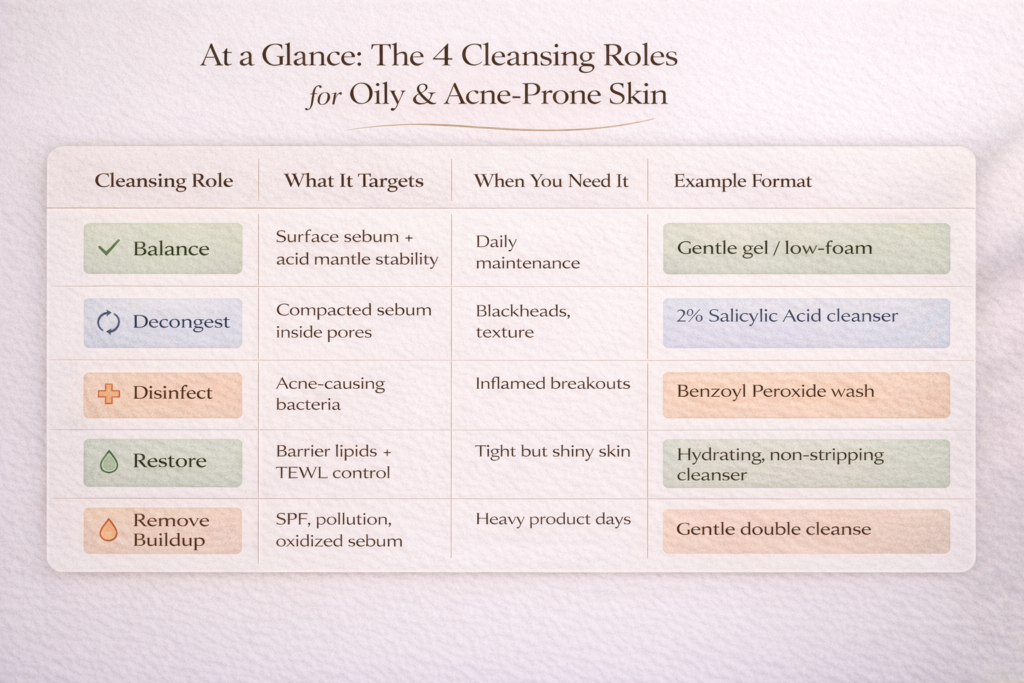
Not every oily skin type needs the same cleanser. Some people struggle with clogged pores. Others feel tight but still shiny. Some deal with red, inflamed breakouts.
The right choice depends on what your skin is doing right now — not just your label.
Cleanser Selection Table
| If your main concern is… | Choose… | Why it helps |
|---|---|---|
| Daily oil control without tightness | A gentle gel or low-foam cleanser | Removes surface sebum while preserving protective lipids |
| Blackheads & clogged pores | A 2% Salicylic Acid (BHA) cleanser | Oil-soluble exfoliant that works inside the pore |
| Red, inflamed acne | A Benzoyl Peroxide wash (short contact therapy) | Reduces acne-causing bacteria |
| Tight but still oily skin | A hydrating, non-stripping cleanser | Prevents transepidermal water loss (TEWL) and rebound oil |
| Sensitive, reactive oily skin | Minimal-ingredient, fragrance-free cleanser | Lowers irritation that can worsen oil imbalance |
| Heavy sunscreen or makeup daily | A gentle double cleanse | Removes buildup without aggressive scrubbing |
If your skin feels tight after washing but looks shiny by midday, you’re likely not “too oily.” You may be disrupting your barrier without realizing it.
If you’d like a deeper explanation of how oily skin behaves — from sebum production to acne formation — read our Complete Guide to Oily and Acne-Prone Skin.
And if tightness + shine sound like your daily struggle, you may be dealing with dehydrated oily skin.
Now that you understand how cleansing roles work, choosing the best cleanser for oily and acne-prone skin depends on your skin’s current state — not just your label.
The 7 Best Cleansers for Oily and Acne-Prone Skin (2026)
Now that we’ve reframed cleansing the right way, here’s how to choose the cleanser that fits your skin’s current needs.
Because oily skin isn’t one-size-fits-all — and your routine shouldn’t be either..
1️⃣ Best Overall Daily Barrier-Safe Cleanser
CeraVe Foaming Facial Cleanser (Normal to Oily Skin)
Best for: Stable daily oil control without tightness.
Why it works:
This formula uses mild surfactants (cleansing agents that lift oil and debris) instead of harsh sulfates. It also contains ceramides — lipids that naturally exist in your skin barrier — which help maintain structural integrity while cleansing. Niacinamide adds calming support and assists in regulating visible oil over time.
Ceramides are essential for maintaining the stratum corneum (the outermost skin layer). Research consistently shows that barrier-supporting ingredients reduce irritation and water loss.
Texture: Light gel that foams gently without feeling squeaky.
Pros:
• Widely available
• Fragrance-free
• Balanced for daily use
Cons:
• May not be strong enough for severe congestion
Gentle Glow Verdict:
If your skin feels tight after washing but still gets oily, this is often the safest reset point.
2️⃣ Best for Clogged Pores and Blackheads
La Roche-Posay Effaclar Medicated Gel Cleanser (2% Salicylic Acid)
Best for: Blackheads, enlarged pores, and visible congestion.
Why it works:
Salicylic acid (also known as BHA, or beta hydroxy acid) is oil-soluble, meaning it can move through sebum and work inside the pore rather than only exfoliating the surface. At a 2% concentration — the maximum allowed in many over-the-counter formulas — it helps loosen compacted oil and dead skin cells that contribute to comedones (clogged pores).
Clinical research shows that properly formulated 2% salicylic acid cleansers can reduce acne lesions while preserving skin barrier function.
I personally used this cleanser consistently for awhile, and it noticeably reduced my blackheads and overall congestion — but only once I stopped overusing it. When I limited it to once daily and paired it with a barrier-supporting moisturizer, the improvement became steady rather than irritating. That adjustment made the real difference.
Texture: Clear gel with a moderate foam. It rinses clean without leaving residue, though you can feel that it’s an active formula.
Pros:
• Effectively targets pore congestion
• Helps reduce blackheads over time
• Uses a clinically established acne ingredient
Cons:
• Can feel drying if used twice daily
• Not ideal for already-dehydrated skin without barrier support
Gentle Glow Verdict
Use once daily at most. If your skin begins to feel tight or sting, scale back. Salicylic acid works best when it supports your routine — not when it overwhelms it.
If you’d like a deeper explanation of how salicylic acid works inside the pore, read our Salicylic Acid (BHA): The Gold-Standard Exfoliant for Oily and Acne-Prone Skin.
3️⃣ Best for Inflamed, Red Breakouts
PanOxyl 4% Creamy Benzoyl Peroxide Wash
Best for: Painful, red, inflamed acne lesions.
Why it works:
Benzoyl peroxide works differently from salicylic acid. Instead of dissolving oil inside the pore, it reduces Cutibacterium acnes — the bacteria involved in inflammatory acne. It also has mild keratolytic effects, meaning it helps prevent pore blockage over time.
Dermatology guidelines consistently recommend benzoyl peroxide as a frontline treatment for inflammatory acne due to its antibacterial and anti-inflammatory properties.
The key with a benzoyl peroxide cleanser is short-contact therapy: apply to damp skin, leave it on for about 60–90 seconds, then rinse thoroughly. This method helps reduce irritation while maintaining efficacy.
Texture: Creamy wash that feels less stripping than older, high-foam benzoyl peroxide formulas.
Pros:
• Strong anti-inflammatory action
• Clinically established acne treatment
• Affordable and widely available
Cons:
• Can bleach fabrics and towels
• May cause dryness if used twice daily
• Not ideal for already compromised barriers
Gentle Glow Verdict
Reserve this for active, inflamed breakouts — not as a daily “oil-control” cleanser. If your acne is mostly blackheads rather than red lesions, salicylic acid is usually the better fit.
4️⃣ Best for Tight but Oily Skin
Vanicream Gentle Facial Cleanser
Best for: Dehydrated oily skin, reactive barrier.
Why it works:
This cleanser avoids fragrance, dyes, and common irritants. It relies on very mild surfactants that cleanse without aggressively removing lipids from the skin’s surface.
When the barrier is compromised, transepidermal water loss (TEWL) increases — meaning water evaporates more easily from the skin. Reducing irritation lowers this cycle.
Texture: Low-foam, soft lather.
Pros:
• Extremely gentle
• Safe during retinoid or BHA use
• Minimal ingredient list
Cons:
• May feel “too simple” for severe acne
Gentle Glow Verdict:
If your skin feels tight but shiny, this is often more effective than stronger cleansers.
5️⃣ Best Budget Drugstore Option
Neutrogena Ultra Gentle Daily Cleanser (Foaming Version)
Best for: Affordable daily maintenance.
Why it works:
Formulated without harsh sulfates, this cleanser focuses on removing surface oil while maintaining skin comfort. It’s designed to support the skin’s natural moisture barrier rather than disrupt it.
Gentle cleansing twice daily is generally recommended for acne-prone skin. According to the American Academy of Dermatology’s guidance on washing acne-prone skin, over-cleansing and harsh scrubbing can worsen irritation and breakouts.
Texture: Soft foam that rinses clean.
Pros:
• Budget-friendly
• Widely accessible
• Fragrance-light
Cons:
• Not treatment-focused
Gentle Glow Verdict:
Simple, stable, reliable — especially if you’re rebuilding your routine.
6️⃣ Best for Structured Acne Routines
Paula’s Choice CLEAR Pore Normalizing Cleanser
Best for: Acne-focused routines using actives.
Why it works:
Designed to pair with salicylic acid or retinoid treatments, this cleanser avoids over-exfoliation while maintaining pore clarity. It’s intentionally non-aggressive to prevent compounding irritation from other actives.
Research shows that excessive irritation worsens acne inflammation — barrier support matters as much as antibacterial action.
Texture: Gel, moderate foam.
Pros:
• Acne-routine compatible
• Balanced formula
• Non-comedogenic focus
Cons:
• Higher price point
Gentle Glow Verdict:
Ideal if you’re already using leave-on treatments and need a supportive cleanser.
7️⃣ Best 2026 Microbiome-Friendly Option
KraveBeauty Matcha Hemp Hydrating Cleanser
Best for: Low-foam, barrier-conscious cleansing.
Why it works:
Formulated at skin-friendly pH, this cleanser prioritizes preserving the skin microbiome — the ecosystem of beneficial microbes living on your skin. Over-disruption of this ecosystem may contribute to inflammation and acne imbalance.
Emerging dermatology research increasingly highlights microbiome balance in acne management.
Texture: Low-foam gel, cushiony.
Pros:
• Gentle
• Hydrating feel
• Modern formulation philosophy
Cons:
• Not strong enough for severe acne
Gentle Glow Verdict:
A modern, barrier-first cleanser for daily balance.
Why Does Your Face Feel Tight After Washing?
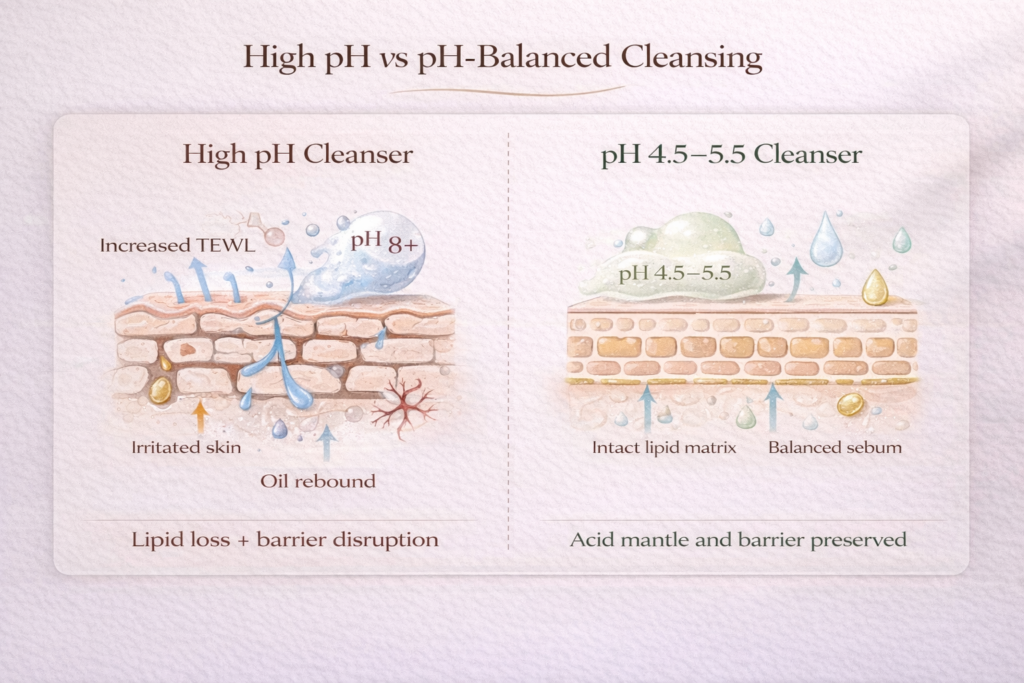
That tight feeling is not a sign of cleanliness.
It’s often a sign that your skin barrier has been disrupted.
When cleansers are too harsh or too alkaline, they can increase transepidermal water loss (TEWL) — the gradual evaporation of water from the skin’s surface. As water escapes, the skin can begin to feel dry, reactive, or slightly itchy, even if it still looks oily.
In some cases, this triggers what dermatologists refer to as reactive seborrhea — where the sebaceous glands increase oil production to compensate for water loss.
The result?
More shine, not less. This rebound cycle can worsen hormonal acne on oily skin, where increased oil production and barrier disruption make breakouts more persistent.
Dermatology research on skin barrier function has shown that barrier disruption increases TEWL and irritation. When this happens repeatedly, it can lead to over-exfoliation and barrier damage, making the skin more reactive over time. This pattern becomes even more common when exfoliating acids are used too frequently without enough recovery time between active nights.
If this pattern sounds familiar — tight after washing, shiny a few hours later — you may be dealing with dehydration rather than excess oil alone. We explain this mechanism in depth in our guide to Dehydrated Oily Skin: Why Your Face Feels Tight but Still Breaks Out (2026 Guide).
What Makes the Best Cleanser for Oily and Acne-Prone Skin Non-Stripping?
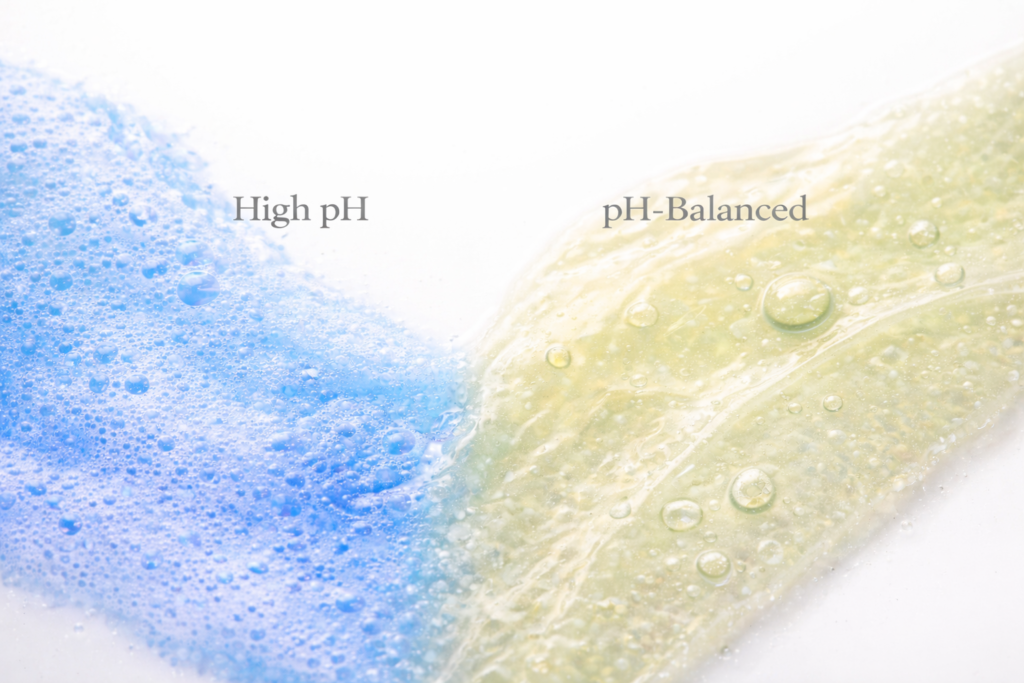
“Non-stripping” is often used in marketing, but biologically it means something specific.
Cleansers contain surfactants — ingredients that bind to oil and water at the same time. They lift sebum, sweat, and debris off the skin so they can be rinsed away.
The problem isn’t surfactants themselves. It’s how aggressive they are.
Harsh surfactants (such as certain sulfates) remove oil very efficiently — sometimes too efficiently. They don’t just remove excess sebum; they also remove structural lipids that help maintain barrier function.
When the barrier is disrupted like this, the skin can become more reactive—not just to products, but also to daily triggers. Factors like stress, diet, and sleep can further influence oil production and breakouts. We explore this further in our guide on how daily patterns contribute to acne throughout the day.
Gentler surfactants cleanse without aggressively dissolving that lipid matrix.
Foam level is not a reliable indicator of effectiveness. A cleanser can foam heavily and still be irritating. It can foam lightly and still cleanse properly.
What matters more is:
- pH balance (ideally close to 4.5–5.5)
- Surfactant type
- Frequency of use
- Whether your barrier is supported afterward
According to the American Academy of Dermatology’s guidance on washing acne-prone skin, gentle cleansing no more than twice daily is generally recommended to prevent irritation and worsening breakouts.
Can You Remove Oily Skin Permanently?
Short answer: No.
Oily skin is largely influenced by genetics and hormones. Your sebaceous glands produce sebum to lubricate and protect the skin.
The rate at which they produce oil is sometimes referred to as the Sebum Excretion Rate (SER). While treatments can reduce visible shine and regulate oil output, you cannot permanently “turn off” your sebaceous glands without medical intervention.
Management is realistic. Elimination is not.
Salicylic Acid vs Benzoyl Peroxide Cleansers — Which Should You Choose?
Both treat acne — but in different ways.
Salicylic acid (BHA):
• Oil-soluble
• Works inside pores
• Best for blackheads and non-inflammatory congestion
Benzoyl peroxide:
• Antibacterial
• Reduces Cutibacterium acnes
• Best for red, inflamed acne
Dermatology guidelines continue to recommend benzoyl peroxide as a frontline option for inflammatory acne.
If your acne is mostly blackheads, BHA is typically more appropriate. In that case, focusing on salicylic acid products that are specifically designed to clear blackheads can help improve results beyond what a cleanser alone can achieve.
If your acne is red and painful, benzoyl peroxide may be more effective. Many newer benzoyl peroxide cleansers and treatments for oily skin also focus on lower concentrations and better tolerability compared to older high-strength acne formulas.
For a full comparison of mechanisms, side effects, and layering guidance, see our in-depth guide:
Salicylic Acid vs. Benzoyl Peroxide: Which Is Better for Your Acne and Hormonal Breakouts?
What Can I Use Instead of Face Wash for Oily Skin?
This is a common question — especially for people whose skin feels tight after cleansing.
Temporary alternatives include:
- Micellar water
- Gentle cleansing milk
- Simply rinsing with lukewarm water in the morning
However, replacing cleanser entirely with harsh DIY remedies (like lemon juice or baking soda) can disrupt pH significantly and worsen irritation.
Your skin’s natural pH is slightly acidic. Alkaline substances disturb that balance and increase barrier stress.
If your cleanser consistently leaves you tight, the solution is not to stop cleansing — it’s to choose a gentler formula.
How Often Should You Cleanse Oily and Acne-Prone Skin?
More cleansing does not equal clearer skin.
For most oily and acne-prone skin types, washing your face twice daily is enough — once in the morning and once at night. Cleansing more frequently can disrupt the skin barrier and increase oil rebound over time.
Dermatology guidelines consistently emphasize gentle cleansing and avoiding over-washing, as irritation can worsen breakouts rather than improve them.
If you exercise heavily or sweat significantly, a third gentle cleanse may be reasonable — but avoid harsh or highly foaming formulas. In these situations, having a few after-exercise skincare products on hand can help remove sweat, sunscreen, and excess oil without over-cleansing the skin.
Cleansing should leave your skin comfortable, not squeaky.
If your face feels tight immediately after washing, that’s usually a sign the cleanser is too aggressive for your current skin state.
Morning vs Night: Does It Matter?
Yes — a little.
In the morning, cleansing is mostly about resetting the skin. Overnight, your sebaceous glands continue producing oil, and sweat can accumulate while you sleep. A gentle cleanse removes that surface buildup and prepares your skin for moisturizer and sunscreen as part of a barrier-first morning routine for oily skin.
After cleansing, lightweight niacinamide serums for oil control can help balance oil and prepare the skin for the rest of your routine.
At night, cleansing becomes more important. This is when you’re removing sunscreen, makeup, pollution particles, and oxidized sebum that has been sitting on your skin all day. Skipping a proper nighttime cleanse is one of the most common reasons oily skin feels congested. This step becomes even more important when your routine includes retinol products adapted for oily and acne-prone skin, as clean skin helps these treatments work more effectively.
If you wear sunscreen daily, proper nighttime cleansing helps prevent buildup. For guidance on choosing pore-safe formulas, see our 10 Best Non-Comedogenic Sunscreens for Oily and Acne-Prone Skin (2026 Guide).
Should You Double Cleanse?
Double cleansing isn’t necessary for everyone — but it can be helpful in certain situations.
If you wear water-resistant sunscreen, makeup, or live in a high-pollution environment, starting with a first cleanse — such as micellar water or a lightweight oil cleanser — helps break down surface debris. Your second cleanse then cleans the skin itself rather than struggling through layers of buildup.
This approach fits especially well into a structured evening routine. If you’d like to see how cleansing integrates with treatments and moisturizer step by step, explore our Night Routine for Oily and Acne-Prone Skin: 3 Steps to Clearer Skin.
If you don’t wear heavy products, a single well-formulated cleanser is usually enough. Some people prefer adding a facial cleansing tool, so it is worth understanding whether cleansing devices are good for oily, acne-prone skin and when the extra mechanical cleansing is actually useful. If you’re unsure when a double cleanse is actually beneficial, learn how to decide between a single cleanse and a double cleanse based on your sunscreen, makeup, and daily routine.
Water Temperature and Contact Time
Small details make a difference.
Use lukewarm water — not hot. Hot water increases transepidermal water loss (TEWL), which can make oily skin feel tight and trigger rebound oil production later.
Massage your cleanser gently for about 20–30 seconds. That’s enough time for surfactants to bind to oil and debris. Cleansing longer doesn’t make your skin cleaner — it just increases the risk of irritation.
Rinse thoroughly, but avoid scrubbing. Your skin barrier prefers consistency over intensity.
What If Your Skin Still Feels Greasy?
If your skin feels greasy within an hour of cleansing, the issue may not be that you didn’t cleanse enough.
It could be that your cleanser is too aggressive. It could be dehydration. It could even be skipping moisturizer because your skin “already feels oily.”
Yes — even oily skin needs hydration.
Cleansing removes excess oil. Moisturizing stabilizes it. When both steps support the barrier, oil production becomes more predictable instead of reactive.
For deeper guidance on hydration balance, see our Best Moisturizer for Oily Acne-Prone Skin (2026): What Dermatologists Recommend.
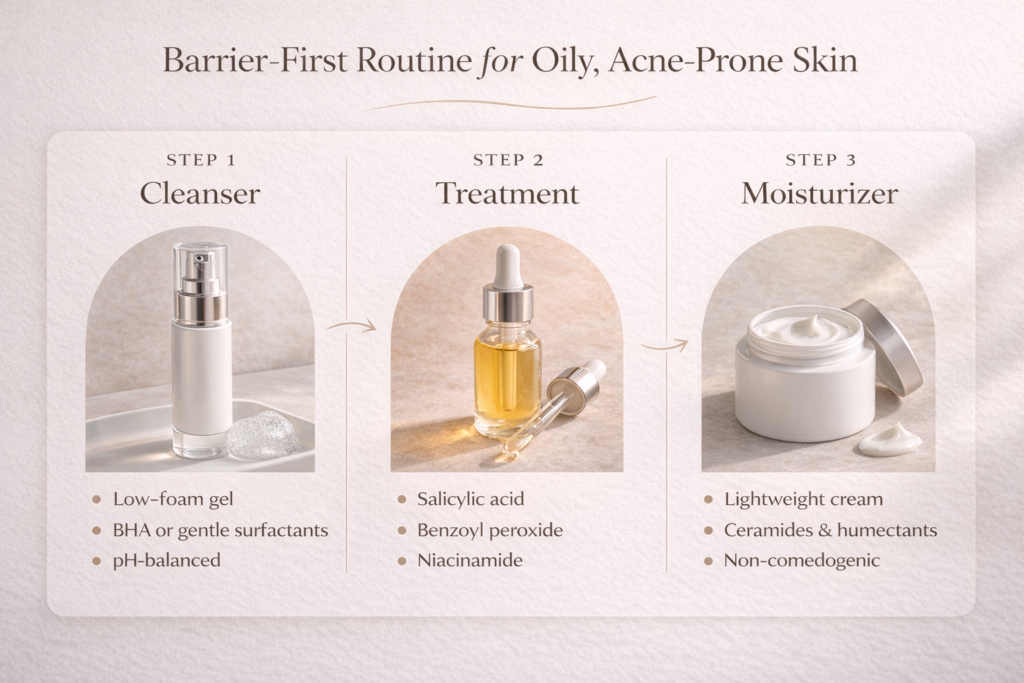
Final Takeaway — Cleanse to Balance, Not to Strip
The best cleanser for oily and acne-prone skin is not the strongest one on the shelf.
It’s the one that removes excess sebum without disrupting your skin barrier — the one that keeps pores clear while maintaining hydration.
Oily skin isn’t something to erase. It’s something to stabilize.
When cleansing is too harsh, oil becomes reactive. When cleansing is balanced, oil becomes predictable. Breakouts become easier to manage.
Clear skin doesn’t come from doing more.
It comes from doing the right amount — consistently.
Choose a cleanser that works with your skin, not against it. Balance creates clarity.
Frequently Asked Questions
Why does my face feel tight after washing?
Tightness is a sign of Acid Mantle disruption. It happens when a cleanser has a pH that is too high (alkaline) or contains harsh sulfates that strip away the skin’s natural lipids, leading to Transepidermal Water Loss (TEWL).
Can I wash oily skin 3 times a day?
It is not recommended. Washing more than twice daily can trigger reactive seborrhea, where the skin overproduces oil to compensate for the perceived dryness, making your face shinier in the long run.
How to remove oil from face permanently?
You cannot remove oil permanently because sebum production is largely influenced by genetics and hormones. However, you can help manage the Sebum Excretion Rate (SER) with Salicylic Acid cleansers and ingredients that support balanced sebum production, reducing excess surface oil while maintaining a healthy skin barrier.
Is salicylic acid cleanser safe daily?
Yes, most 2% Salicylic Acid (BHA) cleansers are formulated for daily use. However, if you experience redness or peeling, reduce usage to once every other day until your barrier adjusts.
Does benzoyl peroxide damage the skin barrier?
Benzoyl Peroxide can be drying and may cause temporary peeling, but it does not “damage” the barrier permanently if used correctly. Always follow with a ceramide-rich moisturizer to maintain barrier integrity.
What is the best pH for oily skin cleanser?
The ideal pH for a facial cleanser is between 4.5 and 5.5. This matches the natural acidity of the skin’s acid mantle, which helps keep acne-causing bacteria at bay and prevents dehydration.
What is the best cleanser for oily and acne-prone skin?
The best cleanser for oily and acne-prone skin is a pH-balanced, non-stripping formula that removes excess sebum without damaging the skin barrier. Look for ingredients like 2% salicylic acid (for clogged pores) or benzoyl peroxide (for inflamed acne), depending on your breakout type.
Medical Disclaimer
Gentle Glow guides are developed using peer-reviewed dermatology research and established clinical guidelines. The information provided is for educational purposes only and does not replace professional medical advice, diagnosis, or treatment. Always consult a board-certified dermatologist or qualified healthcare provider before starting new active skincare treatments.