كل ما تحتاجين معرفته عن البشرة الدهنية


Are Cleansing Devices Good for Oily Acne-Prone Skin?

راجع المحتوى طبيًا
Sana Wazir, MBBS, MD Dermatology
Dermatologist & Medical Reviewer at Gentle Glow
Reviewed أغسطس 18, 2026
Are cleansing devices good for oily acne-prone skin? Yes, they can be a useful addition when they improve surface cleansing without irritating the skin. They help remove excess oil, sunscreen, makeup, and other residue. A small cohort study of one sonic cleansing system found improvements in mild-to-moderate acne, but these findings cannot be generalized to all cleansing devices.
- Results depend on the device: Evidence from one sonic cleansing system cannot be applied to every cleansing brush or facial device.
- Technique matters: Gentle pressure and short contact are more important than aggressive scrubbing.
- Stop if your skin becomes irritated: Persistent redness, stinging, tightness, or peeling are signs that the device may be too much for your skin.
جدول المحتويات
What Are Facial Cleansing Brushes and Devices?
Facial cleansing devices are manual or powered tools designed to add movement to your normal cleansing step. Depending on the design, they may use soft bristles, silicone touchpoints, rotation, oscillation, or vibration to move cleanser across the skin and help loosen material sitting on the surface.
Some devices also provide mild physical exfoliation as they move across the outermost layer of the skin. How much exfoliation occurs depends on the contact surface, pressure, movement, frequency, and how long the device is used. This is one reason two cleansing devices can behave very differently even when both are marketed as “gentle.”
Some people with oily skin add a cleansing device because it can help remove surface oil and reduce shine temporarily. The more important question is whether that extra mechanical cleansing actually benefits oily, acne-prone skin—or simply adds more friction than the skin needs.
What Can a Cleansing Device Help Remove?
A cleansing device may help remove excess surface oil, sunscreen, makeup residue, environmental particles, and loose skin cells. Its best-supported role is improving surface cleansing; however it does not directly target acne inside the follicle.
That said, a cleansing device may be especially useful when you are trying to remove stubborn surface residue. A study of one specific sonic cleansing brush found that it removed more experimentally applied particles from the skin than manual cleansing. However, the study used a laboratory model with unusually high levels of pollution and was industry funded. Therefore, the results suggest that the brush may be effective at removing surface particles, but they do not show that sonic cleansing improves acne.
Its benefit is primarily at the skin surface rather than cleaning deep inside the pore.
This distinction is especially useful if you wear water-resistant sunscreen, makeup, or several skincare layers. A device may sometimes make removal feel more thorough.
However, when it comes to more visible oil, a more mechanical cleansing is not usually needed. A well-formulated cleanser can already lift oil. Adding a device is only worthwhile if it solves a specific cleansing problem without making the skin uncomfortable.
What a Cleansing Device Does Not Directly Target
A cleansing device does not directly target the biological processes that drive acne, permanently shrink pores, stop sebum production, or permanently remove recurring sebaceous filaments.
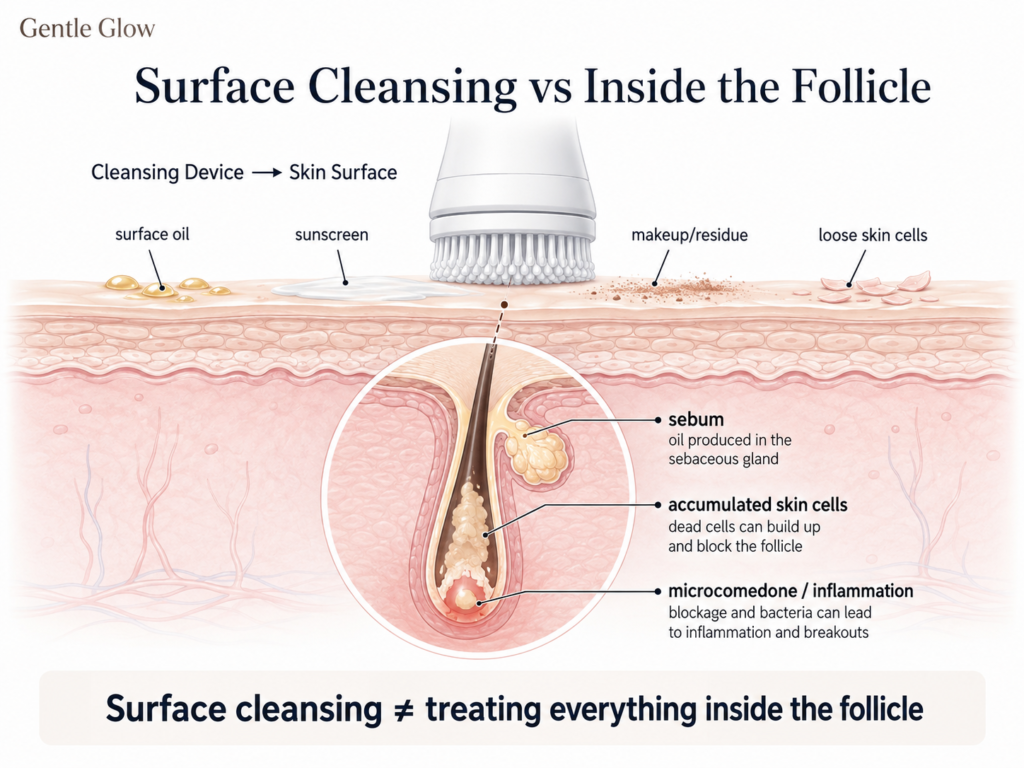
Acne does not develop simply because the surface of the face is not clean enough. Breakouts involve changes occurring inside the follicle, including the buildup of sebum and shed skin cells, microcomedone formation, microbial activity, and inflammation. These are the biological processes that can form acne inside the follicle, and repeatedly brushing the skin surface does not correct all of them.
A device also cannot permanently make pores smaller. However, removing surface oil may temporarily make them look less noticeable, and light physical exfoliation can make the surrounding skin appear smoother. This is because pore visibility can change without the pore itself permanently shrinking.
Can a Cleansing Device Help Acne—or Make It Worse?
A cleansing device may be beneficial for some people with oily, acne-prone skin when it improves cleansing without causing irritation. A small cohort study of one specific sonic cleansing system found improvements in mild-to-moderate acne, but these findings cannot be generalized to all cleansing devices or prove that the brush itself caused the improvement.
Clinical research on sonic cleansing in people with mild-to-moderate acne found improvements in both inflammatory and non-inflammatory acne lesions after four weeks of use, with no adverse events reported during the study period. However, because the device was used together with a cleansing gel and participants continued their usual skincare products, the results do not tell us how much of the improvement came from the cleansing brush itself.
However, using the device aggressively or on skin that is already irritated may increase redness, discomfort, or sensitivity. Firm pressure, repeated passes over the same area, prolonged scrubbing, or moving repeatedly over tender breakouts can add unnecessary friction. The American Academy of Dermatology recommends gentle cleansing and avoiding scrubbing that irritates acne-prone skin, which remains an important principle even when a cleansing device is well tolerated.
This is especially relevant if the skin is already peeling, stinging, persistently red, or sensitive from acne treatments. In that situation, adding more mechanical movement may offer little extra cleansing benefit while making the skin feel more uncomfortable.
Can a Cleansing Device Cause Purging?
A facial cleansing device does not cause true treatment-related purging. If breakouts appear after introducing one, they should not automatically be interpreted as a sign that the device is “bringing impurities to the surface.”
Instead, pay attention to how the rest of the skin feels. New breakouts alongside persistent tightness, stinging, redness, tenderness, flaking, or increased sensitivity may suggest that the device is more than your skin currently tolerates.
Oily skin can make these warning signs easy to overlook. If even familiar products begin to sting or the skin stays rough and irritated, it may be better to pause the device and allow the skin barrier to recover before adding more friction.
The key is whether the device provides a useful cleansing benefit while your skin remains comfortable. If it does, it may have a place in the routine. If irritation begins to outweigh that benefit, more cleansing is unlikely to be better.
Can Cleansing Devices Remove Blackheads or Sebaceous Filaments?
Cleansing devices can remove surface oil and loose skin cells around visible pores, which may temporarily make blackheads and sebaceous filaments look less noticeable. However, they cannot permanently remove either one because both involve material within the follicle rather than simply dirt sitting on the skin surface.
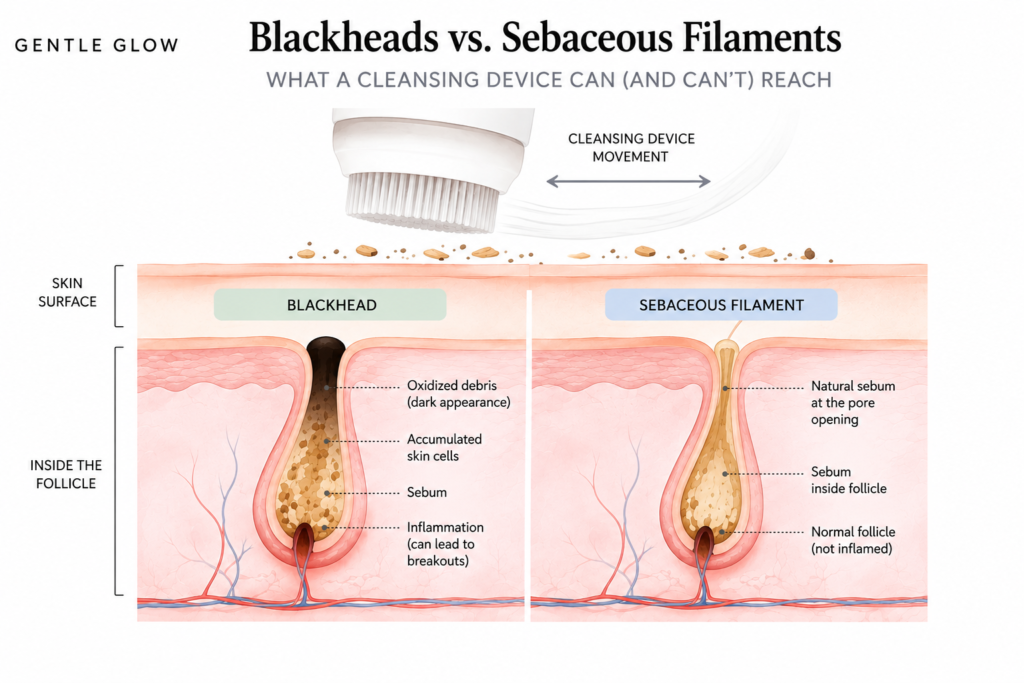
الرؤوس السوداء are open comedones formed when sebum and dead skin cells accumulate inside a follicle. A cleansing device may improve how clean and smooth the surrounding skin looks, but mechanical cleansing does not directly correct the follicular buildup that allows blackheads to form.
This is also why repeatedly scrubbing visible black dots on the nose is unlikely to make them disappear permanently. An oil-soluble exfoliant such as salicylic acid can work within the follicular environment where blackheads form, while a cleansing brush mainly acts across the skin surface.
Sebaceous filaments are different. They are normal structures that help move sebum through the pore and naturally refill after they are emptied. A cleansing device may temporarily remove some surface oil and make them appear less obvious, but it cannot stop them from returning.
If you are unsure which type of visible pore you have, understanding the difference between blackheads and normal sebaceous filaments can help you decide whether more cleansing is actually useful.
Can You Use a Cleansing Device With Acne Treatments?
A cleansing device can be used alongside acne treatments, but the combination needs to remain gentle. Salicylic acid, benzoyl peroxide, and retinoids can already make skin dry or sensitive, so adding mechanical cleansing may increase irritation if the routine becomes too aggressive.
The important factor is the total amount of stress your skin is receiving, rather than whether one product or device seems harsh on its own.
With Salicylic Acid
Salicylic acid already provides chemical exfoliation and helps reduce the buildup of dead skin cells within the follicle. A cleansing device adds a separate form of mechanical exfoliation at the skin surface.
Using both does not automatically cause a problem, but there is usually little benefit in aggressively scrubbing skin that is already being exfoliated. If your routine includes salicylic acid for blackheads or clogged pores, keep the device gentle and pay attention to dryness, stinging, or flaking.
With Benzoyl Peroxide
بنزويل بيروكسيد can be very effective for inflammatory acne, but it can also cause dryness, peeling, and irritation, especially when first introduced or used at higher strengths.
A cleansing device does not make benzoyl peroxide work better. If your skin already feels dry or sensitive from treatment, adding repeated mechanical movement may simply increase discomfort.
With Retinoids
الريتينويدات (مشتقات فيتامين A) affect how skin cells behave within the follicle and are commonly used to prevent clogged pores and treat acne. During the adjustment period, however, the skin may become drier, more sensitive, or more prone to irritation.
This is a time when extra friction deserves particular caution. If your skin is peeling, stinging, or visibly irritated from a retinoid, it is usually better to reduce unnecessary mechanical exfoliation until the skin feels comfortable again.
The important thing is to keep the skin comfortable while using these treatments and avoid adding anything that causes extra irritation. If your skin tolerates a cleansing device alongside them without redness, stinging, or peeling, it can be worth including in your routine.
Are Facial Cleansing Brushes Worth Using for Acne-Prone Skin?
Facial cleansing brushes can be worth using for acne-prone skin when they solve a specific cleansing problem and the skin tolerates them well. They are most useful when extra help is needed to remove sunscreen, makeup, or surface residue—not simply because the skin is oily or prone to breakouts.
A cleansing device is more likely to be useful when:
- Your skin is comfortable and not irritated, peeling, or stinging.
- You regularly wear water-resistant sunscreen, makeup, or several skincare layers.
- The device helps you cleanse effectively without aggressive pressure or repeated scrubbing.
- Your current acne treatments remain comfortable when the device is added.
On the other hand, if your cleanser already removes everything effectively and your skin feels comfortable afterward, adding more mechanical cleansing may provide little extra benefit.
A simple way to decide is to ask: Does the device solve a real cleansing problem, or does it simply add more friction to a routine that was already working?
For oily, acne-prone skin, the best cleansing device is not necessarily the one that feels the most powerful. It is the one that cleans effectively while keeping the skin comfortable and the barrier well tolerated.
GENTLE GLOW PRODUCT COMPARISON
Considering a cleansing device for your routine?
Compare four designs by cleansing surface, intensity control, upkeep, and skin tolerance—including when skipping a device may be more sensible.
What Should You Look for in a Cleansing Device for Oily, Acne-Prone Skin?
The best cleansing device for oily, acne-prone skin should provide effective cleansing without adding unnecessary friction or irritation. Look for a design that feels gentle, is easy to control, and can be kept clean between uses.
Important features include:
- A gentle contact surface: Soft bristles or flexible silicone touchpoints are generally easier to control than stiff or abrasive surfaces.
- Adjustable intensity: Multiple speed or vibration settings make it easier to start gently and increase only if your skin tolerates it.
- Good pressure control: A device should work without needing to press firmly against the skin.
- Easy cleaning and drying: The surface or brush head should be simple to rinse and dry according to the manufacturer’s instructions.
- A design that suits your routine: Consider where you plan to use it, how often, and whether replacement heads or regular maintenance are required.
Do not choose a cleansing device simply because it promises “deep pore cleansing” or stronger exfoliation. For acne-prone skin, more power does not automatically mean better cleansing.
The better question is whether the device gives you enough cleansing assistance while remaining comfortable on your skin. Product design, movement, and contact surface can vary considerably, which is why choosing the right type matters as much as deciding to use a cleansing device in the first place.
الخلاصة
Cleansing devices can be a useful addition for oily, acne-prone skin when they improve cleansing without causing irritation.
The benefit, however, depends on the device, your skin condition, and how gently it is used. A cleansing device should help remove sunscreen, makeup, oil, or other residue without leaving the skin red, tight, stinging, or uncomfortable.
For oily, acne-prone skin, the goal is not stronger or deeper cleansing. It is effective cleansing that keeps the skin comfortable and works alongside the rest of your acne routine.
الأسئلة الشائعة
Are facial cleansing brushes good for acne-prone skin?
Yes, facial cleansing brushes can be suitable for acne-prone skin when they improve cleansing without causing irritation. Limited clinical evidence suggests that some sonic cleansing routines may be associated with acne improvement, but this does not mean every cleansing device will have the same effect.
Do silicone face scrubbers help acne?
Silicone face scrubbers can help support acne-prone skin by improving surface cleansing, but evidence of acne improvement is limited to specific cleansing systems. Their benefit depends on the device design, how gently it is used, and how well your skin tolerates it.
Can a cleansing brush make acne worse?
A cleansing brush does not automatically worsen acne, and some sonic cleansing systems have been well tolerated in acne-prone skin. However, excessive pressure, repeated scrubbing, or use on already irritated skin can increase irritation and may aggravate breakouts.
How often should you use a facial cleansing device?
There is no single frequency that works for every cleansing device or skin type. Follow the manufacturer’s instructions and adjust based on how your skin responds. If you use acne treatments or exfoliants, start gradually and reduce use if irritation develops.
Do cleansing brushes clean pores?
Cleansing brushes primarily clean the skin surface rather than reaching deep inside pores. They can remove surface oil and residue around visible pores, which may temporarily make them look cleaner or less noticeable, but they cannot remove buildup deep within the follicle.
Can you use a cleansing brush with salicylic acid or retinol?
Yes, but the combination should remain comfortable for your skin. Salicylic acid and retinoids can already increase dryness or sensitivity, so adding mechanical cleansing may become irritating if too many exfoliating or acne-treatment steps are used together.
المصادر والمراجع
- Peterson G, Rapaka S, Koski N, Kearney M, Ortblad K, Tadlock L. A Robust Sebum, Oil, and Particulate Pollution Model for Assessing Cleansing Efficacy of Human Skin
- Gold MH, Ablon GR, Andriessen A, Bucay VW, Goldberg DJ, Green JB, Hooper D, Mandy SH, Nestor MS, Ortiz A. A Cohort Study Using a Facial Cleansing Brush With Acne Cleansing Brush Head and a Gel Cleanser in Subjects With Mild-to-Moderate Acne and Acne-Prone Skin
- American Academy of Dermatology. Ludmann P, Schleehauf B. Acne: Tips for Managing
تنويه طبي
يتم إعداد أدلة Gentle Glow استنادًا إلى أبحاث علمية محكّمة في مجال طب الجلدية وإرشادات سريرية معتمدة. المعلومات المقدَّمة هنا لأغراض تعليمية فقط، ولا تُعد بديلاً عن الاستشارة الطبية المهنية أو التشخيص أو العلاج. يُنصح دائمًا باستشارة طبيب جلدية معتمد أو مقدم رعاية صحية مؤهل قبل البدء باستخدام أي مكوّنات علاجية نشطة جديدة في روتين العناية بالبشرة.