Everything You Need to Know About Oily Skin

How Can You Tell the Difference Between Sebaceous Hyperplasia and Enlarged Pores?

Medically reviewed by
Gamal Henin, B.Pharm
Pharmacist & Medical Reviewer at Gentle Glow
Reviewed July 24, 2026
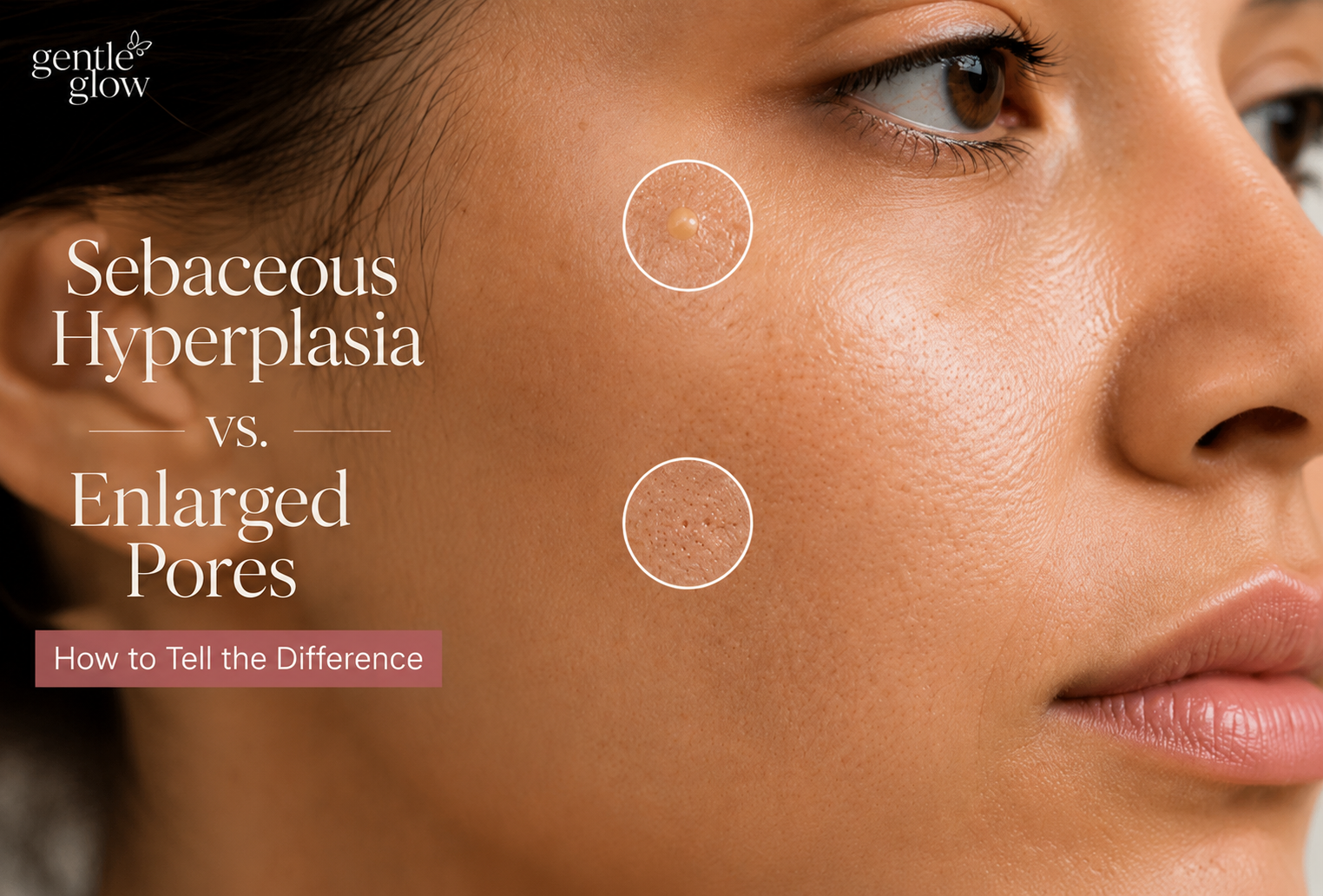
Sebaceous hyperplasia and enlarged pores are distinct conditions of the pilosebaceous unit that often co-occur on oily skin. Enlarged pores affect the surface opening of the hair follicle due to high sebum production and reduced elasticity. In contrast, sebaceous hyperplasia is a benign enlargement of the underlying sebaceous gland itself.
- Anatomical Target: Enlarged pores affect the hair follicle opening, while sebaceous hyperplasia affects the sebaceous gland.
- Visual Appearance: Pores look like tiny indented openings; sebaceous hyperplasia presents as small, soft, yellowish bumps with a central dimple.
- Treatment Response: Skincare (like retinoids and BHA) can refine pore appearance, but established sebaceous hyperplasia requires in-office dermatological removal.
Table of Contents
Watch: How to Tell the Difference Between Sebaceous Hyperplasia and Enlarged Pores
Why People Confuse Sebaceous Hyperplasia and Enlarged Pores
Sebaceous hyperplasia and enlarged pores are often confused because they commonly appear in the same oilier areas of the face, such as the forehead, nose, and cheeks. Although they can look similar at first glance, they have distinct characteristics that set them apart.
People often mistake one for the other because both can appear as small, noticeable skin features that become more visible under bright lighting or when the skin is producing more oil. Knowing how they differ can help you identify each condition more accurately and set realistic expectations for treatment.
Both conditions involve the pilosebaceous unit—the structure made up of the hair follicle, sebaceous gland, and pore opening. However, enlarged pores affect the visible opening of the hair follicle, whereas sebaceous hyperplasia develops when the sebaceous gland beneath the skin becomes enlarged. This difference explains why the two conditions may look similar while requiring different approaches to management.
How to Tell the Difference Between Sebaceous Hyperplasia and Enlarged Pores
Although sebaceous hyperplasia and enlarged pores can appear similar, there are a few key characteristics that can help distinguish between them, including their shape, texture, and overall appearance.
| Feature | Enlarged Pores | Sebaceous Hyperplasia |
|---|---|---|
| Appearance | Visible pore opening that may appear larger or darker | Small, soft, flesh-colored or yellowish raised bump |
| Texture | Usually flat or slightly indented | Smooth, rounded, and slightly raised |
| Center | Open pore that may contain visible sebum or a sebaceous filament | Often has a small central indentation (umbilication) |
| Common locations | Nose, cheeks, forehead and chin | Forehead, cheeks and nose, and around the eyelids |
| Who is more likely to develop it? | People with oily skin, larger pores or reduced skin elasticity | Most common in middle-aged and older adults, although it can occur earlier |
| What causes it? | Enlargement of the hair follicle opening | Enlargement of the sebaceous gland |
| Can skincare help? | Often improves the appearance over time | May improve surrounding skin, but does not remove the enlarged gland |
| Professional treatment | Usually unnecessary unless cosmetic concerns persist | May be considered if diagnosis is uncertain or removal is desired |
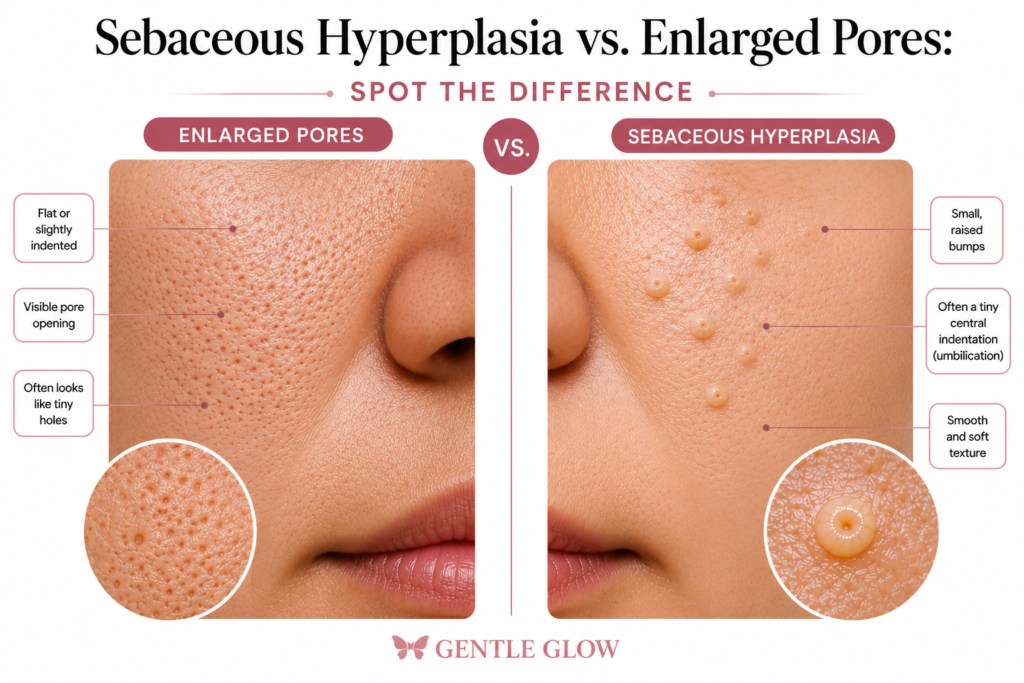
No single feature can confirm a diagnosis, and it’s possible to have both enlarged pores and sebaceous hyperplasia at the same time, particularly in people with oily skin.
What Are Enlarged Pores?
According to research on the causes of enlarged facial pores, enlarged pores are visible openings of the hair follicles. While everyone has pores, their size and appearance vary from person to person and are influenced by a combination of genetics, sebum production, skin elasticity, and sun exposure.
People with oily skin often notice enlarged pores more because their sebaceous glands produce more sebum. As sebum moves through the follicle and reaches the skin’s surface, the pore opening can become more noticeable. Over time, age-related collagen loss and sun damage may also reduce the skin’s support around the follicle, making pores appear larger.
Because enlarged pores are influenced by several factors, they cannot be permanently “closed” or eliminated. However, ingredients that reduce excess sebum, improve skin cell turnover, and protect collagen can often make them appear less noticeable over time.
Products containing retinoids have the strongest evidence for improving the appearance of enlarged pores, while products containing niacinamide and salicylic acid may also help by reducing excess oil and congestion.
What Is Sebaceous Hyperplasia?
Sebaceous hyperplasia is a benign enlargement of the sebaceous gland. The enlarged gland pushes upward beneath the skin, creating a small, soft, flesh-colored or yellowish bump. In many cases, the pore opening remains visible as a tiny central indentation, which is one of the features dermatologists use to distinguish it from other skin growths.
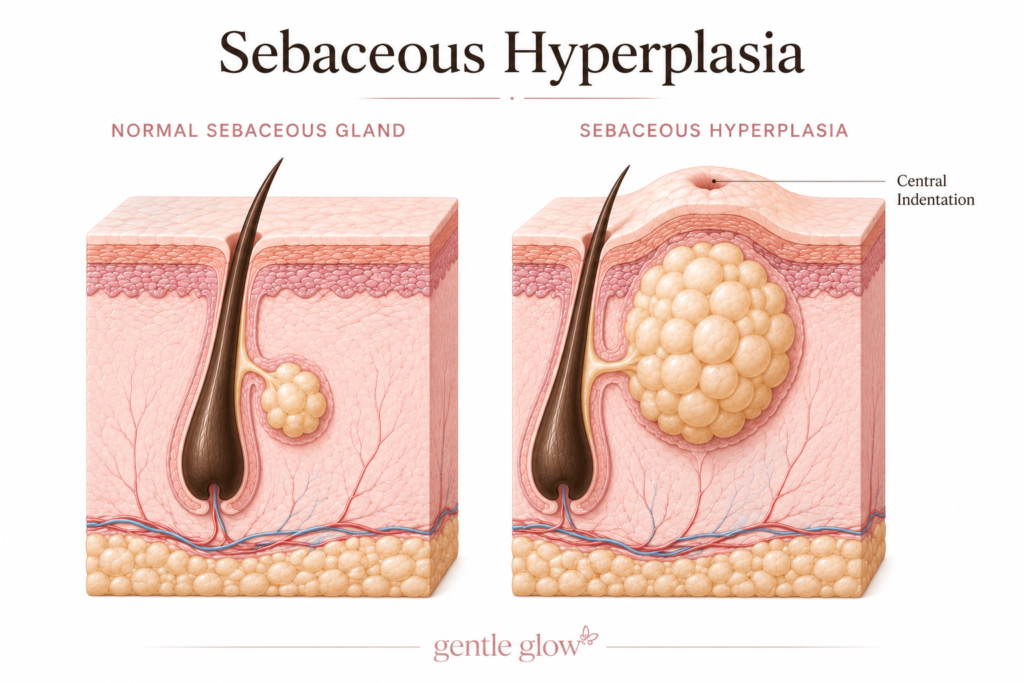
Dermatology literature describes sebaceous hyperplasia as a harmless condition that becomes more common with age, although it can also occur in younger adults, particularly those with naturally oily skin. Unlike acne, these bumps are not caused by clogged pores or bacterial infection, and they usually do not become inflamed or painful.
Because sebaceous hyperplasia results from structural enlargement of the sebaceous gland, topical skincare products cannot remove the bumps once they have formed. However, maintaining a consistent skincare routine may still help manage excess oil and other concerns that often occur alongside sebaceous hyperplasia.
Can Enlarged Pores Turn Into Sebaceous Hyperplasia?
No. Enlarged pores do not turn into sebaceous hyperplasia because they affect different parts of the pilosebaceous unit. Enlarged pores involve the visible opening of the hair follicle, whereas sebaceous hyperplasia develops when the sebaceous gland beneath the skin becomes enlarged. Although both conditions can occur at the same time—particularly in people with oily skin or age-related skin changes—one does not cause or develop into the other.
If a pore appears to have become a persistent raised bump, it’s best to have it examined by a dermatologist. While sebaceous hyperplasia is a harmless condition, other skin lesions, including basal cell carcinoma, can sometimes have a similar appearance. A professional evaluation is recommended if a bump is new, changes in size or appearance, bleeds, or if the diagnosis is uncertain.
When Should You See a Dermatologist?
Although sebaceous hyperplasia is harmless, it can sometimes resemble other skin conditions. Clinical guidance on sebaceous hyperplasia recommends seeking a professional evaluation if you’re unsure about a new or changing bump, especially if it bleeds, grows rapidly, changes color, or develops an irregular appearance.
A dermatologist can usually diagnose sebaceous hyperplasia during a skin examination and may use dermoscopy, a handheld magnifying device that allows them to examine the lesion more closely. In some cases, a skin biopsy may be recommended if the diagnosis is uncertain or if another condition, such as basal cell carcinoma, cannot be ruled out.
If the bump is confirmed to be sebaceous hyperplasia and you are not bothered by its appearance, treatment is usually unnecessary. However, if it becomes a cosmetic concern or is repeatedly irritated, your dermatologist can discuss the most appropriate treatment options for your skin. Clinical guidance on sebaceous hyperplasia notes that treatment is generally optional and is usually performed for cosmetic concerns.
If treatment is desired, dermatologists may use procedures such as electrodessication, laser therapy, or cryotherapy, depending on the lesion and the individual’s skin. However, because these procedures remove or destroy the sebaceous gland, they may carry risks such as temporary pigment changes, scarring, or recurrence, which is why treatment should be performed by an experienced dermatologist.
Prevention
While you can’t completely prevent enlarged pores or sebaceous hyperplasia, certain skincare habits can help minimize the appearance of enlarged pores and support overall skin health. Sebaceous hyperplasia, however, is largely influenced by genetics and aging, and long-term UV exposure so there is no proven way to prevent it completely.
For enlarged pores
You can help reduce the appearance of enlarged pores by:
- Cleansing regularly to remove excess oil, sunscreen, and debris.
- Using salicylic acid (BHA) to help keep pores clear.
- Applying niacinamide to help regulate excess sebum and improve the appearance of pores over time.
- Wearing broad-spectrum sunscreen daily to help protect collagen and maintain the skin’s structural support.
- Harsh cleansing and over-exfoliation can disrupt the skin barrier and may make pores appear more noticeable.
For sebaceous hyperplasia
Because sebaceous hyperplasia is largely influenced by genetics, age, and long-term changes within the sebaceous glands, there is no proven way to prevent it completely. Maintaining a gentle skincare routine and protecting your skin from excessive sun exposure supports overall skin health, but these measures cannot stop the sebaceous glands from enlarging if you’re predisposed to the condition.
The most important step is recognizing that sebaceous hyperplasia is a benign skin condition, and treatment is usually only considered if the bumps become cosmetically bothersome or if the diagnosis is uncertain.
Final Thought
Understanding the difference between sebaceous hyperplasia and enlarged pores helps you make more informed skincare decisions. While they may appear similar at first glance, they are distinct conditions with different underlying causes and treatment approaches. At Gentle Glow, we believe healthy skin starts with understanding your skin’s biology and choosing a routine that works with it.
Frequently Asked Questions
Can skincare remove sebaceous hyperplasia?
No. Topical skincare products cannot remove sebaceous hyperplasia once the sebaceous gland has enlarged. Ingredients such as retinoids, salicylic acid, and niacinamide may improve overall skin texture and help manage oily skin, but they cannot shrink an enlarged sebaceous gland. If treatment is desired for cosmetic reasons, a dermatologist may recommend procedures such as electrocautery, laser therapy, or cryotherapy.
Can retinol help sebaceous hyperplasia?
Retinol cannot remove sebaceous hyperplasia, but it may help improve the skin’s overall appearance. By supporting skin cell turnover and improving texture over time, retinoids can make the surrounding skin appear smoother. However, they do not reverse the enlargement of the sebaceous gland itself.
Are enlarged pores permanent?
Enlarged pores cannot usually be permanently reduced, but their appearance can often be improved with consistent skincare. Ingredients such as salicylic acid, niacinamide, and retinoids may help pores look less noticeable by reducing excess oil, keeping follicles clear, and improving skin texture. Genetics and natural aging continue to influence pore size.
Is sebaceous hyperplasia the same as sebaceous filaments?
No. Sebaceous hyperplasia and sebaceous filaments are completely different skin conditions. Sebaceous filaments are normal structures that help transport sebum through the pore, whereas sebaceous hyperplasia is a benign enlargement of the sebaceous gland that forms a small raised bump beneath the skin.
How do dermatologists diagnose sebaceous hyperplasia?
Dermatologists usually diagnose sebaceous hyperplasia by examining the skin during a clinical examination. In many cases, they use a dermatoscope to look for characteristic features, such as a central indentation and the pattern of surrounding blood vessels. If the diagnosis is uncertain or the lesion has unusual features, a biopsy may be recommended to rule out other conditions.
Should sebaceous hyperplasia be removed?
Sebaceous hyperplasia does not usually need treatment because it is a harmless, benign condition. Many people choose removal only if the bumps become cosmetically bothersome or if there is uncertainty about the diagnosis. A dermatologist can discuss whether treatment is appropriate and which procedure is most suitable.
Sources and References
- Cleveland Clinic. Sebaceous Glands.
- Fabiola Farci, Ronald P. Rapini. Sebaceous Hyperplasia. StatPearls Publishing.
- Lee SJ, Seok J, Jeong SY, Park KY, Li K, Seo SJ. Facial Pores: Definition, Causes, and Treatment Options. Dermatologic Surgery.
- Oakley A, Ngan V, Morrison C. Sebaceous Hyperplasia. DermNet NZ.
Medical Disclaimer
Gentle Glow guides are developed using peer-reviewed dermatology research and established clinical guidelines. The information provided is for educational purposes only and does not replace professional medical advice, diagnosis, or treatment. Always consult a board-certified dermatologist or qualified healthcare provider before starting new active skincare treatments.